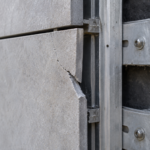
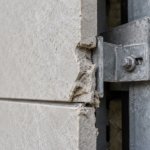
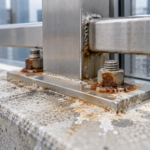
- A coastal Virginia rainscreen project developed measurable subgirt corrosion by Year 4 due to an inadequate zinc phosphate primer specification.
- Zinc phosphate is an inhibitive pigment that cannot protect bare steel at field cuts or in sustained condensation environments.
- Epoxy primers provide true barrier protection but require SSPC-SP 6 surface preparation that many fabricators do not provide.
- Deeper cavities driven by ASHRAE 90.1-2022 compliance create far more aggressive subgirt exposure than legacy primer systems were evaluated against.
- A 2K epoxy primer over G90 galvanized substrate with SSPC-SP 6 prep is the minimum defensible specification for Climate Zones 4A through 6A.
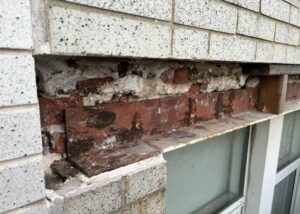
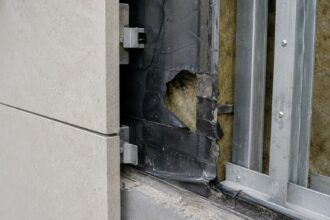
A facade consultant reviewing a 12-story mixed-use building in coastal Virginia during a warranty inspection at Year 4 discovers active red rust bleeding through the sealant joints of a fiber cement rainscreen panel system. Not at the panel face.
At the subgirt attachment clips visible through an open horizontal reveal. The cold-formed steel subgirts had been specified with a zinc phosphate primer per the original submittal, approved without comment and installed per manufacturer instructions.
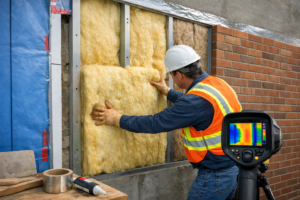
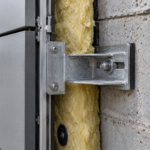
The cavity depth was 3.5 inches to accommodate R-15 continuous mineral wool and no one had modeled the dew point exposure on the secondary steel during the design phase. Four years in, the corrosion was already measurable.
The remediation cost exceeded the original subgirt material budget by a factor of six.
That project is not an outlier. It is a preview.
Why the Subgirt Is the Most Vulnerable Steel in the Assembly
Cold-formed steel subgirts occupy a thermal and moisture position unlike any other steel in a rainscreen assembly. They sit outside the air barrier, inside the drainage plane, exposed to cavity air that cycles between ambient exterior conditions and the modified microclimate created by wall assembly outgassing and wind-driven infiltration.
No other steel element in the stack experiences that combination continuously across a service life.
The geometry makes it worse. Subgirts are typically 16 to 18 gauge, with base metal thickness ranging from 0.054 to 0.
048 inches. That high surface-area-to-mass ratio means corrosion penetrates proportionally faster than it would in heavier structural sections.
A structural wide-flange can tolerate surface oxidation as a percentage of section capacity in ways a 16-gauge subgirt simply cannot. A W8x31 section losing 3 mils of surface steel to oxidation retains structural adequacy.
A 16-gauge subgirt losing the same 3 mils has surrendered roughly six percent of its total base metal thickness and that loss is concentrated at the most mechanically stressed locations: clip attachment points and span midpoints where bending demand is highest.
Secondary framing in rainscreen assemblies is also rarely subjected to the corrosion exposure category scrutiny applied to primary structure under AISC 360-22 or AISI S100-16. AISI S100-16 Section A3. 3 addresses corrosion protection but defers entirely to coating specifications without prescribing cavity-specific performance thresholds.
That deference leaves a gap that submittal reviewers routinely fail to close. The standard does not distinguish between a subgirt in a vented 1-inch cavity in Climate Zone 3 and a subgirt in a 4-inch deep cavity with continuous mineral wool in Climate Zone 5A.
Both receive the same deference to the coating specification and the coating specification is typically written by someone who has not modeled the cavity microclimate.
Subgirts are also frequently sourced from multiple manufacturers across a single project. One fabricator may apply primer by spray in a controlled shop environment with consistent wet film gauge readings and documented dry film thickness verification.
Another may roll-apply in a smaller facility with inconsistent film build, no wet film gauge protocol and a single batch of primer that has been open longer than the pot life window allows. The submittal package shows a single product data sheet.
The field shows four different primer application qualities across the same building elevation, with no means of distinguishing them after installation.
The inspection access problem compounds all of this. Once panels are installed, subgirt surfaces are not visible without removing cladding.
Corrosion can advance for years before any exterior indicator appears. By the time rust bleed reaches a sealant joint or a reveal edge, section loss at the subgirt is already significant.
Early-stage corrosion monitoring is not standard practice on commercial rainscreen projects, which means the first data point on coating performance is often a warranty claim.
What Zinc Phosphate Primer Actually Is and What It Is Not
Zinc phosphate is an inhibitive pigment, not a barrier coating. It functions by passivating the steel surface through phosphate ion chemistry, slowing anodic corrosion reactions at the metal interface.
That mechanism works reasonably well in controlled interior environments and moderate exterior exposures with limited condensation cycling. It does not work in deep rainscreen cavities in humid or coastal climates.
Standard zinc phosphate primers are applied at 1.0 to 2. 0 mils dry film thickness.
At that thickness, film continuity is everything. Fabrication handling, field cutting and clip attachment routinely compromise that continuity and once the film breaks, the inhibitive chemistry has nothing left to offer at the exposed edge.
The phosphate ion passivation cannot migrate laterally to protect bare steel the way a zinc-rich primer can through galvanic action. A zinc phosphate primer with a scratch or a handling gouge does not self-limit corrosion at the defect.
It simply has no mechanism to respond to it. The bare steel at that point corrodes at the same rate as uncoated steel in the same environment.
The performance data is not ambiguous. ASTM B117 salt spray testing, the standard practice for evaluating corrosion resistance under controlled fog exposure, shows that standard zinc phosphate primers typically achieve 250 to 500 hours before failure initiation.
Coastal cavity conditions in Climate Zones 4A through 5A can simulate equivalent chloride and humidity exposure in 18 to 36 months of actual service. That math puts primer failure well inside a standard 10-year warranty period.
A product that passes 500 hours of ASTM B117 testing and is installed in a coastal Virginia cavity in 2020 is statistically likely to show corrosion initiation before 2023. The Year 4 rust bleed described at the outset of this article is consistent with that timeline.
The submittal approval process makes this worse. Reviewers confirm product name and nominal DFT.
They do not evaluate salt spray hours, adhesion retention after wet-dry cycling or compatibility with the specific substrate preparation used in the fabrication shop. Product data sheets for zinc phosphate primers frequently list ASTM B117 performance data measured over a primed steel panel prepared to SSPC-SP 6 in a laboratory setting.
The fabrication shop preparing subgirts to SSPC-SP 3 with a wire wheel is not replicating that test condition and no one in the submittal review chain is asking whether it is. A zinc phosphate primer approved on a submittal is not a zinc phosphate primer evaluated for the cavity it will actually occupy.
It is a product name on a form, matched against a product name on a data sheet, with the actual performance question left unanswered.
What Epoxy Primer Actually Is and Where It Breaks Down
Epoxy primers function as true barrier coatings. Cross-linked polymer chemistry resists moisture vapor transmission and ionic penetration without relying on inhibitive pigment chemistry.
The electrolyte never reaches the steel surface because the coating physically excludes it. That mechanism is substantially more durable under sustained condensation than zinc phosphate’s passivation approach.
Where zinc phosphate slows the corrosion reaction, a properly applied epoxy primer eliminates the conditions for that reaction to start.
Two-component epoxy formulations (2K epoxy) outperform single-component systems in humidity resistance and adhesion retention under thermal cycling. Applied at 3.0 to 5.
0 mils DFT, a properly prepared and applied 2K epoxy primer provides barrier performance that zinc phosphate cannot approach. In moderate cavity exposures, a well-applied epoxy primer can remain intact for 15 to 20 years without topcoat.
Bisphenol A epoxy systems with polyamide curing agents perform particularly well in condensation-prone environments because the polyamide component improves flexibility under thermal movement without sacrificing moisture resistance. That flexibility matters in a subgirt that is cycling thermally across a 100-degree annual temperature range while also carrying cladding dead load and wind pressure simultaneously.
The critical failure mode for epoxy primers in rainscreen cavities is not bulk moisture penetration through the intact film. It is edge and cut-end exposure.
Field-cut subgirt ends, punched holes and clip attachment points create uncoated steel edges that epoxy cannot bridge and cathodic disbondment can propagate from those points under sustained wetness. Cathodic disbondment is the electrochemical process by which an intact coating separates from the substrate at the perimeter of a defect when that defect is under sustained wetness and the coating-substrate interface becomes the site of cathodic reduction reactions.
A subgirt that leaves the shop with perfect coating integrity can have six to twelve unprotected linear inches of bare steel edge by the time installation is complete and each of those edges is a disbondment initiation point.
Epoxy primers also demand surface preparation that fabricators frequently do not provide. SSPC-SP 6/NACE No.
3 commercial blast cleaning is the minimum surface preparation standard for epoxy primer adhesion in exterior exposure categories. Many subgirt fabricators default to SSPC-SP 3 power tool cleaning, which is insufficient for epoxy systems.
A 2K epoxy applied over SSPC-SP 3 prep will disbond under thermal cycling regardless of how well the wet film was applied. The anchor profile produced by SSPC-SP 3 power tool cleaning is typically 0.5 to 1.
0 mils. SSPC-SP 6 abrasive blast cleaning produces an anchor profile of 1.5 to 2.
5 mils, which is the mechanical tooth the epoxy resin needs to develop adhesion values above 400 psi on pull-off testing. Specifying epoxy primer without specifying SSPC-SP 6 minimum surface preparation is specifying half a system.
How Cavity Depth and Continuous Insulation Change the Exposure Equation
ASHRAE 90.1-2022 continuous insulation requirements for Climate Zones 4 through 8 are driving cavity depths to 3 to 5 inches and beyond on commercial rainscreen assemblies. That is a fundamentally different exposure environment than the legacy 1 to 1.5-inch cavities these primer systems were originally evaluated against.
The coating products have not changed. The cavities have.
At 3.5 inches of cavity depth with R-15 continuous mineral wool outboard of the air barrier, the subgirt surface temperature during heating season is governed almost entirely by exterior ambient conditions. The thermal resistance outboard of the air barrier is high enough that the subgirt never warms appreciably from interior heat flux.
It sits at or near exterior ambient temperature for most of the heating season. When cavity air carries moisture vapor from assembly outgassing or wind-driven infiltration, that cold subgirt surface is exactly where condensation forms.
In a coastal Virginia climate with a January mean temperature of 38 degrees Fahrenheit and a typical interior relative humidity of 35 percent, the dew point of interior air is approximately 22 degrees Fahrenheit. Subgirt surfaces in a deep cavity with R-15 outboard insulation can reach temperatures within 5 degrees of exterior ambient during extended cold periods, putting them well below the dew point of any cavity air that carries meaningful moisture load.
Cavity ventilation is the mechanism designers assume will remove that moisture. In a 1-inch cavity with frequent open joints, ventilation velocity is sufficient to do meaningful drying work.
In a 3.5-inch deep cavity with the constrained open joint geometry required for NFPA 285 compliance on assemblies with combustible insulation, that assumption fails. NFPA 285 compliance for assemblies incorporating combustible continuous insulation frequently requires limiting open joint widths and areas in ways that directly reduce cavity ventilation rates.
The ventilation rate drops, residence time of humid air in the cavity increases and the subgirt surface stays wet longer between drying cycles. A cavity that dries in 48 hours under a 1-inch geometry may require 10 to 14 days to dry under a 3.5-inch geometry with restricted joint openings and in a coastal climate with frequent rain events, that drying window may never fully open.
Hygrothermal modeling rarely captures this. WUFI and equivalent tools are typically run at the sheathing or air barrier plane, not at the subgirt surface specifically.
The secondary steel exposure goes uncharacterized in most envelope models, which means the primer specification is made without any quantified understanding of the actual condensation hours the coating will face. Running a WUFI analysis at the air barrier plane and concluding that the assembly performs adequately tells you nothing about the condensation duration at a steel surface sitting 3.5 inches outboard of that plane in a partially ventilated cavity.
Specifiers are making a corrosion protection decision in an information vacuum.
The Field Cutting Problem Neither Primer System Solves
Both zinc phosphate and epoxy primers share one failure mode that no shop-applied coating fully addresses: field cutting. Subgirts are cut to length in the field constantly, whether to fit around penetrations, accommodate dimensional tolerances or respond to as-built conditions that differ from shop drawings.
Every cut creates a raw steel edge with zero corrosion protection. On a typical 12-story rainscreen project, field cuts can number in the thousands across all elevations and each one represents a corrosion initiation point that the shop-applied coating system was never designed to address.
Field touch-up with a brush-applied zinc-rich compound is the standard specified response. In practice, touch-up application quality is inconsistent, coverage at the cut face is incomplete and curing conditions in an open cavity during installation are rarely the controlled conditions the product data sheet assumes.
A 2K epoxy touch-up applied at 45 degrees Fahrenheit in a coastal winter does not perform like the same product applied in a 70-degree shop. Many 2K epoxy systems have minimum application temperature requirements of 50 to 55 degrees Fahrenheit and pot life at low temperatures can extend in ways that produce films with incomplete cure and reduced adhesion.
Installers working in cold conditions who apply touch-up compound and immediately continue installation are not waiting for cure verification. The touch-up is present on paper and absent in performance.
The specification-to-field gap here is structural, not incidental. Specifiers should require galvanized subgirt sections (G90 or G60 minimum per ASTM A653) as the base substrate before any primer is applied.
Galvanizing provides sacrificial cathodic protection at cut edges that neither zinc phosphate nor epoxy can replicate. The zinc coating at a field cut edge corrodes preferentially, protecting the adjacent base steel through galvanic action across a lateral distance of approximately 1 to 2 times the zinc coating thickness.
A G90 coating, which provides 0.90 ounces of zinc per square foot of sheet surface, delivers meaningful edge protection even after field cutting, because the zinc layer is present in the base metal cross-section and sacrifices itself at the cut face before the steel corrodes. The primer system then functions as a second line of defense over a substrate with inherent edge protection, rather than the only line of defense on bare cold-rolled steel.
This is not a common specification approach. It should be.
What the Submittal Process Misses and How to Close the Gap
The standard submittal review for subgirt primer confirms three things: product name, manufacturer’s published DFT and color. None of those three data points predict performance in a specific cavity exposure condition.
The review process was designed for interior structural steel in conditioned space. It has been applied without modification to secondary framing in one of the most aggressive microenvironments in the building envelope.
A reviewer who approves a zinc phosphate primer submittal on a coastal rainscreen project has confirmed that the contractor selected a product that exists. They have confirmed nothing about whether that product will protect the steel for the required service life in the actual cavity conditions.
Closing that gap requires adding specific performance requirements to the specification, not relying on the submittal to surface them. Section 05 41 00 or 07 42 43 specifications should require salt spray testing per ASTM B117 with a minimum 1,000-hour threshold for coastal Climate Zones 4A through 6A.
That threshold is not arbitrary. It corresponds to roughly three to four years of equivalent coastal cavity exposure at the corrosion rates documented in published field studies of rainscreen assemblies in the Mid-Atlantic and Pacific Northwest.
They should require adhesion testing per ASTM D4541 after wet-dry cycling, with a minimum pull-off strength of 400 psi retained after 10 cycles. The wet-dry cycling requirement is the critical differentiator, because many primers that pass static salt spray testing fail adhesion retention after repeated wetting and drying, which is the actual exposure condition in a ventilated cavity.
Specifications should explicitly require SSPC-SP 6 minimum surface preparation for any epoxy primer specification and prohibit SSPC-SP 3 as a substitute. That prohibition needs to appear in the specification text, not just in a reference to the primer manufacturer’s data sheet, because fabricators reading only the submittal requirements will default to the least demanding preparation standard that is not explicitly excluded.
These requirements will generate pushback from subgirt fabricators accustomed to standard submittal approval. That pushback is evidence the current standard is inadequate, not evidence the requirements are unreasonable.
Making the Specification Decision
The binary framing of “zinc phosphate or epoxy” is the wrong question for most coastal and humid climate projects. The right question is: what is the condensation exposure duration at the subgirt surface and what coating system retains adhesion and barrier function across that exposure for the required service life?
For projects in Climate Zones 4A through 6A with cavity depths exceeding 2.5 inches, zinc phosphate primer on bare cold-rolled steel is not a defensible specification. The ASTM B117 performance data does not support it, the field cutting reality does not support it and the increasing cavity depths driven by ASHRAE 90.1-2022 compliance make the exposure conditions materially worse than they were a decade ago.
A specifier selecting zinc phosphate primer for a 4-inch deep cavity in Climate Zone 5A in 2024 is applying a product evaluated for a 1-inch cavity in a moderate climate to a fundamentally different exposure condition, without any performance data to support that extrapolation.
A 2K epoxy primer over G90 galvanized substrate with SSPC-SP 6 surface preparation is the minimum defensible specification for those conditions. The galvanized substrate addresses field cut edges.
The SSPC-SP 6 preparation ensures adhesion values that survive thermal cycling. The 2K epoxy barrier film excludes the electrolyte that zinc phosphate’s inhibitive chemistry can only slow.
Each element of that specification addresses a specific failure mode that the zinc phosphate on bare cold-rolled steel approach leaves unresolved. For projects within three miles of tidal water in Climate Zones 4A through 5A, a zinc-rich epoxy primer over G90 galvanized with SSPC-SP 6 prep and a specified field touch-up protocol using compatible zinc-rich compound is the appropriate specification.
The zinc-rich pigment, typically present at 65 to 85 percent by weight in the dry film, provides the cathodic edge protection that straight epoxy cannot and the galvanized substrate provides a second sacrificial layer at field cuts. Inorganic zinc-rich primers require SSPC-SP 10 near-white blast cleaning for adequate adhesion, which adds cost but is warranted within the tidal exposure zone where chloride loading on cavity surfaces can reach levels that disbond epoxy systems applied over lesser preparation.
The Year 4 rust bleed in coastal Virginia was not a contractor failure. It was a specification failure that the submittal process was never designed to catch.
The next one is already in a cavity somewhere, running its clock.