- ACM panel core type determines fire behavior and drives most compliance decisions on commercial cladding projects.
- NFPA 285 is an assembly-level test and a passing result applies only to the exact configuration that was tested.
- Buildings exceeding 40 feet above grade plane trigger stricter IBC requirements that ASTM E84 ratings alone cannot satisfy.
- Substituting insulation or WRB products without re-evaluating the NFPA 285 listing is one of the most common and costly compliance failures.
- Specifications must name tested assembly components by product designation and prohibit substitution without written re-evaluation.
Not All Metal Cladding Is Created Equal: Understanding the Material Landscape
The term “metal cladding” covers a wide range of products that behave very differently in fire and treating them as a single category is one of the most reliable ways to end up with a stop-work order. Four primary product types dominate commercial facade work: aluminum composite material (ACM), plate aluminum, solid aluminum and steel panel systems.
Each carries a distinct fire performance profile.
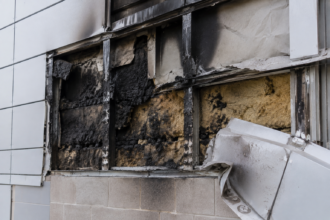
ACM is where the compliance decisions get complicated. The panel consists of two thin aluminum skins bonded to a core material and the core type determines nearly everything about fire behavior.
Polyethylene (PE) cores are highly combustible. Fire-retardant (FR) cores contain flame-spread inhibitors but still carry combustible content.
Mineral-filled cores approach non-combustibility but vary by manufacturer formulation. This core distinction drives the majority of fire code decisions on commercial projects.
A PE-core panel and a mineral-filled core panel may look identical on a cut sheet and identical on the wall, but their fire behavior under NFPA 285 test conditions diverges substantially. The aluminum skins themselves do not sustain combustion, but they conduct heat rapidly and will deform and separate under fire exposure, exposing the core material to direct flame contact.
At that point, the core type is the only variable that matters.
Steel cladding and solid aluminum panels behave fundamentally differently from ACM. They have mass, thermal conductivity and no combustible core material.
That does not make them code-neutral, but it removes the primary ignition and propagation concern that defines ACM compliance. A 3mm solid aluminum panel will absorb and redistribute heat without releasing combustible gases.
A 4mm steel panel behaves similarly. Neither product introduces a fuel load at the cladding face the way a PE-core ACM panel does.
Practitioners who understand this distinction can make more defensible product selection decisions during design development, before the specification is written and before substitution pressure from the contractor enters the conversation.
ASTM E84 (Standard Test Method for Surface Burning Characteristics of Building Materials) provides the baseline distinction between material types, measuring flame spread index and smoke developed index in a controlled tunnel test. A Class A rating requires a flame spread index of 0 to 25 and a smoke developed index of 0 to 450. It is the starting point, not the finish line.
Many practitioners treat a Class A E84 result as sufficient evidence of code compliance and stop there. That reading is incorrect for buildings above the IBC height thresholds discussed in the sections that follow.
The Regulatory Framework: How Building Codes Govern Exterior Wall Assemblies
IBC Chapter 14 governs exterior wall coverings and cladding and practitioners who skip straight to the product data sheet without reading the applicable sections create real project risk. Section 1402 establishes general material requirements.
Section 1403 addresses performance requirements for weather resistance. Neither of these sections is where ACM compliance lives.
Section 1407 is the governing section for metal composite materials (MCM). It establishes two compliance paths: tested assemblies that have undergone full-scale fire testing and prescriptive compliance paths for limited applications.
The distinction between these two paths is not academic. A tested assembly requires documented test reports for the specific combination of components installed.
A prescriptive path applies only within defined parameters and exceeding those parameters automatically voids the path. IBC 2021 Section 1407.4 establishes prescriptive requirements that permit MCM use without full-scale assembly testing only when the building does not exceed 40 feet above grade plane and the MCM system meets specific flame spread and smoke developed index thresholds.
Practitioners who read the prescriptive path and assume it applies to their project without checking the height condition first are reading the code incorrectly.
Building height, occupancy classification and construction type under IBC Chapter 6 (Types I through V) interact to determine which fire performance threshold applies. A Type I high-rise office building and a Type V-B two-story retail building face entirely different requirements, even if the architect specifies the same ACM panel for both.
The code is not product-centric; it is assembly and occupancy-centric. Type I and II construction require non-combustible or limited-combustible materials in structural and exterior envelope applications.
Type III construction permits combustible interior framing but requires non-combustible exterior walls. Type V construction permits combustible materials throughout.
These distinctions affect which compliance path is available and what test evidence is required to document it. A project team that selects a cladding product before confirming the building’s construction type classification is working in the wrong sequence.
IBC 2021 Section 1407.3 establishes prescriptive requirements for MCM systems on buildings exceeding 40 feet in height above grade plane. Above that threshold, the primary compliance mechanism becomes NFPA 285 assembly testing.
The AHJ interprets these provisions at the local level and enforcement consistency varies significantly across jurisdictions. That variability is a project risk that belongs in the specification and the pre-construction meeting, not the final inspection.
Some jurisdictions have adopted the 2021 IBC. Others are on the 2018 or 2015 edition.
Local amendments in states like California, New York and Florida modify base IBC requirements in ways that can tighten or, in rare cases, clarify the compliance path. Confirming the adopted code edition and any local amendments is a pre-design task, not a permit-submittal task.
NFPA 285: The Test That Defines Compliance for Most Commercial Projects
NFPA 285 (Standard Fire Test Method for Evaluation of Fire Propagation Characteristics of Exterior Non-Load-Bearing Wall Assemblies) is the test that most commercial cladding projects above 40 feet must satisfy and most project teams misunderstand what it actually evaluates.
The test protocol involves a full-scale two-story wall assembly, minimum 8 feet wide by 18 feet tall, exposed to an interior room fire. The ignition source simulates a post-flashover room fire venting through a window opening on the first floor.
The test measures flame propagation across the exterior face of the assembly and vertical flame travel through the wall cavity. Both vectors matter.
A system that resists surface spread but allows fire to track vertically through a combustible air barrier or insulation layer fails the test intent entirely. The pass/fail criteria include limits on flame spread above the second floor window opening, lateral flame spread on the exterior face and temperature rise within the wall cavity at defined measurement points.
Meeting all three criteria simultaneously is what constitutes a passing result and the assembly configuration that achieves that result is the only configuration the test report covers.
NFPA 285 is an assembly test. This point cannot be overstated.
A passing result belongs to the specific combination of substrate, sheathing, air and water-resistive barrier, insulation, panel type and attachment system that was physically tested. Changing any component, including substituting a different mineral wool brand with nominally identical density, may invalidate the listed assembly.
The test report will identify each component by manufacturer name and product designation. When a contractor proposes substituting Rockwool Comfortboard 80 for Owens Corning Thermafiber SAFB because one is on backorder, that substitution requires evaluation against the test report before approval, not after installation.
UL and Intertek both publish NFPA 285 test reports that practitioners can access directly to verify listed assembly configurations. Checking those reports against the project specification is a basic quality control step that many teams skip.
The UL Product iQ database and Intertek’s Warnock Hersey directory both allow free searches by product category and test standard. There is no technical barrier to performing this check during design development.
The common misconception that an FR-core ACM panel “passes NFPA 285” is technically meaningless. The panel is one variable in a system-level result.
IBC 2021 Section 1407.11. 1.
1 requires NFPA 285 compliance for MCM used on buildings of Type I, II, III or IV construction exceeding 40 feet. The obligation is on the assembly, not the panel alone.
A manufacturer who markets an FR-core panel as “NFPA 285 compliant” is describing a result that was obtained with a specific assembly configuration. That configuration may or may not match the project conditions.
The design team’s obligation is to confirm the match, not to accept the marketing language at face value.
Where Practitioners Get Into Trouble: Common Compliance Gaps
Four compliance gaps appear repeatedly in project failures and each one is preventable.
The first is substitution without re-evaluation. A contractor swaps the specified mineral wool cavity insulation for a polyisocyanurate product because it is available faster.
The NFPA 285 listing for that assembly was obtained with mineral wool. The substitution voids the listing.
Nobody flags it during submittals because the reviewer is checking R-values, not test report configurations. The project ships, the AHJ catches it at final inspection and the remediation cost exceeds the material savings by an order of magnitude.
This failure pattern is not hypothetical. It appears in dispute records, in contractor claims and in post-occupancy investigations following fire events.
The specification language that prevents it is specific: name the insulation product by manufacturer and product designation, reference the NFPA 285 test report number and prohibit substitution of any listed component without written re-evaluation. Generic language like “mineral wool insulation, R-15 minimum” does not accomplish this.
It leaves the door open for exactly the substitution described above.
The second gap is misreading panel certifications. Manufacturers obtain NFPA 285 test reports for specific assemblies and publish them as product documentation.
Practitioners read “NFPA 285 compliant” on a cut sheet and apply that certification to a completely different substrate and insulation configuration. The test report does not transfer.
It is specific to what was tested. A panel manufacturer may hold test reports for three or four different assembly configurations, each with a different insulation type and substrate.
The project team’s responsibility is to identify which of those configurations matches the project and confirm that the match is complete, not approximate. If the project uses a fluid-applied WRB and the test report was obtained with a self-adhered membrane, that difference requires resolution before the specification is finalized.
The third gap is ignoring height thresholds during design development. A project begins as a three-story building.
Value engineering or a program change adds two floors. The building now exceeds 40 feet above grade plane under IBC 2021 Section 1407.3, triggering NFPA 285 requirements that the original specification never addressed.
The cladding system was not selected with those requirements in mind and may not have a passing assembly configuration at all. This scenario is common enough that it warrants a specific checkpoint in the design process: any program change that affects building height should trigger a re-evaluation of the cladding specification against the applicable code thresholds.
That checkpoint belongs in the project’s quality management protocol, not in the contractor’s submittal review.
The fourth gap is conflating ASTM E84 with NFPA 285. E84 tests material surface burning characteristics in a controlled laboratory tunnel. It does not evaluate assembly-level fire propagation and it does not satisfy IBC 1407 requirements for buildings above the height threshold.
A Class A E84 result is a material-level data point. NFPA 285 is a system-level performance result.
They answer different questions and neither substitutes for the other. Some jurisdictions have adopted local amendments that lower the 40-foot trigger.
California’s Title 24 imposes more stringent requirements than the base IBC and practitioners working in California cannot rely on base IBC thresholds. California Building Code Section 1407A and the associated high-rise provisions impose requirements that go beyond what the base IBC requires and the state’s Office of the State Fire Marshal maintains its own listing program for exterior wall assemblies used on certain occupancy types.
Steel and Solid Aluminum: A Different But Not Simpler Compliance Path
Steel and solid aluminum panels do not contain combustible cores. That removes the primary ACM fire concern and projects using these systems correctly avoid the core-type classification problem entirely.
The compliance path is genuinely simpler in one respect: the panel face does not introduce a fuel load and the design team does not need to evaluate core formulations or obtain core-specific test documentation. A 4mm steel panel system selected for a Type I office building above 40 feet does not require the same level of panel-specific fire documentation that an ACM system requires.
That is a real and meaningful difference in the compliance workload.
The wall assembly behind solid metal panels typically contains combustible materials: polyisocyanurate or mineral wool insulation, a water-resistive barrier that may be a self-adhered membrane or fluid-applied product and sheathing that may be gypsum or wood-based. Those components can sustain fire propagation through the cavity regardless of what the face panel is made of.
IBC Chapter 14 and NFPA 285 address the assembly, not just the cladding face. A fluid-applied WRB with a combustible formulation, installed over polyisocyanurate insulation in a ventilated rainscreen cavity, creates a fire propagation path that the steel panel face does nothing to interrupt.
The cavity itself becomes the problem. Ventilated rainscreen assemblies are particularly susceptible to this failure mode because the air gap that provides drainage and drying also provides oxygen and a vertical channel for flame travel.
NFPA 285 test protocols specifically evaluate this condition, which is why the test requires a full-scale two-story assembly rather than a material-level bench test.
The practical consequence is that a steel panel rainscreen over a combustible insulation and WRB assembly on a Type I building above 40 feet still requires NFPA 285 evaluation of the full assembly. The panel material does not grant a compliance exemption for the system behind it.
Practitioners who select steel panels specifically to avoid fire compliance complexity and then install them over an untested combustible cavity assembly have not solved the compliance problem. They have relocated it from the panel face to the wall cavity, where it is harder to see during inspection and harder to remediate after installation.
Specifying for Compliance: What the Project Manual Needs to Say
The specification is where compliance is either locked in or left ambiguous and ambiguity always resolves against the design team in a dispute. Division 07 sections covering ACM and metal panel systems need to do more than name a panel product.
They need to identify the specific NFPA 285-listed assembly configuration, including the substrate, insulation product and type, WRB product category and attachment system and they need to prohibit substitution of any listed component without written re-evaluation by the envelope consultant or engineer of record. The test report number should appear in the specification, not just in the submittal requirements.
When the test report number is in the specification, every party to the contract has notice of the compliance standard before the project starts. When it appears only in submittals, the contractor may have already purchased materials before the compliance requirement is clearly communicated.
Submittal requirements should explicitly call for the NFPA 285 test report, not just a product data sheet. The submittal reviewer needs to compare the tested assembly configuration against the project conditions, line by line.
This takes more time than checking a flame spread index number. It is not optional on buildings above the IBC 1407.3 height threshold.
The submittal review checklist for a cladding system on a qualifying building should include: confirmation that the test report covers the specific panel product and core type specified, confirmation that the insulation product and thickness match the test report, confirmation that the WRB product category matches the test report, confirmation that the substrate type matches the test report and confirmation that the attachment system configuration matches the test report. If any of these items does not match, the submittal should be rejected and resubmitted with either a conforming product selection or a new test report covering the proposed configuration.
Some manufacturers will provide engineering evaluations or letter of equivalency documentation for minor variations. Those documents require the same scrutiny as the original test report and should not be accepted without review by the envelope consultant.
Pre-construction coordination between the facade contractor, the insulation installer and the WRB installer is essential because the NFPA 285 listing covers the interface between those scopes. A gap in the air barrier at the insulation joint or a different fastener pattern than what was tested can compromise the assembly’s compliance status.
The four control layers (water, air, vapor and thermal) all pass through this assembly and the fire test configuration reflects specific decisions about each one. The pre-construction meeting for a cladding scope on a qualifying building should include a review of the NFPA 285 test report with all installing contractors present.
Each contractor needs to understand which components they are responsible for and how their scope interfaces with adjacent scopes in the tested configuration. This meeting is also the appropriate time to establish the documentation protocol for field changes, so that any deviation from the tested assembly is captured in writing before it is installed rather than discovered during final inspection.
The Field Enforcement Reality and How to Manage It
AHJ interpretation of IBC 1407 is not uniform. Some jurisdictions have plan reviewers who scrutinize NFPA 285 test reports at permit issuance.
Others rely on the contractor’s certification at final inspection. Neither approach guarantees that the installed assembly matches the tested configuration and the project team cannot control which enforcement model applies until they are already in the jurisdiction.
In some jurisdictions, the plan reviewer will request the NFPA 285 test report as a permit condition and will compare the listed assembly against the construction documents before issuing the permit. In others, the permit is issued based on the specification’s representation that a compliant system will be installed and no one verifies the test report until a complaint or a fire event triggers an investigation.
Both enforcement models exist in active practice and the project team’s compliance obligation does not change based on which model the local AHJ applies.
The practical response is to build compliance documentation into the project record regardless of what the AHJ requires. Maintain a copy of the applicable NFPA 285 test report in the project file.
Document any substitution requests with a written determination of whether the substitution affects the listed assembly. If it does, require a new test report or an engineering evaluation from the panel manufacturer before approving the change.
Field observation reports from the envelope consultant or special inspector should document the installed components by manufacturer name and product designation at each stage of the assembly, not just at final completion. A photograph of the insulation product label installed in the wall cavity, taken before the panel system covers it, is worth more in a compliance dispute than any certification letter produced after the fact.
Some project teams engage a third-party envelope commissioning agent specifically to document assembly compliance during construction. On projects where the cladding scope represents significant cost and schedule exposure, that investment is straightforward to justify.
Stop-work orders on cladding systems are expensive and schedule-damaging. The contractor who installed the non-compliant ACM system described at the start of this article did not set out to violate the code.
The failure was a specification that named a panel without specifying a tested assembly and a submittal process that checked material properties instead of system compliance. Fix the process before the project starts and the AHJ’s final inspection becomes a formality rather than a threat.