


- AI can help detect performance drift between design and construction. By comparing specifications, submittals, substitutions, RFIs, and shop drawings, AI can flag when proposed changes begin moving an envelope away from the original design assumptions.
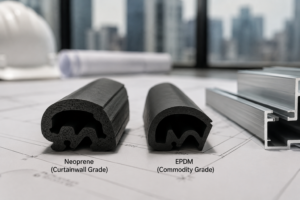
- Product equivalence requires more than matching product categories. Differences in vapor permeance, thermal performance, fastener materials, sealant movement capability, attachment geometry, and tested assemblies can make seemingly similar products perform differently.
- AI is particularly useful for tracking relationships across documents. A change to one component—such as an attachment system, membrane, or insulation product—can affect thermal, moisture, structural, or fire-performance requirements documented elsewhere.
- Shop drawings provide a major opportunity for AI-assisted review. Automated comparison could flag changes involving flashing, fastener spacing, sealant dimensions, drainage paths, membrane laps, thermal isolators, and other critical envelope details.
- AI should flag discrepancies, not make final approvals. Building-envelope performance still requires professional judgment to determine whether a documented difference creates a meaningful technical risk.
- Traceability is essential. Useful AI systems should identify the requirement, proposed condition, source documents, and discrepancy so architects, consultants, and engineers can independently verify the finding.
- The long-term opportunity is continuous envelope configuration control. AI could connect design criteria, specifications, submittals, RFIs, shop drawings, field observations, testing, and closeout documentation to help teams determine whether the enclosure being built still reflects the enclosure that was designed.
AI and Building Envelope Submittal Review: Catching Performance Drift Before Products Reach the Wall
A building envelope can be carefully designed, modeled, detailed, and specified—and still arrive on the jobsite as something materially different from what the design team evaluated.
The change is rarely announced as a redesign.
It happens gradually through substitutions, delegated-design packages, revised product data, value engineering, shop drawings, RFIs, manufacturer recommendations, and contractor submittals. A membrane changes. An insulation product is substituted. A fastener alloy is different from the basis-of-design product. A panel thickness decreases. A sealant is proposed without the primer assumed during testing. An attachment system carries the same general description but has different thermal or structural characteristics.
Individually, these changes may appear minor.
Collectively, they can change how the enclosure performs.
This is an area where artificial intelligence may have a particularly practical role in building envelope work: not designing the wall, but continuously comparing what was designed with what is actually being submitted for construction.
The Envelope Has a Configuration-Control Problem
Building envelope specifications establish a set of interconnected performance assumptions.
Those assumptions may involve:
- Air permeance
- Water resistance
- Vapor permeance
- Thermal conductivity
- Fastener material
- Coating type and thickness
- Sealant movement capability
- Membrane compatibility
- Insulation density
- Cladding thickness
- Attachment geometry
- Fire-performance classifications
- Tested assembly configurations
The problem is that these requirements are distributed across hundreds or thousands of pages of project information.
A single exterior wall may be governed by architectural drawings, specifications, structural requirements, energy-code documentation, manufacturer’s data, engineering calculations, approved testing and several separate submittal packages.
Traditional submittal review asks a human reviewer to reconcile all of that information.
On complicated projects, that is an enormous information-management task.
AI could change that process.
From Document Review to Requirement Tracking
Most submittal reviews are document-centric.
A reviewer opens a package, reads the product data, compares it with the specification and marks the submittal accordingly.
An AI-assisted workflow could instead be requirement-centric.
At the beginning of a project, the system could extract critical enclosure requirements from the construction documents and create a structured performance matrix.
For a rainscreen wall, for example, that matrix might include requirements for the cladding, attachment system, insulation, air/water barrier, flashing, fasteners and fire-safing components.
When a submittal arrives, the AI system could compare the submitted information against that matrix.
Instead of simply identifying whether a manufacturer name appears in the specification, the system could ask more useful questions:
Does the submitted insulation have the specified thermal properties?
Does the proposed membrane have the required vapor permeance?
Does the submitted fastener material match the corrosion-resistance requirement?
Does the proposed cladding attachment system maintain the thermal assumptions used in the wall calculation?
Does the sealant have the movement capability required by the joint design?
Is the submitted assembly actually represented by the referenced fire test?
These are fundamentally different questions from “Is this an approved manufacturer?”
They are questions about whether the performance logic of the original design remains intact.
Detecting Performance Drift
This creates an important concept for envelope professionals: performance drift.
Performance drift occurs when a series of apparently acceptable project changes gradually moves the constructed enclosure away from the assumptions on which the original design was based.
Consider an insulated rainscreen assembly.
The design team establishes a target effective R-value. The thermal analysis assumes a particular insulation thickness and a thermally improved attachment system.
During procurement, another attachment system is proposed.
The replacement may be structurally acceptable and may even resemble the specified system. But if its steel content, clip spacing or geometry creates greater thermal bridging, the effective wall performance can change.
The insulation itself did not change.
The nominal R-value did not change.
The assembly did.
A conventional submittal process can miss this because the insulation and attachment packages may be reviewed separately.
AI is potentially useful precisely because it can maintain relationships between requirements contained in different documents.
The Same Problem Exists With Moisture Control
Moisture-sensitive assemblies create similar risks.
Suppose the design relies on a particular vapor-control strategy.
A membrane substitution is submitted with different permeance characteristics. Viewed as a waterproofing product, the substitution may appear acceptable.
Viewed as part of the entire wall’s hygrothermal strategy, it may not be equivalent at all.
The reviewer therefore needs to understand not merely what the product is, but what role the product performs within the assembly.
That distinction is critical.
AI systems used for envelope review will need to move beyond product-name matching and learn to organize information according to control-layer function:
- Water control
- Air control
- Vapor control
- Thermal control
- Structural attachment
- Fire containment
- Movement accommodation
A substitution affecting one layer may have consequences for several others.
Product Equivalence Is More Complicated Than It Looks
The construction industry frequently uses the language of “or equal.”
For building envelope systems, true equivalence can be difficult to establish.
Two products may occupy the same category while differing significantly in characteristics that matter to a particular assembly.
Two sealants may both be classified as high-performance exterior sealants while having different movement ratings, primer requirements, substrate limitations or compatibility characteristics.
Two mineral wool products may have similar nominal thermal resistance but different densities or attachment requirements.
Two aluminum panel systems may look nearly identical after installation while using very different joint and drainage strategies.
AI could make substitution review more rigorous by comparing products across multiple project-specific attributes rather than relying primarily on category or manufacturer.
But that requires the system to understand an important principle:
Equivalent products are only equivalent relative to the requirements of the specific assembly.
The Fire-Test Problem
Fire-performance documentation is another area where AI-assisted review could become valuable.
Exterior wall fire compliance can depend on specific combinations of components, including insulation, cladding, air barriers, attachment systems, cavity dimensions and fire-blocking configurations.
The existence of a test report does not automatically establish that the proposed wall matches the tested wall.
An AI-assisted system could potentially compare the submitted assembly against the components and configuration represented in the referenced test documentation.
Differences could then be flagged for professional review.
The AI would not determine code compliance.
It would identify discrepancies that deserve attention.
That distinction matters.
AI Could Become a Change-Detection Layer
The most useful future AI system for envelope professionals may therefore look less like a design generator and more like a continuous change-detection system.
Every new document entering the project could be compared against the project’s established enclosure requirements.
A revised shop drawing could trigger a warning that panel dimensions changed.
A new product-data sheet could indicate that membrane permeance differs from the specified value.
An RFI response could alter the termination of an air barrier.
A substitution request could introduce a different fastener material.
A revised attachment layout could affect thermal bridging.
The system would maintain a record of these changes and identify which original assumptions may need to be reconsidered.
This creates something the industry rarely has today: a continuously updated map between design intent and constructed reality.
Shop Drawings Present an Even Greater Opportunity
Shop drawings are especially important because many critical envelope conditions are resolved only after design documents are issued.
Panel joints, anchors, clips, flashings, transitions and fabrication tolerances may not be fully represented until specialty contractors develop their shop drawings.
AI-assisted drawing comparison could eventually identify changes between architectural details and fabrication details.
For example, a system might flag when:
- Flashing end dams disappear
- Fastener spacing increases
- Sealant joint dimensions decrease
- Membrane laps become shorter
- Drainage paths are interrupted
- Panel joints shift relative to backup-wall joints
- Attachment points move closer to panel edges
- Thermal isolators are omitted
- Weeps or cavity vents disappear
None of these conditions automatically means the shop drawing is wrong.
But each may justify review.
The value of AI is therefore not autonomous approval.
It is directing limited professional attention toward the conditions most likely to matter.
The Danger of Automated Approval
This technology also creates an obvious risk.
If AI becomes sufficiently good at identifying compliant submittals, project teams may be tempted to allow software to approve routine packages automatically.
That would be a mistake.
Construction documents contain ambiguity. Product literature can be incomplete. Test reports have boundaries. Shop drawings contain geometric conditions that require engineering judgment. Manufacturers occasionally revise products without obvious changes to trade names.
Most importantly, envelope performance depends on relationships that may not be explicitly documented.
An experienced enclosure professional may recognize that a proposed change creates a sequencing problem even when every individual product technically satisfies its specification.
AI can compare documented requirements.
It cannot assume responsibility for undocumented consequences.
Traceability Will Matter as Much as Accuracy
For professional use, an AI system should never simply report:
“Submittal compliant.”
It should be able to show why.
A useful review output might instead state:
Specified membrane vapor permeance: X.
Submitted membrane vapor permeance: Y.
Source: specification section.
Source: submitted technical data sheet.
Difference exceeds project requirement.
Professional review required.
That traceability allows the architect, consultant or engineer to verify the conclusion.
Without source-level traceability, AI introduces another opaque decision into a process that already suffers from fragmented information.
Manufacturers Will Feel the Impact Too
AI-assisted submittal review could also change how manufacturers present technical information.
Today, important product data may be distributed among technical data sheets, evaluation reports, test reports, installation instructions, environmental documents and engineering guides.
If project teams increasingly use machine-assisted review, manufacturers may benefit from making technical data more structured and consistent.
Products with clearly documented performance characteristics could become easier to evaluate.
Products with ambiguous, incomplete or contradictory documentation could create more review friction.
That means AI adoption may indirectly pressure the building-products industry toward better technical data management.
The Opportunity for Envelope Consultants
For envelope consultants, the opportunity is not simply faster submittal review.
It is better continuity between design, procurement and construction.
A consultant could establish critical enclosure requirements during design and allow an AI-assisted system to monitor those requirements as project documents evolve.
The professional remains responsible for interpretation.
The software handles comparison at a scale that would otherwise require enormous manual effort.
That division of labor is well suited to building-envelope practice.
Computers are good at remembering thousands of requirements and detecting differences.
Experienced professionals are good at deciding whether those differences matter.
The Future: A Digital Chain of Envelope Intent
The longer-term opportunity is a digital chain of technical intent that follows an enclosure from design through construction.
The original performance criteria establish the baseline.
Specifications define products and requirements.
Submittals populate the proposed materials.
Shop drawings establish actual system geometry.
RFIs modify details.
Field observations document installation.
Testing verifies performance.
Closeout documents establish what was ultimately constructed.
AI could connect those currently fragmented stages.
For the first time, an owner could potentially ask a deceptively simple question:
Is the building envelope we are constructing still the building envelope we designed?
Today, answering that question can require searching through hundreds of documents and relying on the memory of multiple project participants.
Tomorrow, it may become a continuously monitored project condition.
Conclusion
The building envelope industry’s most valuable use of artificial intelligence may not be generating designs or replacing technical analysis.
It may be preventing information from getting lost between design intent and construction.
Submittals, substitutions, RFIs and shop drawings constantly modify enclosure systems. Most changes are legitimate. Some improve the project. Others quietly alter assumptions that were established months earlier during design.
AI offers the possibility of tracking those relationships at a scale that human reviewers cannot easily maintain.
But the objective should not be automated approval.
It should be better technical awareness.
For architects, consultants, contractors and manufacturers, the real opportunity is an AI-assisted review process that identifies where the enclosure has changed, explains which performance requirements may be affected and gives experienced professionals the information they need to decide what happens next.
In an industry where small changes at interfaces routinely create large failures, that may prove far more valuable than asking AI to design the wall in the first place.