- Moisture-related failures account for over 40% of envelope litigation claims while AI modeling tool adoption has grown 300% in the same period.
- Physics-based simulation tools like WUFI and pattern-recognition AI models are fundamentally different and conflating them leads to dangerous specification decisions.
- Input errors from manufacturer data sheets, mismatched climate files and training data bias routinely produce outputs that are internally consistent but externally wrong.
- Workmanship variability, transition details and occupant behavior changes fall entirely outside predictive model scope and account for most real-world failures.
- Responsible AI integration requires calibration against completed projects, written scope limitation documents and physical validation through airtightness testing.
AI in Building Envelope Practice: Where Predictive Modeling Earns Its Place and Where It Gets You Sued
A 2023 survey by the National Institute of Building Sciences found that moisture-related failures account for more than 40% of building envelope litigation claims in North America, yet the same survey period saw a 300% increase in AI-assisted moisture modeling tool adoption among envelope consultants. Read that again.
Failure rates are climbing. Model confidence is climbing faster.
That collision is not a coincidence and it is not a comfort. It is the central problem this profession needs to confront before AI-assisted envelope design becomes AI-assisted envelope litigation.
AI Has Arrived in Envelope Practice: and It Is Not Going Away
The tool inventory has expanded dramatically in the past five years. Hygrothermal simulation platforms, EnergyPlus with machine learning extensions, generative facade optimization tools and climate-risk scoring engines embedded in specification software are all in active use on commercial projects right now.
What practitioners frequently miss is the fundamental distinction between rule-based simulation and machine learning models trained on performance datasets. WUFI Pro runs physics.
A neural network trained on building stock data runs pattern recognition. These are not equivalent and conflating them produces dangerous specification decisions.
The drivers are real and not going away. Owner demand for performance guarantees is up.
ASHRAE 90.1-2022 continuous insulation and air barrier requirements have pushed consultants toward modeling tools simply to demonstrate compliance with prescriptive and performance path requirements. Insurance underwriters are beginning to request documented risk modeling as a condition of coverage on high-value facade systems.
The professional credibility question has shifted: using these tools is increasingly expected on complex projects and declining to use them may itself become a standard-of-care liability exposure. That does not mean using them uncritically.
What the tool inventory expansion has not produced is a corresponding expansion in practitioner training on model limitations. Vendors ship tools with confidence-inspiring dashboards and color-coded risk outputs.
They do not ship them with a clear explanation of what the underlying training data looked like, what climate zones are well-represented or what assembly types fall outside the model’s reliable range. The consultant is expected to supply that judgment.
On projects where the consultant is a junior practitioner who learned envelope design in the same period these tools became standard, that judgment may not exist in the form the situation requires. The tool fills the gap where expertise should be and nobody flags the substitution until a failure surfaces.
Where Predictive Modeling Genuinely Reduces Failure and Litigation Risk
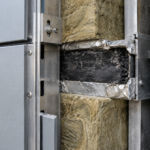
Hygrothermal modeling earns its place when it catches failures before they are built. On a cold climate curtain wall project in IECC Climate Zone 6, a modeling review caught a vapor retarder placement error in the spandrel assembly specification: the retarder was positioned on the exterior side of the mineral wool insulation, creating a condensation plane directly against the steel backup structure.
The model output was unambiguous. The error would not have surfaced in a prescriptive compliance check.
ASHRAE 160-2021, which establishes criteria for moisture-control design analysis in buildings, provides the interpretive framework within which these outputs should be evaluated. Running hygrothermal analysis without referencing 160-2021 acceptance criteria is running a model without a standard.
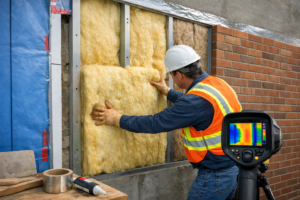
Thermal bridging analysis using finite element tools such as THERM identifies cladding attachment point failures that prescriptive compliance cannot see. A continuous insulation assembly with nominal R-20 mineral wool and aluminum Z-girt framing may deliver an effective R-value closer to R-9 at the girt locations.
That is not a rounding error. That is a fundamentally different assembly.
ASHRAE 90.1-2022 Appendix A provides linear transmittance (psi) values for common thermal bridge conditions, but those tabulated values assume standard geometry. A project with non-standard bracket spacing, mixed insulation thicknesses or proprietary cladding attachment systems requires project-specific THERM analysis to produce defensible effective R-value documentation.
The prescriptive path will not catch the problem. The model will, if the geometry is built correctly.
AI-assisted climate projection modeling allows consultants to design for 2050 climate conditions rather than historical TMY weather data. For assemblies expected to perform for 50 years, this is not speculative; it is responsible practice.
Designing a vapor control strategy based on historical Minneapolis weather data for a building that will operate in a measurably warmer and wetter Minneapolis climate is a durability error with a long fuse. ASHRAE Research Project 1865 produced morphed weather files for future climate scenarios that practitioners can use directly in WUFI and EnergyPlus simulations.
The data exists. Using it requires a deliberate decision to look past the TMY3 file that loads by default.
The litigation risk reduction case is also real. Model outputs create a defensible record of due diligence that prescriptive specification alone cannot provide.
Standard of care in professional liability is evolving toward documented analysis on complex assemblies. A consultant who can produce time-stamped model inputs, assumptions and outputs is in a materially better position than one who cannot.
That record needs to be preserved in project files in a format that remains accessible and readable years after project closeout, because envelope litigation timelines routinely extend five to ten years past substantial completion. A model file that requires a software version no longer in distribution is not a defensible record.
It is a gap.
The Input Data Problem: Where Model Confidence Outpaces Model Accuracy
Garbage-in / garbage-out is not a cliché in envelope modeling. It is the single most underappreciated source of model error in practice.
Material property inputs including vapor permeance, thermal conductivity and sorption isotherms are routinely sourced from manufacturer data sheets that reflect laboratory conditions, not installed, aged or field-conditioned performance. ASTM E96 establishes standard test methods for water vapor transmission of materials and the gap between published E96 values and field-measured permeance in aged assemblies is well-documented in the literature.
A housewrap that tests at 30 perms new may perform at 15 perms after five years of UV exposure. The model does not know that.
The problem extends beyond housewraps. Spray polyurethane foam insulation exhibits vapor permeance values that vary significantly with density and thickness and published values frequently reflect ideal spray conditions and cure times that field application does not replicate.
Closed-cell SPF at 2 inches nominal may be specified at 0.8 perms, but field cores from completed projects routinely show thickness variation of 20 to 30% across a wall plane. The model runs at 2 inches.
The building runs at 1.4 inches in the low spots. That difference shifts the vapor control classification of the assembly under IRC Table R702.7.1 and the model never flags it because the model does not know what the installer did.
Climate file selection errors introduce systematic error that AI tools do not self-correct. Using a TMY3 file for a coastal site with persistent marine layer fog or for an urban heat island location where nighttime temperatures run 4 to 6 degrees Fahrenheit above the surrounding region, produces outputs that are internally consistent and externally wrong.
The TMY3 file for Los Angeles International Airport does not represent the thermal and moisture environment of a building in downtown Los Angeles three miles inland. The consultant who selects that file without adjustment is not making a conservative assumption.
They are making an unexamined one.
The training data bias problem is more subtle and more serious. AI models trained on building stock datasets inherit the characteristics of that stock.
If the training data skews toward code-minimum construction in IECC Climate Zones 3 and 4, the model’s outputs for high-performance assemblies in Climate Zones 6, 7 and 8 are extrapolations. The model is not predicting; it is interpolating outside its reliable range.
Practitioners have no visibility into this. Vendors are not required to publish training data composition, climate zone distribution or assembly type coverage.
A consultant using a risk-scoring tool on a Climate Zone 7 mass timber project with an exterior air barrier and variable permeance vapor retarder has no way to know whether that assembly type appeared in the training data at all.
The confidence interval problem compounds everything else. Most practitioner-facing AI tools present outputs as point estimates without uncertainty ranges.
A model that returns “0.3 lb/ft² annual moisture accumulation” is presenting a single number where the defensible answer is a probability distribution. That false precision shapes specification decisions in ways that a properly communicated range would not.
A result of 0.3 lb/ft² with a 90% confidence interval of 0. 1 to 0.7 lb/ft² tells a very different story than the point estimate alone.
The upper bound of that range may cross the ASHRAE 160-2021 acceptance threshold. The point estimate does not.
The consultant who acts on the point estimate without understanding the underlying uncertainty has made a decision the model was not actually equipped to support.
Specific Failure Modes That AI Tools Are Poorly Equipped to Predict
Workmanship and installation variability sit entirely outside predictive model scope. No hygrothermal model accounts for the gap between a specified self-adhered air barrier with lapped and sealed seams and what actually gets installed on a winter Friday afternoon with a crew under schedule pressure.
ASTM E779 whole-building airtightness testing consistently reveals field performance two to four times worse than modeled. That is not a modeling error in the traditional sense.
It is a scope error. The model is answering a question about a perfect assembly.
The building is asking a different question entirely.
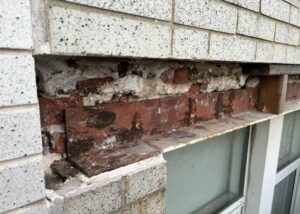
The installation gap is not limited to air barriers. Through-wall flashing at masonry veneer requires end dams, proper slope to drain and continuous bond to the backup wall.
Specifications describe all of this. Field observation on occupied projects with active construction schedules routinely finds end dams missing, flashing lapped in the wrong direction and through-wall flashing terminations that stop short of the required drip edge profile.
No moisture model captures the probability distribution of these installation errors. The Building Enclosure Commissioning process defined in NIBS Guideline 3-2012 exists in part to close this gap through field observation at defined construction milestones, but BECx is not universally specified and is frequently value-engineered out of project budgets before construction begins.
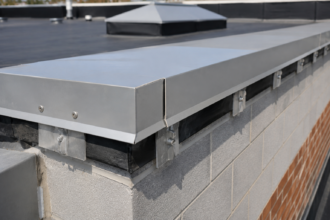
Transition details, penetrations and terminations are where the majority of envelope failures originate. They are also precisely where model geometry gets simplified or omitted.
A hygrothermal model of a wall assembly tells you nothing about the head flashing at a punched opening, the transition from above-grade to below-grade waterproofing or the sill condition at a storefront system. These are the locations where water finds the path of least resistance.
The 2021 IECC Section C402.5 requires a continuous air barrier, but the continuity requirement is only as good as the detailing at transitions. A model that shows a compliant wall assembly and a compliant roof assembly says nothing about the parapet transition between them, which is where a substantial percentage of roofing and wall interface failures actually begin.
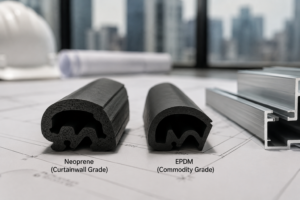
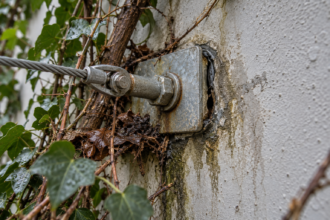
Material interaction failures over time fall completely outside model scope. Sealant-to-substrate adhesion loss at dissimilar materials, galvanic corrosion at mixed-metal cladding attachment brackets and UV degradation of EPDM flashings are durability failure modes that no current hygrothermal model captures.
Neither does occupant behavior. HVAC pressurization changes from tenant fit-out, interior humidity loads from use changes and deferred maintenance on fenestration perimeter sealants drive real-world failures that were never in the model’s scope to begin with.
A laboratory building converted to office occupancy mid-lease may see interior relative humidity conditions shift from 30% to 55% year-round. The original moisture model was not wrong for the original occupancy.
It is simply irrelevant to the building that now exists.
The False Confidence Risk: When Model Output Substitutes for Envelope Expertise
The deskilling risk is real and it is accelerating. A junior practitioner using an AI-assisted moisture risk tool without understanding the underlying physics of air-transported moisture versus vapor diffusion may accept outputs that an experienced envelope consultant would flag immediately as implausible.
Air leakage transports orders of magnitude more moisture than vapor diffusion through a well-constructed assembly. A model that focuses on vapor diffusion while underweighting air leakage risk is not wrong in its math.
It is wrong in its framing. The ASHRAE Handbook of Fundamentals Chapter 25 quantifies this relationship directly: at typical winter conditions, air leakage through a 1 cm² hole can transport more moisture in a single day than vapor diffusion through 1 m² of drywall over an entire heating season.
A practitioner who does not know that number has no basis for evaluating whether a model’s air leakage assumptions are reasonable.
The deskilling dynamic accelerates when firms use AI tools to expand project capacity without expanding senior reviewer time. A tool that produces a color-coded risk output in 20 minutes replaces a process that previously required a senior consultant to spend two hours building a WUFI model, reviewing inputs against project-specific material data and interpreting outputs against ASHRAE 160-2021 criteria.
The 20-minute output looks like the two-hour output. It is not.
The senior review time that would have caught input errors, questioned climate file selection and flagged assembly types outside the model’s reliable range has been compressed out of the workflow. The tool did not eliminate the need for that judgment.
It eliminated the time allocated for it.
Owner and contractor misuse of model outputs is a separate problem. A consultant produces a report showing acceptable moisture risk with stated assumptions and scope limitations.
That report gets forwarded to the owner, who forwards it to the contractor, who references it in a submittal. The assumptions and limitations disappear.
The point estimate survives. The consultant’s careful caveats become someone else’s performance guarantee.
The liability transfer problem cuts directly against the documentation benefit described earlier. If a consultant produces a model showing acceptable moisture risk and failure occurs, the model output will be used against the consultant in discovery.
The question will not be whether the model was run correctly. The question will be whether the consultant understood its limitations and communicated them clearly.
NIBS guidance on building enclosure commissioning (BECx) exists precisely because model outputs require physical validation checkpoints that the model itself cannot provide. BECx is not optional quality assurance on a high-performance project.
It is the process check that separates a model from a building.
No current standard requires third-party validation of AI-assisted envelope models before construction documents are issued. That gap will close after enough litigation.
A Framework for Responsible Integration: Calibration, Validation and Scope Discipline
Calibration discipline comes first. Any AI or simulation tool used for specification decisions on a project should be calibrated against at least one comparable completed project with measured performance data before its outputs inform assembly selection.
This is not an academic requirement. It is the minimum condition under which a model output is defensible.
Calibration means running the model against a project where post-occupancy airtightness test results, infrared thermography findings and any documented moisture intrusion events are known, then comparing model predictions against measured outcomes. Where the model diverges from measured performance by more than an acceptable tolerance, the source of divergence needs to be identified and documented before the model is applied to a new project.
Firms that maintain a calibration library of completed projects with measured performance data are in a materially stronger position than firms that treat each project as the model’s first application.
Scope discipline is equally non-negotiable. Every project record that includes AI-assisted or simulation-based analysis should contain a written “model scope and limitations” document as a standard deliverable.
This document defines explicitly what the model addresses across the four control layers: water, air, vapor and thermal. It states what the model does not address.
It identifies the climate file used, the material property sources and the assumptions embedded in the geometry. A model without a scope document is a liability without a defense.
The scope document should be issued as a numbered project deliverable, not buried in report footnotes. It should be transmitted to the owner and architect of record with a cover letter that explicitly requests acknowledgment of receipt.
That transmission record matters in discovery. The consultant who can show that scope limitations were communicated in writing, transmitted formally and acknowledged by the owner is in a different legal position than the consultant whose limitations were noted in paragraph seven of a report appendix that nobody read.
Validation checkpoints pair model outputs with physical mock-up testing and field measurement. Require ASTM E779 airtightness testing at practical completion and compare results against modeled assumptions.
Where divergence exceeds 50%, revisit the model inputs and document the reconciliation. This is not additional work.
It is the work. On projects where the envelope assembly includes a specified air barrier system, intermediate ASTM E779 testing at rough-in, before interior finishes close access to the air barrier plane, allows remediation while the assembly is still accessible.
A final blower door result that shows 0.4 cfm/ft² at 75 Pa when the model assumed 0. 15 cfm/ft² is not just a performance shortfall.
It is evidence that the moisture accumulation calculations in the hygrothermal model were based on an air leakage assumption the building never achieved. Documenting the reconciliation between modeled and measured performance is the record that demonstrates the consultant treated the model as a starting point rather than a conclusion.
The profession’s obligation is to treat AI tools the way experienced consultants treat any new analytical method: with calibrated skepticism, documented assumptions and a clear understanding of where the method’s reliability ends. A model is a decision-support tool.
The decision belongs to the engineer of record. That accountability does not transfer to the software.
The consultants who will use these tools well are the ones who understand their physics well enough to know when the output is wrong before the building tells them.