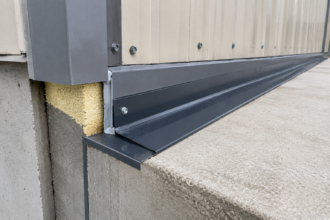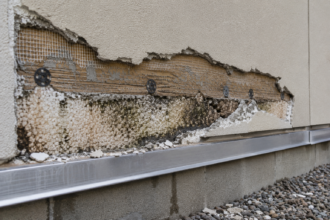
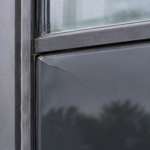
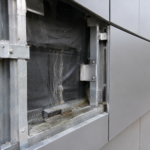
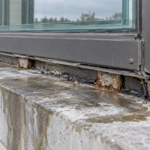
- Cohesive splitting failures at silicone joints on painted steel panels trace back to sealant details originally engineered for aluminum.
- Steel’s lower thermal expansion coefficient does not reduce sealant demand when joint widths are copied directly from aluminum specifications.
- Silicone adhesion to PVDF and polyester coatings is more sensitive to field preparation variability than urethane adhesion on the same substrates.
- Urethane sealants offer more consistent bonding on coated steel and can be painted over for easier long-term facade maintenance.
- Specifiers should verify sealant performance using ASTM C794 and C1521 on the actual panel coating system before approving any product.
Silicone vs. Urethane Sealants at Steel Panel Joints
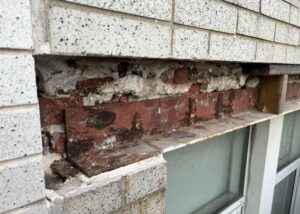
A specifier on a mid-rise institutional project in Chicago discovers cohesive splitting along silicone sealant joints at painted steel rainscreen panels after just two heating seasons. The sealant is intact at both substrates.
It has torn through its own body at midspan. The failure pattern is textbook thermal fatigue and the product was specified directly from the panel manufacturer’s standard detail, a detail written for aluminum.
That single callback reframes every assumption the project team held about sealant selection and it illustrates exactly why the default reach for silicone at metal panel joints deserves serious reconsideration.
Why Steel Rainscreen Panels Are Rewriting the Sealant Specification Playbook
Steel rainscreen adoption is accelerating across North America and the driver is largely regulatory. IBC 2021 Section 1402.5 imposes combustibility requirements that effectively disqualify ACM composite panels with polyethylene cores from use in many occupancy and height combinations.
NFPA 285 fire propagation testing, now referenced by the IBC for exterior wall assemblies containing foam plastics or combustible cladding, has pushed fabricated steel panels into the foreground as a code-compliant substitute. The adoption curve is steep and it is not slowing down.
Several high-profile facade fires in the preceding decade accelerated code committee action and the 2021 cycle codified restrictions that many jurisdictions had already adopted through local amendment. Specifiers who were writing aluminum composite panel details in 2018 are writing steel panel details today, often without pausing to examine what changed beyond the panel material itself.
The problem is that specifiers are inheriting sealant details developed for aluminum curtainwall and aluminum rainscreen systems without adjusting for steel’s fundamentally different thermal behavior and surface chemistry. Panel manufacturers contribute to this by publishing standard details that were originally engineered for aluminum and never updated when the same panel profile was offered in steel.
The detail carries the manufacturer’s logo, it references a compliant sealant product and it appears authoritative. A specifier under deadline pressure has limited incentive to question it.
That institutional inertia is the mechanism by which aluminum sealant assumptions migrate into steel panel specifications at scale.
Most sealant manufacturer technical data sheets present silicone as the default premium choice without substrate-specific caveats for coated steel. The TDS will list coated metal as an acceptable substrate, which is technically accurate in controlled conditions, but it will not flag the adhesion variability that PVDF and polyester coatings introduce relative to anodized aluminum or glass.
That knowledge gap is institutional, not incidental. It persists because the feedback loop between field failures and specification updates is slow and because cohesive splitting failures are often attributed to installation error rather than material mismatch, which closes the loop before the correct lesson is learned.
This article addresses painted and coated steel panels, specifically PVDF, polyester and epoxy primer systems, in ventilated rainscreen assemblies on commercial and institutional facades across North American climate zones.
The Thermal Expansion Gap: Steel vs. Aluminum and What It Means for Joint Movement
Steel’s coefficient of thermal expansion runs approximately 6.5 x 10⁻⁶ in/in/°F. Aluminum’s is approximately 13 x 10-6 in/in/°F.
Steel moves roughly half as much per degree of temperature change and specifiers sometimes treat that as a built-in margin of safety. It is not.
Dark-coated steel panel surfaces in direct sun routinely reach 160 to 180°F in summer. Chicago’s IECC Climate Zone 5A delivers ambient winter lows around -10°F.
The realistic surface temperature delta across a full annual cycle approaches 190°F, not the 150°F design value that appears in simplified examples. For a 5-foot steel panel using a 150°F delta, the linear movement calculates to approximately 0.059 inches per panel.
That movement cycles daily at smaller amplitudes and seasonally at full amplitude. It is cumulative, directional and relentless.
A dark bronze PVDF finish on a south-facing panel in Phoenix, IECC Climate Zone 2B, can push surface temperatures above 185°F, which extends the delta further and compresses the margin between rated sealant capacity and actual demand. The 150°F simplified design value is not conservative in those exposures.
ASTM C1193 defines the movement accommodation factor (MAF) as the ratio of the anticipated joint movement to the sealant’s rated movement capacity and it requires that joint width be sized so the sealant operates within its rated elongation and compression limits. The calculation must use the actual substrate CTE.
Borrowing joint width from an aluminum detail and applying it to a steel panel leaves the sealant operating at a fraction of the joint width it actually needs, because the aluminum detail was sized for roughly twice the movement demand per unit length. The arithmetic consequence is that a joint sized for aluminum movement at a given panel dimension will produce a sealant aspect ratio and width that is geometrically correct for aluminum but undersized for steel when the temperature delta is applied to the actual CTE.
The sealant is not operating at half its rated capacity because steel moves half as much. It is operating at the same absolute movement demand in a joint that was not sized for it.
The specifier error pattern is consistent: joints designed for aluminum movement tolerances applied to steel panels, with the result that sealant operates near or beyond its rated elongation capacity under peak thermal loading. ASTM C719 cyclic movement testing exists precisely to validate sealant performance under these conditions.
The test subjects sealant specimens to repeated extension and compression cycles at the rated movement class and evaluates adhesion and cohesion integrity after cycling. Specifiers who never request C719 test data for the specific substrate are making a selection on incomplete information.
Requesting that data and confirming it was generated on a substrate representative of the actual panel coating system, is the minimum verification step the specification process should require.
Silicone’s Strengths and the Specific Conditions Under Which They Fail
Silicone earns its reputation on glass and anodized aluminum. UV stability, a service temperature range from -65°F to +300°F, low modulus options and decades of documented performance on curtainwall systems are legitimate advantages.
The material is not the problem. The mismatch is.
PVDF and polyester coatings present low-surface-energy substrates. Silicone adhesion to these surfaces depends on primer compatibility and surface preparation quality.
ASTM C794 adhesion-in-peel testing on PVDF-coated substrates consistently shows that silicone adhesion is more variable than urethane adhesion under equivalent preparation conditions. That variability is not random.
It correlates with surface energy, coating batch variation and the specific silicone primer chemistry used. A silicone sealant manufacturer may list a single primer for all coated metal substrates, but PVDF from one panel manufacturer is not chemically identical to PVDF from another and primer performance does not transfer automatically across coating suppliers.
Specifiers who accept a generic “coated metal” primer approval without confirming compatibility with the specific panel coating system are accepting an untested assumption at the most critical point in the adhesion chain.
In field conditions, where surface preparation protocols are abbreviated by schedule pressure, temperature constraints and crew turnover, that variability becomes a liability. ASTM C920 Type S, Grade NS, Class 50 silicone products are rated for plus or minus 50% movement.
That rating assumes proper adhesion is achieved and maintained across the full service life of the joint. When adhesion to a low-surface-energy coating is marginal, the sealant cannot distribute stress uniformly across the bond line.
Stress concentrates at the midpoint of the sealant cross-section. Under high-cycle thermal loading on stiff steel substrates, that concentration produces cohesive splitting, the exact failure pattern described in the opening scenario.
The sealant body fails before the bond fails, which is why the failed joints in the Chicago project showed intact adhesion at both substrates. The material was not under-specified by classification.
It was under-bonded by chemistry and the joint geometry did not provide enough width to keep the sealant within its actual working range given the adhesion it had achieved.
Silicone also cannot be painted over. On coated steel panel systems where color continuity and field repair are maintenance realities, silicone contamination of adjacent surfaces creates a persistent problem that no amount of masking tape fully solves.
Silicone outgassing deposits a thin film on surrounding surfaces that prevents paint adhesion in a radius well beyond the joint itself. Touch-up on silicone-jointed steel panel facades is a documented maintenance headache that the specification rarely anticipates.
On a facade with tight color tolerances and a 40-year service expectation, that limitation compounds over time in ways that are difficult to price at the specification stage but very easy to price after the first maintenance cycle.
Why Urethane Sealants Perform Differently on Coated Steel Substrates
Urethane chemistry bonds through polar covalent interaction with metal oxide layers and coating binders. This mechanism is more compatible with the surface chemistry of epoxy primers, polyester topcoats and PVDF systems than silicone’s condensation-cure adhesion mechanism.
The bond is more consistent across the range of field preparation conditions that actually occur on a commercial facade project. Where silicone adhesion to PVDF depends heavily on primer selection and application precision, urethane adhesion to the same substrate is less sensitive to minor deviations in solvent wipe technique, flash time and substrate temperature at the time of application.
That difference in sensitivity is not marginal. On a large facade project with multiple crews, multiple installation phases and the inevitable schedule compressions that occur between shop drawing approval and substantial completion, it is the difference between a consistent bond and a statistically variable one.
Higher tensile strength and tear resistance in urethane formulations means the sealant body resists cohesive splitting under cyclic loading. The failure mode that terminated the silicone joints in the Chicago project is not a urethane failure mode under equivalent loading conditions.
Urethane’s higher modulus relative to low-modulus silicone is sometimes cited as a disadvantage and in applications where substrate movement is very high or substrates are fragile, that concern is valid. On steel rainscreen panels, where the substrate is stiff and the movement demand is moderate relative to aluminum, the higher modulus is not a disqualifying characteristic.
Joint width sizing per ASTM C1193 using the steel CTE accommodates the modulus difference without requiring oversized joints. That distinction matters when you are selecting a sealant for a 40-year building and the failure mode you are designing against is cohesive splitting, not bond-line stress fracture.
Urethane’s paintability is a practical advantage in coated steel systems that specifiers routinely undervalue. Touch-up, color-matching and field repair are all executable without the silicone contamination problem.
On a facade where panel coatings are color-matched to tight tolerances, the ability to paint over a sealant joint is not a minor convenience. It is a maintenance program enabler.
A building owner who can direct a painter to address a discolored joint during routine facade maintenance is in a fundamentally different position than one who must mobilize a sealant contractor, remove contaminated material and re-prime before any cosmetic correction is possible.
Urethane’s limitations deserve direct acknowledgment. UV degradation is real; exposed urethane joints require paint or coating protection in applications where the sealant face is not shadowed by panel geometry.
The temperature ceiling is lower than silicone, typically -40°F to +180°F, which approaches the surface temperature range on dark steel panels in high solar exposure climates. On deep charcoal or black PVDF finishes in Climate Zones 1 and 2, surface temperatures can approach or exceed that ceiling and the specifier must confirm the specific product’s rated upper limit against the calculated surface temperature before approving urethane for that application.
Moisture-cure urethane formulations require controlled application conditions, specifically relative humidity within the manufacturer’s specified range and cold-weather application below 40°F demands attention to cure kinetics. Applying moisture-cure urethane in very low humidity conditions, common in heated winter enclosures or arid climates, can extend cure time enough to affect joint performance if the sealant is disturbed before full cure is achieved.
ASTM C920 Type M, Grade NS, Class 25 or 35 urethane classifications cover the range of products appropriate for steel rainscreen joints; the class selection depends on the joint movement calculation from Section 2. ASTM C1521 field adhesion testing post-installation is the verification protocol that closes the loop between specification and actual performance.
Reading the Test Data: What ASTM Standards Actually Tell Specifiers
ASTM C920 classification is a minimum performance threshold. It is not a comparative ranking and it is not substrate-specific.
A product that “meets ASTM C920” has passed a standardized battery of tests on standardized substrates under standardized conditions. Those conditions may or may not resemble your project.
ASTM C719 cyclic movement testing tells you how a sealant performs under repeated extension and compression cycles. Class 25 means the sealant accommodates plus or minus 25% movement.
Class 50 means plus or minus 50%. But the class rating is only meaningful in the context of actual joint movement calculations.
A Class 50 silicone operating on a marginal adhesion bond to a PVDF coating is not performing at its rated capacity. The rating assumes the bond holds.
Verifying that assumption requires ASTM C794 adhesion-in-peel testing on actual project substrate samples, not generic TDS data. ASTM C794 measures the force required to peel a cured sealant bead from a substrate at a standardized rate and it distinguishes between adhesive failure at the bond line and cohesive failure within the sealant body.
Adhesive failure on a PVDF substrate at a low peel force is a direct indicator that the primer system is not performing. Cohesive failure at a high peel force indicates the bond is stronger than the sealant body, which is the acceptable result.
Requesting C794 data generated on the specific panel coating system, not a generic coated metal substrate, gives the specifier substrate-specific adhesion performance data rather than a classification that was earned on mortar and glass.
ASTM C1521 field adhesion testing closes the loop between laboratory data and installed performance. The test involves cutting a tab of cured sealant from an installed joint and pulling it back at 180 degrees to evaluate whether failure is adhesive or cohesive.
It is a destructive test, which means it requires patching, but it is the only method that confirms the sealant is actually bonded to the substrate as installed. Specifying C1521 testing at the start of each installation phase, after any primer lot change and after any interruption in installation exceeding 72 hours gives the project team real-time feedback on bond quality rather than a post-failure analysis.
Specifiers who stop at “meets ASTM C920” are not making a substrate-specific selection. They are making a default selection and calling it due diligence.
The distinction matters when the callback arrives. Request C719 test data.
Request C794 peel adhesion data on the actual coating system specified for the project. Ask the sealant manufacturer to confirm primer compatibility with the specific PVDF or polyester topcoat from the panel manufacturer.
These are not extraordinary requests. They are basic substrate-specific verification steps that the specification process should require before a product is approved.
Sealant manufacturers with active technical service programs will provide this data. A manufacturer who cannot confirm primer compatibility with the specific coating system in writing is not a manufacturer whose product belongs on a 40-year facade.
The Field Preparation Gap That Specifications Don’t Close
The specification can require ASTM C920 compliance, primer application and minimum joint width. It cannot guarantee execution.
The gap between what the spec requires and what happens on a scaffold 80 feet up on a windy Chicago morning in October is where most sealant failures actually originate.
Silicone’s adhesion to coated steel is more sensitive to surface preparation variability than urethane’s. Solvent wiping protocol, primer flash time, application temperature and substrate moisture content all affect bond quality.
When those variables are controlled in a laboratory, silicone performs well. When they are managed by a crew working under schedule pressure, the results are inconsistent.
A two-rag solvent wipe technique, where the first rag applies solvent and the second clean rag removes dissolved contamination before it redeposits, is the correct protocol. A single-rag wipe that spreads contamination across the substrate is the protocol that actually occurs when the foreman is three bays ahead and the apprentice is working alone.
Primer flash time is specified in minutes on the TDS. On a cold day with low humidity, that flash time extends.
On a hot day with direct sun on the substrate, it shortens. Neither condition is flagged on the label and neither is managed by a specification clause that says “apply primer per manufacturer’s instructions.
Urethane’s polar bonding mechanism is more forgiving of minor surface preparation deviations on coated metal substrates. That forgiveness does not eliminate the need for proper preparation.
It reduces the consequence of minor deviations that are statistically certain to occur on a large facade project. A 200-linear-foot daily installation rate across a 50,000-square-foot facade produces thousands of individual joint segments over the course of an installation.
The probability that every one of those segments receives textbook surface preparation is not 100 percent. Specifying a material whose adhesion performance degrades sharply at the margin of acceptable preparation is accepting a failure probability that the specification cannot reduce to zero through language alone.
This is not an argument for relaxing field quality control. It is an argument for selecting a sealant whose adhesion mechanism is better matched to the realistic range of field conditions your project will encounter.
Specifying a material that performs perfectly under laboratory conditions and inconsistently under field conditions is not conservative practice. It is optimistic practice and optimism is not a building envelope strategy.
The specifier’s job is to select materials that perform within the range of conditions that will actually exist, not within the range of conditions that should exist if every trade performs perfectly every day.
Making the Call: A Defensible Specification Position
The default specification of silicone at steel rainscreen panel joints is not wrong in every case. In applications with protected joints, aluminum or galvanized substrates, controlled installation conditions and low thermal cycling amplitude, silicone remains a legitimate choice.
The problem is applying that choice reflexively to painted steel rainscreen panels in high-thermal-cycling environments without running the movement accommodation calculation and without verifying adhesion performance on the actual coating system.
For PVDF-coated or polyester-coated steel panels in IECC Climate Zones 4 through 7, with panel surface temperatures reaching 160°F or above and annual temperature deltas exceeding 140°F, the movement demand and adhesion risk profile favors urethane. Specify ASTM C920 Type M, Grade NS, Class 25 or 35 urethane with primer compatibility confirmed in writing by the sealant manufacturer for the specific panel coating system.
Require ASTM C1521 field adhesion testing at the start of each installation phase and after any interruption exceeding 72 hours. Size joint width using ASTM C1193 MAF methodology with the steel CTE, not the aluminum CTE from the panel manufacturer’s standard detail.
Where panel surface temperatures may approach or exceed 180°F on dark finishes in southern exposures, confirm the specific urethane product’s rated upper service temperature against the calculated surface temperature before finalizing the product selection. If that confirmation cannot be obtained, the specification should require a two-component urethane or a hybrid urethane-silicone product with a documented upper temperature rating that clears the calculated surface temperature by a minimum margin of 10°F.
The Chicago callback was preventable. The detail existed.
The product was compliant. The substrate-specific analysis was never done.
That is the failure the specification needs to prevent and it starts with recognizing that the aluminum sealant playbook does not transfer to steel without scrutiny.