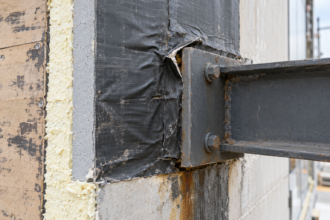
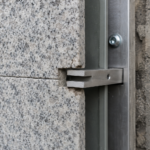
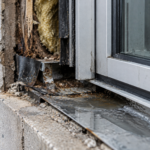
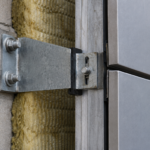
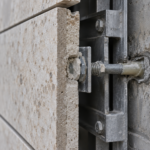
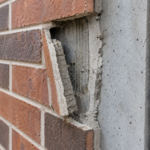
- Mechanically galvanized shelf angles can pass submittal review while providing roughly one-tenth the zinc thickness of a hot-dip galvanized specification.
- Hot-dip galvanizing forms a metallurgical bond with the steel substrate that provides cathodic edge protection at punched holes and sheared ends.
- Cavity wall environments in cold and urban climates fall into corrosivity categories that mechanically galvanized coatings are not rated to handle.
- Specification language must explicitly exclude mechanical galvanizing as a substitute to close the procurement gap that enables this substitution.
- A single floor line of corroded shelf angles can require 200 to 400 square feet of veneer removal costing far more than the original procurement savings.
Hot-Dip vs. Mechanically Galvanized Shelf Angles
Why the Shelf Angle Is the One Element You Cannot Get Wrong
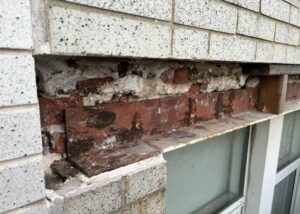
A masonry veneer facade on a mid-rise mixed-use building in the Mid-Atlantic region begins showing stair-step cracking and shelf angle rust-bleed at year nine: well past the contractor’s warranty period and after ownership has changed hands twice. Investigation reveals the original hot-dip galvanized shelf angle specification was substituted during procurement with mechanically galvanized angles that met the specified zinc weight on paper but exhibited coating gaps at sheared edges and bend radii.
The failure is not dramatic. It is slow, invisible and expensive precisely because it looked like a compliant substitution at the time of submittal review.
That scenario is not hypothetical. I have investigated three assemblies in the past five years where the root cause traced directly to this substitution.
The coating comparison looked clean on the submittal. The field reality was corrosion advancing at the exact locations the coating was thinnest.
What makes this substitution particularly dangerous is that it passes through multiple review gates without triggering a flag. The procurement team sees a product data sheet referencing a recognized ASTM standard.
The submittal reviewer sees a zinc weight number that appears to satisfy the specification. The special inspector performing periodic structural observations has no mandate to measure coating thickness at punched hole perimeters.
By the time the building envelope consultant is called in, the angles are embedded behind flashing, air barrier membrane and masonry. Destructive investigation to confirm the coating type requires removing veneer and that cost falls on whoever owns the building at the time of discovery, not the contractor who made the substitution.
Shelf Angles Are the Most Consequential Steel in a Masonry Veneer Wall
Shelf angles carry cumulative dead load from each wythe segment above. That load path is not shared with ties, lintels or relieving angles elsewhere in the assembly.
The shelf angle is the gravity transfer element and its structural integrity is non-negotiable.
What makes corrosion here particularly consequential is location, not just function. The shelf angle sits at the intersection of the drainage plane, the flashing termination and the structural steel frame.
Corrosion does not just weaken a single component. It compromises the water control layer, the structural connection and the facade simultaneously.
That is a multi-system failure from a single point of deterioration.
Rust jacking compounds the problem. Zinc iron corrosion byproducts expand at roughly six to eight times the volume of the original steel.
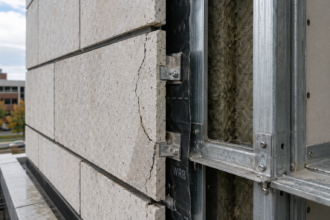
That expansion cracks mortar joints and masonry units from behind, producing the stair-step cracking pattern that typically sends the owner to a facade consultant. NCMA TEK 12-4B identifies differential movement at shelf angle locations as a primary crack initiator in concrete masonry veneers.
The cracking is not the failure; it is the visible symptom of a coating that stopped protecting steel years earlier.
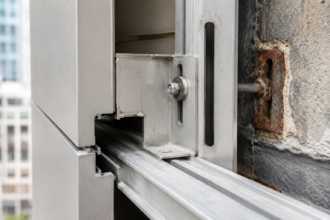
The structural consequence extends beyond the angle itself. Shelf angles are typically welded or bolted to embed plates or directly to the structural steel frame.
When corrosion advances from the angle outward along the connection, it attacks the weld toe or the bolt bearing surface. Weld toe corrosion is particularly difficult to detect during routine facade inspections because it occurs at the back face of the angle, against the structural frame, where visual access requires removing the flashing and air barrier.
By the time rust bleed appears at the mortar joint below the shelf angle, the connection has often been compromised for two to four years. IBC Section 1604.3 requires that structural systems maintain serviceability under sustained loads and a corroding shelf angle connection does not meet that standard regardless of whether the angle itself retains section.
No other element in a masonry veneer assembly concentrates structural, waterproofing and facade integrity consequences the way a corroding shelf angle does.
How Each Coating Process Works and Where They Diverge
Hot-dip galvanizing (HDG) is a metallurgical process. The steel is cleaned, fluxed and immersed in molten zinc at approximately 840 degrees Fahrenheit.
The zinc reacts with the iron substrate to form intermetallic alloy layers: gamma, delta, zeta and eta. These layers are not applied to the steel; they are grown from it.
The coating is integral to the base metal.
Mechanical galvanizing works differently. Zinc powder is tumbled onto chemically prepared steel using glass bead impact at ambient temperature.
The coating adheres mechanically, not metallurgically. There is no intermetallic bonding layer.
That distinction matters most at cut edges, punched holes and bend radii. HDG coatings provide cathodic protection to adjacent exposed steel through zinc’s electrochemical sacrifice.
The intermetallic alloy layer extends this protection laterally across small gaps. Mechanically galvanized coatings do not form the same intermetallic structure and provide substantially reduced cathodic throw at sheared or punched edges.
Fabrication reality makes this worse. Shelf angles are sheared to length in the shop, punched for anchor bolts and sometimes bent or coped in the field.
Every one of those operations exposes bare steel at locations where moisture concentrates preferentially. ASTM A123/A123M governs hot-dip galvanized coatings on iron and steel products and requires the metallurgical bond that provides this edge protection.
ASTM B695 governs mechanically deposited zinc coatings and describes a fundamentally different adhesion mechanism that does not replicate that protection at cut edges.
The cathodic throw distance for HDG coatings on structural steel is generally accepted at 0.5 to 1. 0 millimeters from the coating edge, sufficient to protect the narrow bare steel band left by a clean shear cut.
Mechanically galvanized coatings provide cathodic throw measured in tenths of a millimeter under the same electrochemical conditions. A punched bolt hole in a shelf angle has a perimeter of roughly 50 to 75 millimeters depending on bolt diameter.
An HDG coating bridges that exposure zone electrochemically. A mechanically galvanized coating leaves the majority of that perimeter with no effective cathodic protection, relying instead on the zinc powder particles in direct contact with the steel surface, which is a contact zone that fabrication handling and installation can disrupt before the angle ever reaches the wall.
Coating Thickness: What the Standards Require vs. What Arrives on Site
This is where substitution requests fall apart under scrutiny.
ASTM A123/A123M Table 1 requires a minimum average coating thickness of 3.9 mils (99 micrometers) for structural steel in the relevant material category. That measurement is taken by magnetic thickness gauge per ASTM E376 and reflects a metallurgically bonded, uniform coating across the full surface including corners and edges.
ASTM B695 Class 50, the most common mechanically galvanized class offered as an equivalent, requires a minimum of 50 grams per square meter. That converts to approximately 0.28 mils or 7 micrometers average.
Class 80 reaches approximately 0.45 mils or 11. 4 micrometers.
Both are a fraction of the HDG minimum.
The substitution trap is a unit problem. Specifiers see “Class 50” or “Class 80” and sometimes read the number as mils or microns rather than grams per square meter.
That misreading produces apples-to-oranges submittal approvals that look technically defensible until someone does the unit conversion.
Coating thickness variability in mechanical galvanizing is highest at complex geometry: inside corners of angles, punched hole perimeters and sheared ends. These are precisely the locations where shelf angles accumulate moisture and where coating protection is most needed.
American Galvanizers Association technical data shows HDG coatings on structural angles average 4.2 to 5. 8 mils in practice.
Mechanically galvanized Class 80 averages 0.4 to 0. 5 mils.
That is roughly a 10:1 ratio that does not appear anywhere in a standard submittal comparison.
The gap is even wider when you account for coating distribution. HDG produces a thicker coating at inside corners and re-entrant geometry because the molten zinc pools slightly before it drains.
The gamma and delta intermetallic layers build uniformly regardless of geometry because they form by diffusion, not by drainage. Mechanical galvanizing produces thinner coatings at inside corners because the glass bead impact that drives zinc powder onto the surface has reduced effectiveness in confined geometry.
The inside corner of a shelf angle, the exact location where the outstanding leg meets the horizontal leg and where mortar droppings and condensate collect, receives the least coating from the process that already provides the least coating overall.
A contractor submitting a Class 80 mechanically galvanized angle as equivalent to an HDG specification is not providing an equivalent product. The submittal may show compliance with a zinc weight number, but the coating performance is not equivalent.
The Cavity Wall Environment Is More Aggressive Than It Looks
The shelf angle does not live in a controlled exposure environment. It lives in the cavity, a space specifically designed to collect and drain water.
Intermittent wetting and drying cycles consume zinc faster than continuous immersion. The zinc oxide and zinc hydroxide byproducts that form during wet periods partially rinse away during drainage events, accelerating net zinc loss compared to static exposure.
Mortar droppings are a near-universal site condition. They accumulate on the top flange of the shelf angle and create poultice corrosion: trapped moisture combined with elevated pH from cement leachate.
Alkaline environments attack zinc coatings faster than neutral water. A shelf angle buried under mortar droppings is not in a benign microenvironment; it is in one of the most aggressive corrosion conditions the assembly produces.
Chloride and sulfate contamination enter the cavity through weep holes and mortar joints. Urban environments, deicing salt exposure in IECC Climate Zones 4 through 7 and coastal locations all accelerate zinc depletion at rates that laboratory corrosion data from controlled exposures does not fully capture.
The shelf angle is also typically the coldest steel surface in the assembly during winter. Condensation forms preferentially on cold surfaces, extending wet time well beyond what exterior exposure data would predict.
A thin mechanically galvanized coating that might perform adequately on an exterior handrail will not perform equivalently on a shelf angle that experiences repeated condensation cycles from November through March.
ASTM G101 provides a corrosivity index framework that accounts for time of wetness, sulfur dioxide exposure and chloride deposition. Cavity wall environments in urban cold-climate locations routinely fall into Corrosivity Category C4 or C5 under ISO 9223, the same categories used to classify industrial and coastal marine exposures.
Specifiers who select HDG for shelf angles in those environments are applying a coating system rated for C4 and C5 service. Specifiers who accept a mechanically galvanized Class 80 substitution are applying a coating system rated for C2 or C3 service at best, to a component in a C4 or C5 environment.
The service life differential is not marginal. Published zinc depletion rate data from ISO 9224 shows a C4 environment consumes zinc at two to four times the rate of a C2 environment.
A coating that starts at one-tenth the thickness and depletes at two to four times the rate will reach bare steel in a fraction of the time the specified system would.
Reading the Submittal: What to Check Before You Stamp It
Most substitution requests for mechanically galvanized shelf angles arrive with a product data sheet showing zinc coating weight in grams per square meter and a statement that the product meets ASTM B695. That statement is accurate. It is also insufficient.
The review question is not whether the product meets ASTM B695. It is whether ASTM B695 Class 50 or Class 80 provides equivalent corrosion protection to ASTM A123 in the cavity wall environment described above. It does not.
When reviewing submittals, require the following: coating thickness in mils or micrometers (not grams per square meter) measured per ASTM E376 at the inside corner radius of the angle, at a punched hole perimeter and at a sheared end. If the submitter cannot provide those measurements, the data does not exist to evaluate the substitution.
Require the coating class to be explicitly stated and require the specifier of record to confirm that the class provides equivalent service life to the HDG specification in the project exposure category.
If the substitution request does not include engineering review by the structural engineer of record and the building envelope consultant, reject it. This is not a finish substitution.
It is a structural corrosion protection substitution at the primary gravity load transfer element in the facade.
The submittal review process for shelf angles should also flag any indication that the angles will be field-cut or field-punched after delivery. A mechanically galvanized angle that arrives with marginal coating thickness at the factory-punched holes will have zero coating at field-punched holes.
HDG angles that are field-cut require zinc-rich paint touch-up per ASTM A780/A780M and that requirement should appear explicitly in the submittal review comments, not just in the specification. Reviewers who stamp a submittal without noting the field touch-up requirement create a documentation gap that becomes relevant when the building envelope consultant is trying to assign responsibility for corrosion at field-cut ends nine years later.
The submittal stamp is not just an approval; it is a record of what the design team understood about how the product would be installed.
What the Specification Should Say to Prevent This Substitution
The specification is where this problem starts. A shelf angle specification that reads “hot-dip galvanized per ASTM A123” without explicitly excluding mechanical galvanizing as a substitute creates the opening for the procurement substitution described at the top of this article.
The specification should state the coating process explicitly, not just the standard. It should state “hot-dip galvanized per ASTM A123/A123M, mechanically galvanized coatings per ASTM B695 are not an acceptable substitute.
” That language is not punitive; it is technically accurate. The two processes produce different coating structures with different edge protection characteristics and different service life expectations in cavity wall exposure conditions.
The specification should also require that any field cutting, punching or coping of HDG shelf angles be treated with zinc-rich paint per ASTM A780/A780M, applied to a minimum 6-mil dry film thickness. Field fabrication that exposes bare steel at anchor bolt holes is a common post-installation gap that even a properly HDG-coated angle can fail to bridge without touch-up.
Beyond the coating exclusion language, the specification should define the acceptance criteria that will be used during special inspection. Specifying ASTM A123/A123M without identifying the inspection method leaves the verification step undefined.
Reference ASTM E376 for magnetic thickness gauge measurement and specify that readings will be taken at the inside corner, at punched hole perimeters and at sheared ends, with minimum acceptable values stated in mils. If the project has a special inspector assigned to structural steel, coordinate with the structural engineer of record to include shelf angle coating verification in the inspection program.
That coordination rarely happens by default. The special inspector’s scope is typically defined by the structural drawings and the statement of special inspections, neither of which addresses coating thickness at re-entrant geometry unless the building envelope consultant or specifier explicitly requests it.
CSI MasterFormat Section 05 50 00 is the typical location for this requirement and the language should cross-reference the masonry specification section where the shelf angle is also described to prevent the two sections from creating conflicting or incomplete requirements.
The Substitution That Looks Compliant Until Year Nine
The building envelope consulting community is not well-served by specification language that allows procurement teams to make coating substitutions without engineering review. The failure mode described here is not a fringe case.
It is a predictable outcome of applying a coating system with 10 percent of the zinc thickness of the specified system to the most corrosion-exposed structural element in the facade.
Require the process, not just the standard. Reject submittals that do not include thickness data at critical geometry.
And when you see a mid-project substitution request for mechanically galvanized shelf angles on a coastal, urban or cold-climate project, treat it as a structural substitution request, because that is exactly what it is.
The cost argument for the substitution is real but narrow. Mechanically galvanized angles cost less per linear foot than HDG angles and on a large project that difference can reach several thousand dollars.
That number looks significant during procurement and becomes irrelevant when set against the cost of a facade investigation, destructive opening, veneer removal and shelf angle replacement at year nine. A 2023 RSMeans unit cost comparison for masonry veneer repair in the Mid-Atlantic region puts selective veneer removal and replacement at $85 to $140 per square foot, not including engineering fees, scaffolding or water intrusion remediation.
A single floor line of corroded shelf angles on a mid-rise building can require 200 to 400 square feet of veneer removal to access and replace. The procurement savings that drove the substitution decision disappear in the first day of remediation work.