- A $140,000 remediation on a Minneapolis project traced back to a single buried note about wax-coated mineral wool CI boards.
- Wax-coated and factory-primed mineral wool boards look nearly identical on site but produce radically different adhesion results under fluid-applied membranes.
- ASTM C612 does not address surface coatings so specifiers cannot rely on type designations to confirm compatibility with fluid-applied WRBs.
- A simple water drop test takes under ten seconds and can catch surface contamination before it is sealed under the membrane.
- Requiring a manufacturer joint compatibility letter and ASTM D4541 pull-off testing in the specification closes the gap before materials ever reach the site.
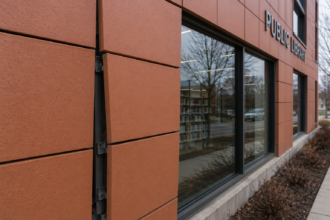
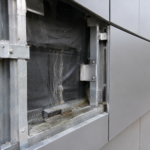
A mid-rise mixed-use project in Minneapolis reaches the air barrier inspection phase and the fluid-applied membrane over the mineral wool CI is peeling in sheets across three full elevations. The product passed all lab submittals.
The installer followed the manufacturer’s instructions. Nobody on the project team can explain why.
The root cause, identified six weeks and $140,000 in remediation costs later, is a single line buried in the board manufacturer’s data sheet: “wax-coated surface; prime before application of adhesive products. ” The specifier had written the fluid-applied WRB into the project manual without ever cross-referencing the CI board’s surface treatment.
That is not a fringe scenario. It is becoming a recurring pattern as mineral wool CI moves from niche application to standard practice on commercial facades.
Why Mineral Wool CI Is Suddenly Everywhere on Commercial Facades
ASHRAE 90.1-2022 Table 5. 5.
4 is the immediate driver. Prescriptive CI R-value requirements for steel-framed above-grade walls in climate zones 4 through 8 have climbed to levels that foam plastic boards struggle to meet cost-effectively when you account for fire-code compliance, intumescent detailing at penetrations and the IBC Section 2603.4 interior finish requirements that kick in when foam is left exposed.
Mineral wool CI sidesteps most of those constraints. It is vapor-open, which keeps the assembly drying to the exterior in cold climates without the vapor management gymnastics that closed-cell spray polyurethane demands.
Its inherent fire resistance satisfies insurance underwriters who have grown skeptical of foam-heavy facade assemblies after several high-profile cladding fires internationally.
The market uptake has been fast. Too fast for specifier familiarity to keep pace with product-specific installation variables.
Mineral wool CI is not a single product category with a single set of surface characteristics. Different manufacturers produce boards with meaningfully different surface treatments and those differences directly affect the performance of every fluid-applied product applied over them.
ASHRAE 90.1-2022 created the demand signal. It did not create the specification literacy to go with it.
The Two Surface Treatments: What They Are and Why They Exist
Wax-coated boards arrive at the job site carrying a paraffin or microcrystalline wax release agent applied during production. The wax prevents boards from adhering to conveyor equipment and to each other during packaging and transport.
It is a manufacturing artifact, not a performance feature and the manufacturer has no reason to remove it before shipping. The wax remains on the board face that gets installed outboard of the sheathing, directly under the fluid-applied WRB.
Factory-primed boards are different in intent. Some manufacturers apply an acrylic or latex-based coating to one or both faces specifically to improve adhesion compatibility with fluid-applied membranes and adhesives.
That coating is a deliberate performance feature, not a byproduct of the production line. The primer consolidates the surface fiber matrix, raises surface energy into the range that fluid-applied membranes require for adequate wetting and provides a chemically receptive interface.
The distinction between a factory-primed face and a field-primed face also matters. A factory-applied primer is applied under controlled conditions to a clean, freshly manufactured surface.
A field-applied primer is applied to a board that has been transported, stored and potentially contaminated. The starting condition is not the same and the performance outcome is not guaranteed to be equivalent even when the same primer product is used.
The critical problem is that ASTM C612-22, the governing specification for mineral fiber block and board thermal insulation, says nothing about surface coatings or adhesion compatibility. The standard addresses thermal performance, dimensional tolerances, density and compressive resistance.
It does not establish any requirement or even a classification framework for surface treatments. That omission leaves the entire distinction to individual manufacturer data sheets, which vary in how prominently they disclose it.
A Type IA board per ASTM C612 from one manufacturer and a Type IA board from another manufacturer can have entirely different surface conditions with no indication of that difference in the specification reference. The ASTM type designation tells the specifier nothing about what will happen when a fluid-applied membrane contacts the board face.
Visual identification in the field is unreliable. Wax-coated and factory-primed boards can appear nearly identical under normal job site lighting.
A specifier or installer cannot distinguish them by sight alone without documentation in hand. Some experienced installers report that wax-coated boards have a faint sheen under raking light, but that observation is inconsistent across board densities and wax application rates.
It is not a reliable field test. A simple water drop test, where a few drops of water placed on the board face will bead on a wax-coated surface and absorb on a primed or untreated surface, takes less than ten seconds and provides a meaningful field indicator.
That test is not written into any standard specification language currently in wide use, but it should be. On a project where the boards arrive on a pallet with a single data sheet tucked under the shrink wrap, the absence of a documented field verification protocol is a specification gap that the job site cannot self-correct.
How Fluid-Applied Air Barriers Bond and Where Wax Breaks the Mechanism
Fluid-applied air barriers bond to substrates through a combination of mechanical adhesion, where the membrane penetrates surface micro-texture as it cures and chemical adhesion, where polar groups in the membrane formulation interact with the substrate surface. Both mechanisms require the membrane to wet the surface fully before curing begins.
Wetting requires adequate substrate surface energy.
Paraffin wax has a surface energy in the range of 25 to 30 mN/m. Most fluid-applied WRB formulations require substrate surface energy above 35 to 40 mN/m for adequate wetting.
Below that threshold, the membrane does not spread and penetrate; it beads or films, leaving only incidental contact rather than a true bond. The membrane cures in that configuration and appears intact to a visual inspection.
It is not intact. This is the specific characteristic that makes wax contamination so dangerous in practice.
A failed bond from inadequate surface energy looks identical to a successful bond during the application phase and for weeks afterward. The failure does not manifest until thermal cycling, wind load or moisture infiltration introduces stress at the interface.
The failure mode is adhesive, meaning it occurs at the membrane-to-board interface, not cohesive within the membrane itself. That distinction is the diagnostic signature.
When you pull the failed membrane and find clean board face on one side and clean membrane on the other, with no substrate fiber transfer, the failure is at the bond line. That points to surface contamination, not product defect and not applicator error.
Pull-off testing per ASTM D4541 will confirm it. Values below 4 psi on mineral wool CI substrates are a common failure threshold cited in fluid-applied WRB manufacturer technical literature and wax-contaminated boards routinely produce values below 1 psi even with correct application technique.
By contrast, properly primed mineral wool CI substrates with compatible fluid-applied membranes typically produce pull-off values in the 8 to 15 psi range, with cohesive failure within the board fiber matrix rather than adhesive failure at the interface. That cohesive failure mode, where board fibers transfer to the back of the pulled membrane, is the target outcome.
It confirms the bond exceeded the substrate’s own tensile strength.
Temperature compounds the risk in a way that controlled lab testing does not capture. Wax migrates to the board surface more aggressively as substrate temperature rises.
A board installed on a south-facing elevation in July, with surface temperatures potentially exceeding 120 degrees Fahrenheit, presents a meaningfully higher wax concentration at the surface than the same board tested at 72 degrees in a conditioning room. Summer installations on sun-exposed elevations carry higher risk.
That is a field variable the submittal process does not address. Projects in Minneapolis, Chicago or Detroit that begin facade installation in late spring and run through summer will see the highest-risk conditions on west and south elevations during peak afternoon hours.
A morning pull-off test on a shaded elevation does not represent conditions on a sun-loaded elevation four hours later on the same day.
What the Manufacturer Data Sheets Actually Say and Where Specifiers Stop Reading
The compatibility gap between fluid-applied WRBs and wax-coated mineral wool CI is a documentation problem as much as a chemistry problem. Most fluid-applied WRB manufacturers include substrate preparation language in their technical data sheets and published system approvals.
The language is often conditional and buried in footnotes rather than flagged at the top of the document. A specifier reviewing a product data sheet for a fluid-applied membrane is typically confirming that the product meets the specified vapor permeance, tensile strength and elongation requirements.
Reading substrate preparation footnotes for every potential CI substrate combination is not standard practice. It should be, but it is not.
Mineral wool CI board manufacturers disclose surface treatment in their data sheets, but the terminology is not standardized. “Wax-coated,” “release agent applied,” “prime before bonding” and “factory-primed face” are all in active use across different manufacturers’ literature.
A specifier writing a performance specification that names a fluid-applied WRB product type and a mineral wool CI board type by generic category has created an assembly where the compatibility of the two products is not verified by any document in the project file. The problem compounds when a project substitutes a specified CI board for an approved equal during procurement.
The substituted product may carry a different surface treatment than the originally specified board and the substitution review process rarely includes a cross-check of surface treatment compatibility with the fluid-applied WRB already in the submittal log.
ICC ES AC212, the acceptance criteria for water-resistive coatings used as water-resistive barriers over exterior sheathing, governs the evaluation reports that specifiers rely on to confirm product approvals. Those evaluation reports list tested substrate conditions.
The tested substrates frequently do not include wax-coated mineral wool surfaces. An evaluation report that lists mineral wool board as an approved substrate without specifying which surface condition was tested is not a compatibility confirmation.
It is a gap. Specifiers who treat an ICC ES evaluation report listing as a blanket approval for all mineral wool CI substrates are reading more into that document than the testing protocol supports.
The evaluation report reflects the condition of the boards submitted for testing by the WRB manufacturer. If the WRB manufacturer submitted factory-primed boards for testing, the resulting approval does not extend to wax-coated boards from a different manufacturer, regardless of how the substrate is described in the report.
Neither the WRB manufacturer nor the CI board manufacturer takes explicit ownership of the cross-product compatibility statement in their standard literature. That ownership void lands on the specifier.
Some WRB manufacturers will issue project-specific compatibility letters when asked directly, but that process requires the specifier to know the question needs to be asked, to ask it before the boards ship and to document the response in the project file. That sequence does not happen on most projects.
Field Conditions That Amplify the Risk
Job site storage is where the problem compounds. Mineral wool CI boards stored horizontally on pallets outdoors accumulate surface contamination from dust, form oil overspray, concrete splatter and construction traffic.
That contamination layers over the factory surface treatment and creates adhesion problems independent of whether the board left the plant wax-coated or primed. Boards should be stored vertically, covered and away from concrete work.
On a typical urban infill site, that standard is aspirational. Horizontal pallet storage is the default because it is faster to unload and stack.
The boards on the bottom of a horizontal stack are the last to be installed and the most contaminated by the time they reach the wall. On a project where the CI board installation runs over multiple weeks, the contamination profile of boards installed in week one versus week four can differ significantly even from the same delivery.
Concrete flatwork and foundation work running concurrently with facade installation introduces form oil and curing compound overspray that can travel considerable distances on a job site. A board stored 30 feet from an active concrete pour is not necessarily protected.
Form oil is a release agent with surface energy characteristics similar to wax. Its presence on a mineral wool CI board face creates the same adhesion failure mechanism as factory-applied wax and it is invisible under normal lighting conditions.
A water drop test on boards pulled from storage before installation takes less than a minute per board and catches this contamination before it is covered with membrane.
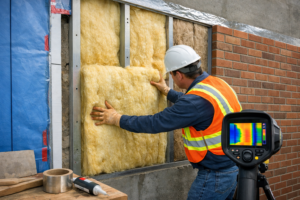
Sequence also matters. On steel-stud cavity wall assemblies, the CI boards are often installed in advance of the fluid-applied WRB by days or weeks, depending on the project schedule.
Extended exposure before membrane application allows additional surface contamination to accumulate and, in warm weather, allows wax migration to progress further. The specifier who writes a note requiring membrane application within 24 hours of CI board installation is adding a specification requirement that the schedule may not support but that the chemistry actually demands.
A more practical specification approach is to require field pull-off testing per ASTM D4541 immediately before membrane application begins on each elevation, regardless of elapsed time since board installation. That requirement does not constrain the schedule but does create a documented quality gate that catches contamination problems before they are sealed under the membrane.
Applicator training on mineral wool substrates is thinner than on gypsum sheathing or CMU. Most fluid-applied WRB installers have extensive experience on glass mat gypsum sheathing.
Mineral wool CI as a primary substrate is newer territory. The surface preparation steps, including priming protocols on wax-coated boards, are not embedded in standard installer practice the way they are for other substrates.
Field quality control depends on the installer reading the substrate-specific preparation notes, which assumes the installer knows to look for them. A pre-installation meeting that specifically addresses CI board surface treatment, field verification methods and primer requirements for the specified board product is not a standard agenda item on most projects.
Adding it costs nothing and creates a documented record that the installation team received substrate-specific guidance before work began.
The Specification Fix: What Actually Needs to Change
The standard specification approach of naming a fluid-applied WRB by ASTM performance class and a mineral wool CI board by ASTM C612 type, then relying on each manufacturer’s data sheet for installation guidance, does not close the compatibility gap. It creates it.
The specification needs to require one of two things. First, a manufacturer-issued joint compatibility letter that explicitly confirms the named fluid-applied WRB product is compatible with the named CI board product in its as-delivered surface condition, without field priming or with a specific field-applied primer named and specified.
Second, a tested system approval from the WRB manufacturer that lists the specific CI board product and surface condition as a tested substrate. A generic reference to “mineral wool board” in an ICC ES evaluation report does not satisfy this requirement.
The submittal package for the fluid-applied WRB should include a substrate compatibility matrix that cross-references every CI board product specified or approved for substitution on the project. That matrix does not exist as a standard submittal item in most specification sections today.
Writing it in as a required submittal creates the administrative mechanism that forces the compatibility question to be answered before materials arrive on site.
The Division 07 specification section covering fluid-applied air barriers should also include an explicit statement that approved substitutions for the CI board product require re-verification of WRB compatibility before the substitution is accepted. Procurement-phase substitutions are where compatibility documentation most commonly breaks down.
A board product approved as an equal on cost grounds may carry a different surface treatment than the originally specified product and the substitution review rarely triggers a re-check of the WRB compatibility documentation already in the file.
Field verification by ASTM D4541 pull-off testing at the start of each installation phase is best practice, not an optional add. Write it into the specification as a contractor-performed quality control requirement with a minimum acceptance threshold referenced from the WRB manufacturer’s technical literature.
Three pulls per elevation per day, documented. That protocol catches the problem before it covers three full elevations.
The cost of pull-off testing equipment rental and the time to perform and document three pulls per elevation per day is a fraction of one percent of the WRB installation cost. Against a $140,000 remediation scenario, the economics are not close.
Specifiers who treat pull-off testing as an owner-optional add are misreading where the cost risk sits.
What the Next Generation of Failures Will Look Like
The Minneapolis scenario will repeat on projects currently in design. The assemblies being specified today for IECC climate zone 5 and 6 projects, where ASHRAE 90.1-2022 Table 5.
5. 4 requires CI R-values of R-7.5 to R-11.
8 for steel-framed walls at the prescriptive path, are pushing designers toward thicker mineral wool CI boards from a wider range of manufacturers, some of whom entered the North American market recently and whose data sheet language has not been vetted against the installed base of fluid-applied WRB products common in this market. Thicker boards, in the 3-inch to 4-inch range needed to reach R-15 and above, also introduce new attachment hardware requirements that create additional penetrations through the WRB plane.
Each penetration is a location where the membrane must bond to both the board face and the fastener head or plate. A compromised bond at the field of the board is compounded at every penetration detail.
The four control layers in a cavity wall assembly, water, air, vapor and thermal, are interdependent. When the air control layer delaminates from the CI board because of a surface treatment incompatibility, the thermal control layer is now exposed to air movement at the board face, the water control function is compromised at every seam and penetration and the vapor control assumptions embedded in the hygrothermal analysis become invalid.
WUFI or THERM models built on the assumption of a continuous, adhered air barrier do not predict the moisture accumulation behavior of an assembly where that barrier has partially delaminated. The condensation risk calculations change.
The drying potential calculations change. The building science basis for the assembly specification becomes disconnected from the as-built condition in ways that are not visible from the exterior and not detectable without invasive investigation.
One overlooked line in a data sheet does not just cause a warranty callback. It invalidates the performance logic of the entire assembly.
The projects at highest risk are those where the CI board manufacturer is new to the North American market, where the WRB product was specified before the CI board was selected and where the substitution process during procurement changed one or both products without triggering a compatibility re-check. Those three conditions describe a significant share of commercial facade projects currently in construction.
Require the compatibility documentation before the boards ship to the site. That is when it costs nothing to fix.