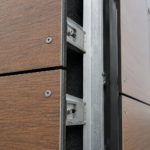
- A forensic investigation on a 14-year-old coastal Georgia building traced seven-figure veneer damage to value-engineered PVC-coated ties.
- Cavity wall ties are the sole structural connection between masonry veneer and backup wall making material selection a life-safety decision.
- PVC coatings fail predictably at mortar embedment zones through mechanical damage field bending and alkaline chemical attack.
- Type 316 stainless steel provides a self-repairing passive oxide layer that cannot delaminate and realistically meets a 50-year service life.
- Vague specification language like corrosion-resistant creates the substitution pathway that leads to failure and the fix is explicit alloy designation with no approved substitutions.
PVC vs. Stainless Steel Cavity Wall Ties
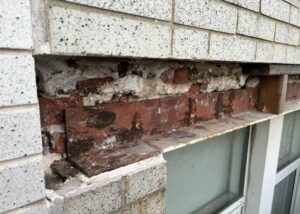
A forensic investigation on a 14-year-old coastal Georgia medical office building recently exposed what happens when a submittal review goes wrong. Spalled brick veneer and fractured mortar joints traced back to corroded PVC-coated carbon steel ties: ties that were substituted for specified stainless steel during value engineering.
The coating had delaminated at mortar embedment zones, leaving bare carbon steel cycling through chloride-laden moisture in an open cavity. The project is now facing a seven-figure remediation claim with no clear responsible party.
Nobody wins in that scenario. Not the owner, not the design team and not the contractor who thought they were saving money.
Why Cavity Wall Tie Material Selection Is a Structural Decision, Not a Budget Line Item
Cavity wall ties are the sole structural connection between masonry veneer and the backup wall. Full stop.
When they fail, the veneer becomes an unrestrained panel subject to wind pressure, seismic loading and differential movement with no mechanism to transfer those forces back to the structure. This is a life-safety issue, not a maintenance concern.
Ties perform three distinct structural functions: lateral wind load transfer, accommodation of differential movement between veneer and backup and veneer stability under seismic loading. IBC 2021 Section 1405.6 governs anchored masonry veneer requirements and establishes minimum anchor spacing and capacity thresholds that assume full cross-sectional integrity of the tie material.
TMS 402-22 Section 6.2 reinforces those anchor requirements. Neither standard contemplates a scenario where tie capacity degrades progressively over the building’s service life: they assume the specified material performs as designed from day one through the end of the design life.
Material corrosion directly reduces cross-sectional area and load capacity. This is not a surface appearance problem.
A tie that has lost 20% of its cross-section has lost 20% of its tensile and shear capacity, regardless of whether the veneer looks intact from the street. That capacity loss is invisible to a building inspector conducting a visual survey.
It does not show up in routine maintenance walkthroughs. It accumulates silently until a wind event or seismic load demand exposes the deficit in the worst possible way.
The cost-substitution logic driving PVC-coated selection typically focuses on first cost. Stainless steel ties cost more.
That is true. What that logic ignores is a 50 to 75-year design life during which a coating-dependent system must maintain perfect continuity under conditions specifically designed to destroy coatings.
The comparison is not stainless steel cost versus PVC-coated cost. The comparison is stainless steel cost versus PVC-coated cost plus the probability-weighted remediation expense across a multi-decade service life.
When you frame the decision that way, the value engineering calculation inverts completely. The design team’s obligation is to make that framing explicit before the substitution conversation starts, not after the forensic investigator arrives.
How PVC-Coated Carbon Steel Ties Are Manufactured and Where the System Is Vulnerable
PVC-coated ties start as cold-formed carbon steel wire or strap, then receive their coating through either extrusion or dip-coating processes. Both methods can produce acceptable coating thickness on a flat, undamaged substrate under controlled conditions.
The problem is that controlled conditions end the moment the product leaves the fabrication facility.
The industry term “coating holiday” refers to pinholes, voids and mechanical damage points in the coating film. These defects are introduced at every stage: fabrication tolerances, coil straightening, cutting operations, bundling for shipping, jobsite handling and installation.
A bundle of ties dropped from a scaffold or dragged across a pallet introduces dozens of abrasion points that are invisible to the naked eye but fully functional as corrosion initiation sites. There is no ASTM performance standard governing coating continuity or adhesion under mortar exposure for PVC-coated ties.
ASTM A153 establishes zinc coating requirements for hot-dip galvanized hardware, which at least provides a quantifiable baseline for that system. PVC-coated ties have no equivalent.
Specifiers are accepting a coating-dependent corrosion protection system with no standardized performance verification requirement, which means there is no objective pass-fail criterion at the point of delivery or installation.
Mortar embedment is the specific failure zone that concerns me most. Mortar shrinkage during cure creates microcracking at the tie-mortar interface.
The alkaline chemistry of portland cement mortar, with a pH typically ranging from 12 to 13, degrades PVC over time through a saponification-adjacent chemical attack on the plasticizers that keep the coating flexible. Once plasticizers leach out, the coating becomes brittle and loses its adhesion to the steel substrate.
Mechanical abrasion during installation strips coatings at the embedment point before the mortar even sets. These are not edge cases; they are predictable outcomes of the installation process that any experienced mason could describe from direct observation.
Field bending compounds the problem significantly. Masons routinely bend ties to adjust for coursing variations, wall thickness tolerances and backup wall irregularities.
Every bend at a tight radius fractures the coating and creates a direct corrosion initiation site at the most structurally stressed location on the tie. The bend point concentrates both mechanical stress and corrosion attack simultaneously, which is precisely the combination that produces accelerated cross-sectional loss.
A tie bent in the field to accommodate a 3/8-inch coursing adjustment has a compromised coating at the exact point where tensile demand is highest under lateral wind loading.
The Corrosion Mechanism: From Coating Breach to Structural Capacity Loss
Once bare carbon steel is exposed at a coating holiday, the electrochemical corrosion pathway is straightforward and relentless. Moisture and oxygen drive anodic dissolution of the iron substrate.
In coastal environments, chloride ions from marine aerosol penetrate the open drainage cavity and dramatically accelerate the reaction rate. Sulfate compounds from atmospheric pollution produce a similar acceleration in urban environments.
The cavity assembly, designed to drain and dry, also provides a continuous moisture source for active corrosion.
The volumetric expansion of iron oxide corrosion products is the mechanism that destroys surrounding masonry. Ferrous corrosion products expand 2 to 10 times their original volume depending on oxidation state.
That expansion generates internal pressure within the mortar bed joint, fracturing the mortar and initiating the veneer cracking that eventually becomes visible spalling. By the time a building owner sees cracked mortar joints, the underlying tie has typically been corroding for years.
The visible distress is a lagging indicator, not a leading one. In my experience reviewing these failures, the corrosion timeline from coating breach to visible veneer distress runs 5 to 12 years depending on exposure severity, which means a building showing symptoms at year 14 likely had active corrosion by year 4 or 5.
Cross-sectional area loss of 15 to 20% can reduce tie tensile and shear capacity below design minimums for wind uplift loads specified under IBC 2021 Section 1405.6. Research cited in the Masonry Society Journal indicates corroded ties in coastal exposures can lose 30 to 40% cross-sectional area within 10 to 15 years under moderate chloride exposure conditions. That is not end-of-life performance degradation; that is mid-service failure in a building designed for 50-plus years.
A tie system that reaches structural inadequacy at year 12 in a building with a 60-year design life has failed to perform for 80% of its intended service period.
Climate amplifiers matter here. IECC Climate Zones 1 through 3 along the Gulf Coast and Atlantic seaboard combine high ambient humidity with chloride exposure.
Climate Zones 5 through 7 add freeze-thaw cycling, which drives moisture infiltration through the veneer and into the cavity through capillary action and pressure differentials. ASTM C1601 field water penetration testing consistently demonstrates that masonry veneers in these zones experience sustained wetting periods that maintain the moisture conditions necessary for active corrosion.
A project I reviewed in coastal South Carolina showed tie corrosion consistent with continuous wetting exposure despite a properly installed drainage mat and weep system, because the cavity humidity alone was sufficient to sustain the electrochemical reaction between wetting events. BRE Digest 401, while UK-sourced, provides supporting corrosion rate data that aligns with North American forensic findings in comparable exposure conditions and gives specifiers a useful reference framework when U.
S. data sets are limited.
Stainless Steel Tie Performance: Alloy Selection, Standards and Real-World Durability
Alloy selection matters as much as the decision to specify stainless steel. Type 304 stainless is appropriate for interior or low-exposure applications.
It is not the right specification for most commercial masonry veneer assemblies in coastal or freeze-thaw environments. Type 316 stainless adds molybdenum to the alloy at approximately 2 to 3% by weight, which significantly improves resistance to chloride-induced pitting and crevice corrosion.
The molybdenum stabilizes the passive oxide layer under chloride attack conditions where 304 would begin to pit. For projects in IECC Climate Zones 1 through 3 with coastal exposure or any project within a mile of tidal water, 316 is the correct specification.
Specifying 304 in those environments is a compromise that will eventually show up in a forensic report, typically around year 20 to 30 when pitting corrosion has progressed far enough to produce visible distress.
The corrosion resistance of stainless steel derives from a passive chromium oxide layer that forms spontaneously on the alloy surface and self-repairs when damaged. This is not a coating.
It cannot delaminate, holiday or be abraded off during installation. Field bending does not compromise it.
Mortar alkalinity does not attack it. The passive layer re-forms in the presence of oxygen, which means that even a scratched or mechanically damaged stainless tie surface recovers its corrosion protection automatically under normal atmospheric conditions.
That self-repair mechanism is the fundamental performance difference between stainless steel and any coating-dependent system and it is the reason stainless ties can realistically meet a 50 to 75-year service life requirement without maintenance intervention.
Two conditions can compromise the passive layer: crevice corrosion in low-oxygen environments with high chloride concentration and incorrect alloy selection that puts 304 into a 316-required exposure. Both are avoidable through proper specification.
Crevice corrosion risk is managed by ensuring ties are not in continuous contact with standing water in sealed cavities, which a properly designed drainage cavity prevents. Alloy selection risk is managed by writing the alloy designation explicitly into the specification and making it non-negotiable at submittal review.
The cost differential is real. Stainless steel ties typically run 3 to 5 times the material cost of PVC-coated alternatives.
In practice, ties represent less than 0.5% of total project cost in most masonry veneer assemblies. On a $4 million masonry veneer scope, the entire tie material budget might be $15,000 to $20,000. The premium for upgrading to stainless steel in that scenario is $10,000 to $15,000.
That figure does not register as a meaningful budget item in the context of the overall project, but it consistently gets flagged during value engineering because it is a discrete, visible line item that appears easy to cut. Ties meeting ASTM A276 for wire-form products and ASTM A480/A480M for flat-rolled forms provide the baseline material verification that procurement teams and inspectors can confirm at delivery.
BS EN 845-1 tie classification criteria are worth referencing in forensic analysis because they provide a more granular framework for exposure-based material selection than current U. S.
standards, particularly in distinguishing between moderate and severe marine exposure categories.
Specification Disputes in the Field: How Substitutions Happen and Who Bears the Risk
The substitution pathway follows a predictable sequence. The design documents specify stainless steel ties.
The masonry subcontractor submits PVC-coated ties as a “comparable alternative. ” The submittal lands on a project manager’s desk during a busy phase.
The spec language says “corrosion-resistant ties” without defining the performance standard. The submittal gets stamped and returned.
Nobody runs a performance equivalency analysis because the spec language did not require one and the reviewer did not have a clear technical basis to reject it. The ties go in the wall.
The building gets occupied. Fourteen years later, a forensic investigator is coring through brick veneer trying to reconstruct a submittal log.
This is the specification language gap that creates most of the liability exposure I see in forensic work. “Corrosion-resistant” is not a performance standard.
It is an adjective. PVC-coated carbon steel is technically corrosion-resistant in the sense that the coating provides some degree of protection under some conditions for some period of time.
That description is accurate and completely useless as a specification requirement. Without referencing a specific alloy, ASTM designation or minimum service life requirement, the language creates ambiguity that contractors will exploit, not out of bad faith, but because their job is to build the project within budget.
Vague specification language is an invitation to substitution and the design team that writes vague language owns a share of the outcome.
AIA A201-2017 General Conditions Section 3.12 places submittal responsibility on the contractor and requires that substitutions be submitted as such rather than as equivalents. In practice, the distinction between “substitution” and “equivalent” is rarely enforced at the submittal review stage.
A contractor who submits PVC-coated ties against a stainless steel specification and labels the submittal “equivalent” is technically in violation of Section 3.12 if the materials are not equivalent. But that argument is cold comfort in litigation if the design professional’s stamp is on the returned submittal.
CSI MasterFormat Section 04 20 00 specification language best practices recommend explicit material designations with ASTM references rather than performance adjectives, precisely because adjectives do not survive a substitution review. The specification should name the alloy, cite the applicable ASTM standard and state explicitly that no substitutions are approved.
That language closes the gap.
Liability allocation after failure is genuinely complicated. The design professional carries exposure if the submittal was approved without adequate review, particularly if the substituted material was clearly non-equivalent to the specified product.
The contractor carries exposure if the substitution was made without approval or if installation practices damaged the coating in ways that accelerated failure. The owner carries exposure if value engineering was owner-directed and documented as such, because that documentation can shift the design team’s liability significantly.
In one South Carolina case I reviewed, the owner’s written direction to reduce tie costs by 40% was the single most important document in the liability analysis. Forensic investigations rarely recover complete submittal logs.
That absence of documentation is itself a liability amplifier, because it leaves every party’s account of the approval process unverifiable and forces the dispute into a he-said-she-said posture that benefits nobody except the attorneys.
Closing: What the Specification Should Actually Say
The Georgia case is not unusual. I have reviewed similar failures in South Carolina, Florida and along the Texas Gulf Coast in buildings ranging from 8 to 22 years old.
The pattern is consistent: PVC-coated ties in high-humidity or coastal exposures, coating failures at mortar embedment zones, progressive cross-sectional loss and eventual veneer instability. The buildings look different.
The owners are different. The contractors are different.
The specification language that allowed the substitution is nearly identical in every case.
The specification fix is straightforward. For any project in IECC Climate Zones 1 through 3 or any project with coastal exposure regardless of climate zone, the masonry tie specification should read: Type 316 stainless steel, wire ties conforming to ASTM A276, strap ties conforming to ASTM A480/A480M, with no approved substitutions.
Not “corrosion-resistant. ” Not “stainless steel or approved equal.
” No approved substitutions. That language needs to appear in the specification section, in the submittal requirements and in the general notes on the masonry drawings.
Redundancy across documents is not over-engineering; it is the only way to ensure the requirement survives the submittal review process intact when the project manager reviewing the submittal has not read the full specification.
If an owner or contractor pushes back on cost, the conversation is simple. The material premium is less than 0.5% of the masonry veneer assembly cost.
The remediation cost for a failed tie system in a mid-size commercial building starts at six figures and scales with facade area. A 40,000-square-foot brick veneer facade with failed ties requires full veneer removal, backup wall inspection, new tie installation and veneer reconstruction.
That scope does not come in under seven figures in today’s construction market. The risk transfer math is not close and any owner who understands the comparison makes the right decision.
Specify the alloy. Lock the submittal language.
Make the substitution pathway explicitly unavailable. That is the only specification approach that survives a 50-year design life in a challenging exposure environment.