- Forensic investigation of a seven-year-old Gulf Coast tower found fractured 304 stainless anchors behind limestone cladding, triggering a remediation cost exceeding the original cladding contract.
- Specifying ‘stainless steel’ without an alloy grade designation is a systematic error that lets contractors legally install 304 in environments that demand 316L or duplex 2205.
- Chloride-induced pitting and crevice corrosion at weld heat-affected zones can reduce anchor cross-section to structural failure within five to ten years in C4 coastal environments.
- IBC 2021 Section 1403.5 delegates material selection to the design professional, meaning code compliance does not protect specifiers when undergraded anchors fail.
- Specifying 316L by UNS number with passivation per ASTM A967 and mill certification submittals closes the liability gap that vague specifications leave wide open.
Stainless Steel Facade Anchors: Stop Specifying 304 in Coastal Zones
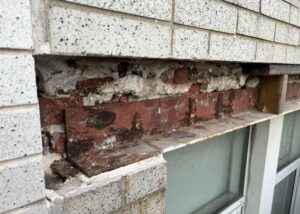
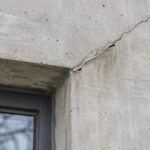
A forensic investigation on a seven-year-old mixed-use tower in a Gulf Coast city revealed rust staining bleeding through limestone panel joints. The source was not the stone.
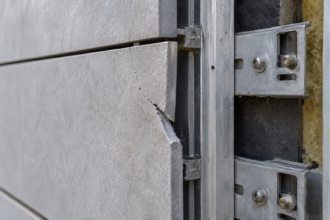
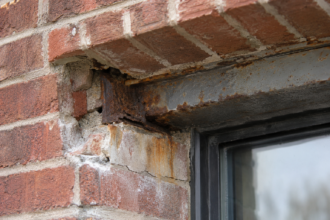
The embedded 304 stainless steel anchors behind the cladding had lost measurable cross-section and two had fractured at the weld toe. The specification read “stainless steel anchors” with no grade designation and the contractor defaulted to 304 because it was cheaper and no one told him otherwise.
Seven years. Two fractured anchors.
A remediation scope that will cost more than the original cladding contract.
That project is not an anomaly. It is a pattern.
The Corrosion Grade Problem Nobody Talks About at Bid Time
The phrase “stainless steel” in a specification is functionally meaningless without an explicit alloy grade designation. Architects and specifiers use it constantly and contractors read it as permission to install the cheapest compliant product on the market.
That product is almost always 304.
ASTM A240/A240M defines the compositional difference precisely: 304 contains approximately 18% chromium and 8% nickel with no molybdenum. 316 contains approximately 16% chromium, 10% nickel and 2 to 3% molybdenum.
That molybdenum addition is not a minor refinement. It fundamentally changes how the alloy resists chloride attack by stabilizing the passive oxide film under conditions where 304’s film breaks down and does not regenerate.
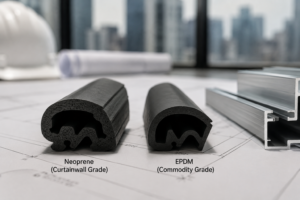
The industry defaults to 304 because it is the commodity grade. It costs less.
It is stocked at every metals distributor. Fabricators quote it automatically when the specification gives them no reason to do otherwise.
During value engineering, it survives because the specification gave the contractor no basis to reject it. A contractor presented with a substitution request for 316 and a specification that says only “stainless steel” has no contractual obligation to upgrade.
The substitution is not a substitution at all. It is a compliant bid.
This is a systematic specification error. It is not a product defect and it is not an installation failure.
The product performed exactly as its chemistry predicts in a chloride-rich environment. The specification failed to match the product to the exposure.
That distinction matters enormously when the remediation invoice arrives and the project team begins reconstructing the decision chain. The specifier who wrote “stainless steel” without a grade designation will find that the contractor, the fabricator and the material supplier all acted within the terms of the contract.
The liability does not distribute evenly in that scenario.
How Chloride-Induced Corrosion Actually Destroys an Anchor
Pitting corrosion initiates when chloride ions penetrate the passive oxide film at surface discontinuities, including grain boundaries, inclusions and surface scratches from fabrication. Once a pit initiates, the local chemistry inside the pit shifts: the anodic dissolution reaction lowers pH and concentrates chloride ions, which accelerates further dissolution.
The process is autocatalytic. The pit deepens faster than it widens and the surrounding passive surface can appear intact while the anchor is losing structural section from the inside of the defect.
Crevice corrosion compounds this problem at every anchor-to-bracket interface and at grout pocket boundaries. Geometry matters here.
A tight crevice depletes oxygen from the trapped solution while chloride ions migrate in to maintain charge balance. The result is an aggressive local chemistry that attacks 304 even when the bulk chloride concentration in the surrounding environment would not initiate pitting on an open surface.
Weld heat-affected zones are the most dangerous initiation sites in fabricated anchor assemblies. During welding, chromium carbides precipitate at grain boundaries in the HAZ, depleting the local chromium concentration below the approximately 10.5% threshold required to maintain a passive film.
This sensitization creates a metallurgically vulnerable band around every weld. In 304 anchors in marine environments, pitting initiation at HAZ sites in splash zones has been documented within 18 to 36 months of installation.
Structural cross-section loss sufficient to affect load capacity follows within 5 to 10 years.
The failure mode is particularly dangerous in embedded anchor configurations because the corrosion is invisible during routine facade inspection. An inspector examining the exterior face of a stone or terracotta cladding system sees no evidence of distress until rust bleed-through stains the panel joints or a panel shifts.
By the time staining is visible, the anchor behind it has typically been corroding for years. The staining is not the beginning of the problem.
It is a late-stage indicator that the structural section is already compromised.
ASTM G48 provides the laboratory basis for understanding why 304 fails earlier than 316. Method A testing exposes specimens to ferric chloride solution and 304 initiates pitting at significantly lower temperatures than 316 under identical test conditions. The critical pitting temperature differential is not marginal.
It reflects the real-world performance gap that shows up in forensic investigations. Method B testing, which evaluates crevice corrosion resistance, shows an even wider performance gap between the two grades, which directly corresponds to the anchor-to-bracket interface conditions present in every facade assembly.
Defining the Exposure Zones That Demand an Upgrade
ISO 9223:2012 classifies atmospheric corrosivity into categories C1 through CX, with Table 1 defining chloride deposition rate thresholds across salinity categories S0 through S3. Category C4 begins at chloride deposition rates above 60 mg/m²/day. Category C5-M encompasses marine environments with deposition rates exceeding 300 mg/m²/day.
Anchors embedded in cladding assemblies within 1,000 meters of tidal saltwater typically fall into C4 or C5-M depending on prevailing wind direction, topography and facade orientation.
That 1,000-meter threshold is a starting point, not a hard boundary. A west-facing facade on a building 800 meters from the Gulf of Mexico in a location with prevailing onshore winds will accumulate chloride at rates that exceed a north-facing facade at 400 meters in a sheltered bay.
Specifiers need to evaluate actual deposition conditions, not apply a fixed radius. ISO 9223 Annex A provides guidance on estimating deposition rates from environmental data and some coastal jurisdictions have published regional corrosivity maps that specifiers can reference when site-specific deposition testing is not feasible.
When in doubt, assume the higher category and specify accordingly. The cost of upgrading from 316 to duplex 2205 on a typical anchor package is a fraction of a percent of the cladding contract value.
The cost of remediating a failed anchor system is not.
De-icing salt environments receive less attention than coastal exposure but produce comparable anchor damage. Parking structures, grade-level facades adjacent to roadways and bridge abutment cladding in northern climates accumulate chloride-laden melt water at anchor locations throughout the winter season.
The exposure is cyclical rather than continuous, but chloride concentration at anchor points during freeze-thaw cycling can reach levels that initiate pitting in 304 within a few seasons. Chicago and Minneapolis forensic investigations on parking structure cladding have documented 304 anchor failures within eight to twelve years of installation in conditions that would not register as marine exposure under ISO 9223 but produce chloride deposition rates at anchor locations that rival C4 coastal conditions.
Splash and spray zones demand separate treatment from atmospheric zones. An anchor assembly at a podium deck waterline or behind an open-joint rainscreen at grade faces direct wetting with chloride solution.
An anchor at the 20th floor of the same building in the same city faces a fundamentally different exposure. Treating the entire building envelope as a single corrosion zone is a specification error that either over-spends on the upper floors or under-protects the lower assembly.
A zone-differentiated anchor specification, with 316L above the splash zone and duplex 2205 at grade-level and podium conditions, is both technically correct and cost-rational. It concentrates the material premium where the exposure demands it.
What the Codes and Standards Actually Require and Where They Fall Short
IBC 2021 Section 1403.5 requires corrosion-resistant fasteners for exterior applications. Read that language carefully.
It establishes a performance intent without defining the alloy grades that satisfy it. The code delegates material selection to the design professional, which means the specifier carries the liability for grade adequacy in a given exposure environment.
AAMA TIR-A9 addresses material selection for aluminum curtain wall systems but does not mandate stainless steel grades for embedded anchors. ASTM A1082/A1082M covers high-strength stainless steel bolts and provides mechanical property requirements, but it does not prescribe environmental suitability criteria by exposure zone.
A contractor can supply A1082-conforming 304 bolts and claim full code and standard compliance while installing anchors that will corrode to structural inadequacy within a decade in a C4 environment.
AAMA 501.2 and AAMA 503 address field quality assurance for curtain wall and storefront systems but contain no anchor alloy verification requirements. A project can pass every AAMA field test on record and still have 304 anchors corroding behind the cladding.
The testing framework was not designed to catch this failure mode. ASTM C1242, which covers the design and installation of stone cladding systems, references corrosion resistance as a design consideration but does not specify minimum alloy grades for embedded anchors in chloride environments.
The standard literature, taken as a whole, creates a performance obligation without providing the prescriptive grade requirements that would make that obligation enforceable at the contractor level.
This is the liability gap. Code compliance does not equal corrosion adequacy.
Specifiers who rely on minimum code language in chloride-exposed facade assemblies are not protected by that language when the anchors fail. The forensic record on Gulf Coast and Atlantic seaboard buildings is consistent: the specification said “stainless steel,” the contractor supplied 304, the code was technically satisfied and the anchors failed anyway.
The liability sits with the specifier who did not designate the grade.
Write the grade into the specification. Every time.
No exceptions for coastal or de-icing salt exposure zones.
The Case for 316, Duplex 2205 and Super Duplex Grades
Grade selection should follow the pitting resistance equivalent number (PREN), calculated as Cr + 3.3Mo + 16N. This number provides a comparative index of chloride resistance across alloy families.
316 (UNS S31600) carries a PREN of approximately 24 to 26. The molybdenum addition raises the critical pitting temperature and makes 316 appropriate for C4 atmospheric exposure in most coastal facade applications above the splash zone. For the majority of mid-rise and high-rise coastal buildings where anchors are embedded in cladding assemblies above grade, 316 is the correct minimum specification.
The cost premium over 304 is real but modest relative to the remediation exposure it prevents. On a typical 200-unit residential tower with a stone cladding system, the incremental material cost of upgrading all embedded anchors from 304 to 316L runs in the range of $8,000 to $15,000 depending on anchor count and configuration.
A single panel drop event or a full anchor replacement program on the same building costs orders of magnitude more.
Duplex 2205 (UNS S32205) carries a PREN of approximately 35 and offers higher yield strength than either 304 or 316. The strength advantage allows reduced section sizes in some anchor geometries, which partially offsets the material cost premium. More importantly, duplex 2205 provides substantially better resistance to stress corrosion cracking, which is relevant in anchor assemblies subject to sustained tensile load in chloride environments.
Specify duplex 2205 for C5-M exposure, splash zone applications, open-joint rainscreen assemblies at grade and any anchor configuration that creates crevice geometry at the bracket interface. The duplex microstructure, approximately equal parts austenite and ferrite, also reduces the sensitization risk at weld HAZ locations compared to standard austenitic grades, which is a meaningful fabrication advantage in anchor assemblies with multiple weld connections.
Super duplex 2507 (UNS S32750) carries a PREN exceeding 40 and is appropriate for direct marine immersion or severe splash zone conditions. The cost premium is significant, often two to three times the material cost of duplex 2205 for equivalent section sizes.
Reserve it for high-consequence anchor configurations where section loss would produce a life-safety failure mode rather than a cosmetic or serviceability failure. Podium-level anchors on occupied pedestrian areas, anchor assemblies at building entries and any configuration where panel drop would endanger building occupants or the public are the appropriate candidates for super duplex specification.
Weld Quality and Post-Fabrication Treatment Are Not Optional
Grade selection solves half the problem. Fabrication practice solves the other half.
Sensitization in the HAZ is not inevitable. Low-carbon variants, specifically 316L (UNS S31603) and 304L (UNS S30403), reduce carbide precipitation during welding by limiting carbon content to 0.03% maximum.
For fabricated anchor assemblies with field or shop welds, specify the L-grade variant. The price difference between standard and L-grade material is negligible at the anchor assembly scale, typically less than 2% of the fabricated component cost and the metallurgical benefit at the HAZ is not marginal.
It directly addresses the most common initiation site in fabricated anchor failures.
Passivation after fabrication removes free iron and other surface contaminants introduced during machining, grinding and handling. ASTM A967 covers chemical passivation treatments for stainless steel parts.
Passivation per ASTM A967 Method C1 or nitric acid methods restores the chromium-rich passive film at the surface and at the HAZ. It is not expensive relative to the anchor assembly cost.
Specifiers who require 316L and passivation per ASTM A967 on fabricated anchor components are specifying to the actual failure mode, not to a generic material category. Require the fabricator to provide a certificate of conformance documenting the passivation treatment, the method used and the date of treatment.
That documentation creates an auditable record that matters if the assembly is ever subject to forensic investigation.
Surface condition at installation matters as well. Embedded anchors that contact carbon steel formwork, rebar or tools pick up iron contamination that initiates rust staining and can seed pitting.
This contamination is not theoretical. It is routine on active construction sites where stainless and carbon steel components are handled in the same work areas.
Require stainless steel handling procedures in the specification, including dedicated storage areas, non-carbon-steel lifting hardware and prohibition on grinding or cutting carbon steel within the stainless anchor installation zone. Verify these procedures during pre-installation meetings and document them in the meeting minutes.
A fabricator who passivates to ASTM A967 and then ships the anchors in the same crate as carbon steel hardware has negated the passivation treatment before the components reach the site.
Specifying Correctly Before the Next Coastal Project Goes to Bid
The forensic pattern on coastal facade failures is clear enough that continued grade omission in anchor specifications is no longer a defensible practice. The combination of rising coastal construction volume, documented failure timelines of five to ten years and the direct liability exposure created by IBC 2021 Section 1403.5’s delegation of material selection to the design professional creates a straightforward professional obligation.
Specify 316L as the minimum for all exterior facade anchors in ISO 9223 C4 environments. Specify duplex 2205 at grade-level assemblies, splash zones, open-joint rainscreen conditions and any anchor configuration with inherent crevice geometry.
Require passivation per ASTM A967 on all fabricated assemblies. Designate the grade in the specification by UNS number, not by common name alone, because “316” without the UNS designation leaves room for substitution with non-conforming material.
Add a submittal requirement for mill certifications and passivation certificates of conformance. Mill certifications verify that the alloy chemistry meets the specified composition, including the molybdenum content that distinguishes 316 from 304. Without that submittal requirement, the specification grade designation is unenforceable in the field because there is no verification mechanism between the written requirement and the installed product.
Include a substitution clause that explicitly prohibits downgrading anchor alloy grades during value engineering without written approval from the specifier of record. Value engineering pressure on anchor grades is predictable on coastal projects and a specification that does not anticipate and prohibit it will lose the grade designation at the worst possible moment in the project schedule, when the contractor is under cost pressure and the design team is managing a hundred other open items.
The clause does not need to be long. It needs to be unambiguous.
The building that prompted this article is seven years old. The remediation scope is still being negotiated.
The specification that caused it was two words long: “stainless steel. ” Do not write that specification again.