- The 2021 IBC tightened exterior wall finish requirements for buildings over 40 feet, directly affecting HPL facade specifications.
- ASTM E84 Class A ratings do not predict full-scale facade fire behavior and are insufficient for mid-rise and high-rise compliance.
- NFPA 285 tests entire wall assemblies and a passing result applies only to the exact configuration that was tested.
- Swapping insulation type, WRB product or cavity depth can invalidate a tested assembly without anyone flagging it as a compliance issue.
- Specifiers can prevent costly field substitution errors by naming tested components as non-substitutable in Division 07 specifications.
In 2021, the International Building Code updated Section 1402.5 to tighten exterior wall finish requirements for buildings over 40 feet in height, directly affecting the specification of combustible cladding materials including high-pressure laminate panels. The revision caught several active projects mid-design, forcing costly material substitutions and schedule delays.
For building envelope consultants, this moment crystallized a persistent gap: HPL panels are widely specified for their aesthetics and durability, yet their fire performance characteristics remain poorly understood at the point of specification.
What High-Pressure Laminate Panels Actually Are: And Why Fire Behavior Starts at the Material Level
HPL panels are manufactured by stacking resin-impregnated kraft paper layers, bonding them under high heat and pressure and finishing the surface with a decorative layer that can replicate wood grain, solid color or stone texture. The result is a dense, dimensionally stable sheet product that handles moisture and UV exposure well enough to justify its widespread use in ventilated rainscreen assemblies.
Specifiers frequently conflate HPL with compact laminate, thermally modified wood and aluminum composite material. These are not interchangeable categories.
ACM uses a thermoplastic polyethylene core between aluminum skins; compact laminate is essentially thick HPL without a substrate; thermally modified wood is a solid wood product. Each behaves differently in fire and substituting one for another mid-project without re-evaluating fire performance is a specification error with real consequences.
A project team that approves a compact laminate substitution for a specified HPL product because both are “laminate panels” has introduced an untested variable into the assembly without recognizing it as one. The compact laminate product may be thicker, carry a different resin formulation and have no NFPA 285 test history in the proposed assembly configuration.
The resin binder governs fire behavior more than any other material variable. Phenolic resins generally outperform melamine resins in fire testing, but formulations vary significantly across manufacturers and even across product lines within a single manufacturer’s catalog.
A manufacturer may offer both a standard HPL line and a fire-retardant HPL line; the FR designation does not mean those products share fire test results or that one can substitute for the other in a tested assembly. Panel thickness, typically ranging from 6mm to 13mm, also matters: thicker panels carry more fuel load.
A 13mm panel contains roughly twice the combustible mass per square foot of a 6mm panel, which affects both ignition behavior and the duration of fuel contribution during a fire event. Attachment method and substrate type influence how heat transfers through the assembly during a fire event.
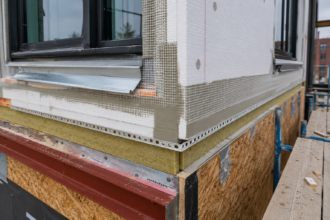
A panel mechanically fastened through a continuous insulation layer to a steel stud framing system transfers heat differently than the same panel adhered to a concrete substrate and those differences show up in test outcomes.
ASTM E84 is the test most specifiers encounter first. Know its limitations before you rely on it.
The Core Question: Are High-Pressure Laminate Panels Fire-Resistant?
HPL panels are not inherently fire-resistant. That statement needs to stand on its own because the specification errors that flow from misunderstanding it are expensive and sometimes dangerous.
“Fire-resistant” describes a rated assembly characteristic, specifically the ability of a complete assembly to contain fire for a defined period as measured under ASTM E119. “Fire-retardant” describes a material property or surface treatment that reduces flame spread and smoke development. Conflating these two terms produces specifications that appear compliant on paper while delivering assemblies that have never been tested as systems.
A specification that calls for “fire-resistant HPL” without defining which standard governs that designation is not a specification; it is an open question that will be answered differently by every product representative who reads it.
FR-grade HPL products exist. Manufacturers achieve reduced flame spread through modified resin systems, intumescent coatings or both.
These products can achieve ASTM E84 Class A ratings (Flame Spread Index below 25, Smoke Developed Index below 450), which satisfies many interior finish requirements and provides a useful baseline for exterior applications. Some manufacturers publish E84 results prominently in their marketing materials and specifiers reasonably interpret a Class A rating as evidence of strong fire performance.
The problem is that a panel’s standalone ASTM E84 result does not predict its behavior in a full-scale facade fire. The tunnel furnace test that produces E84 results exposes a horizontal sample to a controlled ignition source under conditions that do not replicate vertical flame propagation across a multi-story exterior wall with an air cavity behind the cladding.
A product that earns a Class A E84 rating can still contribute to rapid vertical flame spread in a facade assembly, depending on what is behind it.
The Grenfell Tower fire in 2017 did not involve HPL; it involved ACM panels with polyethylene cores. But the regulatory response it triggered worldwide was a direct acknowledgment that combustible cladding systems had been specified and approved without adequate full-scale testing.
That lesson applies directly to HPL specification practice today. Post-Grenfell reviews in the United Kingdom, Australia and Canada each identified a common pattern: panel-level material data was treated as sufficient evidence of system-level fire performance and no one in the approval chain required full-scale assembly testing.
North American code development absorbed that finding and the 2021 IBC cycle reflects it.
Code compliance for HPL on mid-rise and high-rise buildings runs through NFPA 285 assembly testing, not through panel-level material data sheets. IBC Section 1402.5 (2021) makes this explicit for buildings over 40 feet.
The Testing Landscape: Which Standards Actually Matter for Facade Applications
Four test standards define the compliance framework for HPL facades in North America and they are not interchangeable.
ASTM E84 measures surface burning characteristics: Flame Spread Index and Smoke Developed Index on a 10-inch by 24-foot sample in a horizontal tunnel furnace. It was designed for interior finish materials.
Applying it as the sole fire performance criterion for an exterior facade assembly is technically insufficient and, on taller buildings, likely non-compliant with IBC. The test’s horizontal orientation, fixed ignition source and enclosed chamber conditions do not replicate the thermal exposure or airflow dynamics of a ventilated rainscreen cavity under fire conditions.
AHJs in jurisdictions that have adopted the 2021 IBC are increasingly flagging submittals that cite only E84 results for exterior wall applications on buildings over 40 feet and the correction process at that stage is time-consuming.
NFPA 285 is the test that actually matters for multi-story exterior wall assemblies. It evaluates flame propagation across a full-scale two-story wall assembly under a realistic fire exposure scenario, measuring vertical and lateral flame spread across the exterior face and through the assembly cavity.
The test apparatus simulates a fire originating in a room on the lower floor, venting through a window opening and impinging on the exterior wall assembly above. This exposure condition is specifically designed to evaluate the risk that a facade assembly will carry fire vertically from floor to floor, which is the failure mode that produces the most severe life-safety consequences in multi-story building fires.
The test evaluates the interaction between the HPL panel, insulation, air and vapor barrier and substrate as an integrated system. This is the consequential distinction: NFPA 285 tests assemblies, not materials.
A panel that passes NFPA 285 as part of one assembly configuration has not demonstrated compliance in any other configuration.
ASTM E119 measures fire resistance of building construction assemblies, specifically their ability to contain fire and maintain structural integrity for rated periods. This standard becomes relevant when HPL is incorporated into assemblies required to carry a fire-resistance rating, which is less common in rainscreen applications but does arise in certain occupancy types.
A Type III building with an exterior wall required to carry a two-hour fire-resistance rating presents a situation where both E119 compliance for the rated assembly and NFPA 285 compliance for the exterior finish system may be simultaneously required and those requirements must be reconciled in the assembly design.
FM 4880 and UL 1040 are large-scale fire tests for insulated wall panels. Insurers and authorities having jurisdiction on certain project types, particularly industrial and warehouse occupancies, may require compliance with one of these standards in addition to or instead of NFPA 285. FM 4880 is a Factory Mutual standard that evaluates fire propagation in insulated metal panel assemblies and is frequently required on projects where FM Global is the property insurer, regardless of occupancy type.
Specifiers on industrial or distribution facility projects should confirm insurer requirements before finalizing cladding selection, because FM 4880 compliance is a separate and sometimes more demanding requirement than NFPA 285 compliance.
NFPA 285 test reports are assembly-specific. Substituting mineral wool for polyisocyanurate insulation, changing air barrier product or adjusting cavity depth can invalidate a passing result.
Request the full test report. Verify every component against the tested assembly before specifying.
A compliance letter from a manufacturer is not a substitute for this verification.
IBC Section 1403.5 (2021) references NFPA 285:2019 as the applicable standard for exterior wall assemblies in Types I through IV construction.
How the IBC and NFPA 101 Govern HPL Facade Use by Building Type
IBC construction types I and II require non-combustible construction. HPL is a combustible material.
These two facts create the central compliance challenge for HPL on commercial and institutional projects and the resolution runs through a specific exception pathway rather than a blanket prohibition.
IBC Section 603.1 (2021) lists combustible materials permitted in Types I and II construction and establishes the conditions under which exterior wall finishes qualify for that exception. For HPL, the operative condition is demonstrated NFPA 285 compliance for the complete assembly.
This is the primary compliance route for HPL on high-rise and mid-rise commercial projects and it works provided the specified assembly has actually been tested and passes. The exception pathway is not self-executing; it requires documentation and that documentation must be submitted and accepted by the AHJ before installation begins.
Projects that proceed on the assumption that a manufacturer’s compliance letter satisfies this requirement frequently encounter permit holds that could have been avoided with earlier AHJ coordination.
Types III through V construction carry progressively less restrictive requirements for exterior wall finishes, which is why HPL appears more frequently and with less documentation scrutiny on low-rise wood-frame projects. That reduced scrutiny is not always appropriate; occupancy type and local amendments can impose requirements that exceed the base IBC regardless of construction type.
A three-story Type V-B wood-frame multifamily project in a jurisdiction that has adopted California Building Code amendments, for example, faces exterior wall finish requirements that are meaningfully more restrictive than the base IBC would suggest. Treating construction type as the only variable in a compliance analysis misses the occupancy and jurisdiction layers that frequently control the outcome.
Healthcare (Group I-2), high-rise residential (Group R-1 and R-2) and educational (Group E) occupancies attract additional AHJ scrutiny and frequently trigger state-level amendments more restrictive than the base IBC. In California, the California Building Code includes amendments to exterior wall finish provisions that do not map directly to the 2021 IBC.
The CBC’s treatment of combustible exterior wall finishes on buildings of certain occupancy types requires careful cross-referencing with the base IBC provisions and the more restrictive requirement governs. New York City’s Building Code similarly diverges from the base IBC on exterior wall finish requirements in ways that have caught out-of-state specifiers who assumed IBC compliance transferred.
IBC Section 403 adds a separate overlay for buildings exceeding 75 feet, with provisions that interact with exterior wall finish requirements in ways that are not always obvious from a linear code read. The Section 403 high-rise provisions address sprinkler systems, smoke control and egress in ways that can affect the acceptable risk profile of combustible exterior cladding even on assemblies that otherwise satisfy Section 1402.5.
NFPA 101 (Life Safety Code) is adopted in lieu of IBC in some jurisdictions, particularly healthcare and federal facilities. Its exterior finish provisions parallel but do not replicate IBC provisions.
Specifiers working across state lines must verify local adoption and amendments before assuming IBC compliance transfers.
Assembly Design: The Variables That Make or Break Fire Performance
Fire performance is an assembly outcome. The same HPL product will pass or fail NFPA 285 depending on what it is attached to, what fills the cavity and how the four control layers are configured.
This is the most important operational principle in HPL facade specification and it is the one most frequently ignored when teams swap components after a test report has been issued.
Insulation type and position carry the most influence over fire test outcomes. Mineral wool (non-combustible, with typical melting points above 1800°F) performs fundamentally differently from polyisocyanurate or EPS in a fire scenario.
Assemblies tested with mineral wool do not transfer their NFPA 285 compliance to assemblies substituting foam plastic insulation. The insulation’s position relative to the HPL panel and the air cavity also matters: continuous insulation installed outboard of the sheathing changes the thermal and fire performance profile of the assembly simultaneously.
A project that specifies CI for energy code compliance and selects polyisocyanurate for its R-value-per-inch efficiency has made a fire performance decision whether or not anyone on the team recognizes it as one. Polyisocyanurate at 3 inches outboard of the sheathing, positioned directly behind an HPL panel with a 1-inch drained cavity, is a specific assembly configuration with specific fire test implications.
If that configuration has not been tested and passed NFPA 285, the assembly is not compliant on a building where NFPA 285 is required, regardless of the panel’s E84 rating or the insulation’s individual material properties.
Air and vapor barrier products are assembly components in NFPA 285 testing. A fluid-applied membrane and a self-adhered sheet membrane are not interchangeable from a fire performance standpoint, even if they are equivalent for water and air control.
The combustibility and melting behavior of the WRB product affects how the assembly performs when the fire exposure reaches the cavity. Specifiers who treat the WRB as a procurement variable rather than a tested assembly component create compliance exposure they may not discover until an AHJ review.
This substitution pattern is common on projects where the WRB is specified in Division 07 with an approved-equals provision and the substitution request arrives during bidding, well after the fire performance compliance strategy has been established around a specific tested assembly.
Cavity depth and ventilation configuration affect how fire moves through the assembly. A drained cavity, a vented cavity and a ventilated rainscreen cavity are not the same thing.
Vented and ventilated cavities that allow air movement can accelerate vertical flame propagation; NFPA 285 testing with a specific cavity configuration does not validate performance with a different cavity geometry. A tested assembly with a 3/4-inch drained cavity does not provide compliance evidence for an assembly with a 1.5-inch ventilated rainscreen cavity, even if every other component is identical.
Cavity depth changes are frequently introduced during design development when the facade engineer adjusts bracket sizing for structural reasons and those changes are not always flagged for fire performance review.
Cladding attachment brackets create point thermal bridges and, in fire scenarios, provide conductive pathways that influence heat transfer into the assembly. Bracket material, spacing and penetration depth through insulation layers are all variables that should be locked before finalizing a fire performance compliance strategy.
Aluminum brackets conduct heat more aggressively than stainless steel brackets; bracket spacing affects both the thermal bridging penalty and the structural load path. These variables interact with fire performance in ways that are not captured in panel-level product data and must be evaluated at the assembly level.
Reading Test Reports: What the Documentation Actually Tells You
A NFPA 285 compliance letter tells you that someone, somewhere, tested an assembly that included a panel from the same product family. It does not tell you whether that assembly matches what you are specifying.
Request the full test report. The report will identify every assembly component by product name and specification, including panel thickness and finish type, insulation product and thickness, air barrier product, sheathing type, stud spacing and framing material.
Compare each component against your project assembly specification line by line. Any deviation requires either a return to the tested assembly configuration or a new test.
This comparison is not a clerical task; it requires someone with enough technical knowledge to recognize when a deviation is material to fire performance and when it is genuinely inconsequential. A stud spacing change from 16 inches to 24 inches on center, for example, changes the structural behavior of the assembly and may affect how the wall system responds to fire exposure loads.
That is not a deviation to wave through without evaluation.
Pay attention to the test date and the edition of NFPA 285 under which the test was conducted. The 2019 edition introduced procedural changes from the 2012 edition, including modifications to the test specimen configuration and instrumentation requirements.
Some manufacturers hold reports from older test campaigns conducted under the 2012 edition that may not satisfy current AHJ requirements even if the assembly configuration is otherwise acceptable. An AHJ that specifically requires NFPA 285:2019 compliance will not accept a 2012-edition report and discovering that discrepancy during permit review rather than during product selection adds weeks to the schedule.
Ask the manufacturer directly which edition of NFPA 285 governs each test report in their library and confirm that the applicable edition matches what your AHJ requires before committing to an assembly configuration.
Third-party verification matters. Test reports issued by accredited laboratories (UL, Intertek, Southwest Research Institute) carry more weight with AHJs than in-house or unaccredited testing.
When a project’s occupancy or height places it in a high-scrutiny category, confirm with the AHJ early in design which laboratories and report formats they will accept. Some AHJs in major jurisdictions maintain informal preferences for specific accredited laboratories based on their familiarity with those laboratories’ report formats and their confidence in those laboratories’ testing protocols.
Discovering that an AHJ requires a specific laboratory’s report format during permit review is a schedule problem that is entirely avoidable with a single pre-application meeting or phone call. On projects with long lead times for facade materials, that conversation should happen before the cladding system is selected, not after the purchase order is issued.
The Specification-to-Field Gap: Where HPL Fire Compliance Actually Breaks Down
The most common failure mode in HPL fire compliance is not a bad test result. It is a substitution made in the field that no one flagged as a compliance issue.
A project specifies a tested assembly with mineral wool insulation at R-15 nominal (approximately R-13 effective after accounting for thermal bridging at bracket points). The insulation subcontractor submits a polyisocyanurate product at the same nominal R-value as an approved equal.
The substitution is approved by someone who evaluated thermal performance but did not check NFPA 285 compliance. The installed assembly has never been tested.
This scenario is not hypothetical; it describes a pattern that appears repeatedly in post-occupancy reviews and fire investigation reports. The approval chain in this scenario typically involves a project manager or architect reviewing the submittal against the thermal performance requirement in the specification without recognizing that the NFPA 285 compliance requirement in the same specification section is also affected.
The two requirements are not always written in proximity to each other and the connection between them is not self-evident to someone who has not worked through a fire compliance analysis.
A second common failure pattern involves finish substitutions on the HPL panel itself. A manufacturer’s tested assembly may include a specific panel finish type, such as a solid color with a particular surface coating.
The project specifies a wood-grain finish from the same manufacturer’s catalog. The project team treats these as equivalent because they come from the same product family.
The tested assembly, however, was tested with the solid-color finish and the wood-grain finish uses a different surface treatment with different combustibility characteristics. The manufacturer’s compliance letter covers the product family; the test report covers the specific finish type.
That distinction is not visible in the compliance letter and only becomes apparent when someone reads the full test report.
The fix is procedural, not technical. Identify NFPA 285-tested assembly components as non-substitutable in Division 07 specifications.
Require submittal documentation that includes the full test report, not just a product data sheet. Assign explicit responsibility for verifying assembly compliance to a named party, typically the building envelope consultant or the facade contractor, before installation begins.
Write the non-substitution language with enough specificity that it covers panel finish type, insulation product name and thickness, WRB product name and air barrier configuration, not just generic material categories. A specification that prohibits substitution of “insulation type” without specifying the product by name leaves room for the argument that polyisocyanurate and mineral wool are both “insulation” and therefore interchangeable.
The 2021 IBC cycle tightened the regulatory framework. The next cycle will likely tighten it further, particularly for buildings in high-risk occupancy categories.
Specifiers who build rigorous assembly documentation practices now will be positioned to absorb those changes without the mid-design scrambles that characterized the 2021 transition. The panels are not the problem.
The process is.