- Full-field limestone panel delamination traced to skinned mortar and out-of-plane substrates, not material defects or freeze-thaw damage.
- Panels exceeding MIA+BSI weight and size thresholds push bond demand beyond what thin-set systems reliably deliver under field conditions.
- Steel-stud framing tolerances under ASTM C754 are materially looser than the substrate flatness limits required by ANSI A108.02 for adhered stone.
- Open time on exterior facades can drop below 10 minutes in direct sun and wind, yet most specifications default to standard ANSI A118.4 mortar.
- Specifications that omit pull-test requirements and crew size minimums structurally incentivize the field decisions that produce delamination claims 24 months later.
Adhered Stone Delamination: Why the Mortar Isn’t the Problem
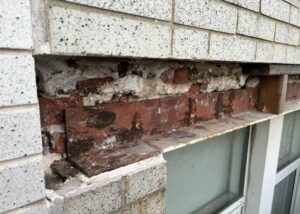
A forensic investigation on a four-story mixed-use building in the Mid-Atlantic region revealed full-field delamination of 3cm limestone panels within 18 months of installation. Not from freeze-thaw cycling.
Not from stone defects. The contractor had specified a polymer-modified thin-set meeting ANSI A118.4 and assumed compliance was sufficient.
It was not, because the mortar was right and the execution was wrong. The substrate was out of plane by nearly 3/16 inch across multiple bays and field crews had spread mortar across four panel positions before setting the first one.
By the time the last panel went in, the mortar had skinned over completely. The bond never formed.
The panels just hadn’t fallen yet.
The Rise of Adhered Stone on Commercial Facades and the Claims That Follow
Adhered natural stone veneer has accelerated onto mid-rise commercial projects over the past decade as a cost-competitive alternative to mechanically anchored systems. Anchored systems require continuous angle supports, back-rod and sealant joints and individual panel clip hardware.
Adhered systems look simpler on paper and carry lower installed cost estimates. That calculus is attracting owners and GCs on projects where the facade engineer may not be the one driving specification decisions.
The claims are following. Forensic practices with significant facade caseloads are seeing delamination failures cluster in the 12 to 36 month post-installation window, which is long enough for the building to be occupied and short enough that the installation crew is long gone.
Initial claims almost universally attribute failure to stone quality or mortar chemistry. Forensic investigation consistently redirects to installation variables.
The MIA+BSI Dimension Stone Design Manual identifies panel weight and size thresholds above which adhered applications carry elevated risk. Panels exceeding 15 pounds per square foot or 36 inches in any dimension push bond demand to the edge of what thin-set systems can reliably deliver under field conditions.
Commercial projects routinely specify panels at or above those thresholds. Residential crews, working at residential scale, never encountered those limits.
On a commercial facade, those limits define the daily work.
The insurance and litigation picture reinforces the pattern. Delamination on an occupied building is not a warranty callback.
It is a life-safety event the moment a panel separates. Facade panels in the 3cm range at heights above the first floor carry enough mass to cause serious injury at grade.
When panels begin to release, building owners face immediate decisions about pedestrian protection, emergency shoring and emergency investigation, all of which generate costs that dwarf the original installation contract. The gap between a compliant material specification and a defensible installation record is where those costs originate.
Forensic investigators pulling panels on failed facades are not finding bad stone or bad mortar. They are finding mortar that never bonded, on substrates that were never flat enough to allow it.
How Adhered Stone Systems Are Supposed to Work: Bond Mechanics Baseline
Thin-set mortar bond depends on mechanical and chemical adhesion at two interfaces: mortar-to-substrate and mortar-to-stone back face. Both interfaces must achieve adequate contact simultaneously.
Neither interface compensates for failure at the other.
ANSI A108.5, Section 6. 1 sets the performance threshold at 95% mortar contact coverage for exterior and wet applications.
That is not a suggestion and it is not a residential standard that gets relaxed for commercial work. Ninety-five percent means the stone back face, when pulled immediately after setting, shows mortar contact across essentially the full surface with no voids larger than the equivalent of a few square inches.
Perimeter contact with a hollow center is a failure condition regardless of how solid the panel feels underfoot or to a tap test.
Polymer-modified mortars classified under ANSI A118.4 improve flexibility and bond strength relative to straight portland-sand mortars. Mortars meeting ANSI A118.15 extend those properties further with higher polymer loading and improved open-time performance.
Neither classification compensates for skinned mortar or inadequate coverage. The polymer improves what a correctly applied mortar can do.
It does not rescue a mortar that was never in full contact with the stone.
Back-buttering is not cosmetic. Applying mortar to the stone back face fills micro-relief on the sawn or honed surface, extends the working window marginally and ensures the mortar-to-stone interface is freshly activated at the moment of embedment.
The TCNA Handbook is explicit on this for large-format stone applications. Skipping back-butter on panels above 15 square feet is a specification deviation, not a field judgment call.
The mechanics of why coverage voids accelerate failure deserve more attention than they typically receive in specification documents. A void beneath a panel is not simply a region of zero bond strength.
It is a cavity that traps water vapor, concentrates thermal stress at the void perimeter and creates a differential movement condition between the bonded and unbonded zones. Under repeated thermal cycling, the bonded perimeter of a void acts as a hinge.
Each cycle flexes the panel slightly at that boundary. Over 18 to 24 months of seasonal temperature swing, that flexure fatigues the bond at the void edge and propagates the delamination outward from the original void.
The panel does not fail at the void. It fails at the perimeter of the void, which means a panel with a single large central void can release completely even though the edges appeared well bonded at installation.
Pull testing immediately after installation would have caught the void. No one required it.
Substrate Flatness: The Tolerance Problem Nobody Budgets For
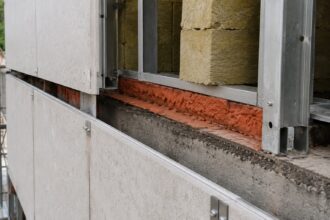
Steel-stud backup walls routinely exceed the flatness tolerances acceptable for adhered stone applications. This is not a surprise to anyone who has walked a commercial framing inspection.
It should not be a surprise to anyone writing an adhered stone specification, but it frequently is.
ANSI A108.02, Section 4. 3.
1 specifies maximum 1/8 inch variation in 10 feet and 1/16 inch in 24 inches for thin-set applications. ASTM C754, which governs steel framing installation, permits tolerances that are materially looser than those limits.
A stud wall built to ASTM C754 tolerance is not necessarily a substrate ready to receive adhered stone. Those are two different tolerance regimes and the gap between them is where delamination starts.
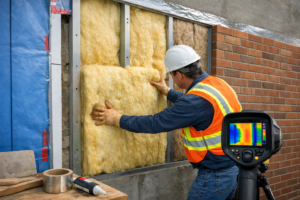
When substrate flatness exceeds the ANSI A108.02 limit, the installer faces a choice: reject the substrate, apply a skim coat or self-leveling overlay to bring it into tolerance or use mortar as a leveling bed. On commercial schedules, the third option happens constantly.
Mortar bed thickness increases beyond the thin-set design range, sometimes reaching 3/4 inch or more in low spots. That is no longer a thin-set application.
It is a medium-bed or thick-bed condition being executed with a thin-set product at thin-set labor rates.
Thick mortar beds shrink unevenly during cure. The differential between the center and edge of an oversized mortar bed generates peel stress at the bond line before the panel ever experiences a thermal cycle.
Add the thermal movement of a 3cm limestone panel across a 60-degree temperature swing and the bond line is working against cumulative stress from day one.
CMU backup walls present a related but distinct problem set. Surface laitance on CMU reduces bond strength at the mortar-to-substrate interface.
Efflorescence migration through the block face introduces soluble salts that disrupt adhesion over time. Block surface porosity varies significantly between units and between manufacturers, which means mortar suction is inconsistent across the substrate.
A CMU wall that looks flat and clean may still deliver inconsistent bond performance unless the surface is mechanically prepared and primed per the mortar manufacturer’s written requirements.
The fix for flatness is not a better mortar. It is a substrate that meets ANSI A108.02 before the stone crew arrives.
That requires a pre-installation inspection with a 10-foot straightedge and a remediation plan with an actual budget line. Most project schedules do not include either.
What makes this problem predictable is that the tolerance gap between structural framing and finish stone installation is not new information. Steel stud framing contractors bid and build to ASTM C754. They are not responsible for meeting ANSI A108.
02 unless the specification explicitly assigns that responsibility and defines a remediation path. On most commercial projects, neither happens.
The stone subcontractor arrives to a substrate that the framing contractor delivered to their own applicable standard, finds it out of tolerance and makes a field decision about how to proceed. That field decision, made under schedule pressure without documented authorization, is the origin point of the delamination claim that surfaces 24 months later.
Open-Time Mismanagement in Field Conditions: The Execution Variable
Open time is the window between mortar spread and panel placement during which full bond transfer is achievable. When surface moisture evaporates and the polymer component begins to film over, open time ends.
The mortar is not chemically inert after that point, but its capacity to wet out and bond to the stone back face drops sharply.
Rated open times on manufacturer technical data sheets reflect laboratory conditions: approximately 70 degrees Fahrenheit, 50 percent relative humidity, no direct sun, no wind. Commercial facades operate in none of those conditions simultaneously.
Direct sun on a west-facing substrate in July can push surface temperature above 120 degrees. Wind accelerates evaporation independent of air temperature.
Low humidity in IECC Climate Zones 4 and 5 during spring and fall installation windows compounds both effects.
Under those conditions, a mortar rated for 20 to 30 minutes of open time may skin over in under 10 minutes. Manufacturer TDS documents for major polymer-modified mortar lines confirm this explicitly.
The data is published. Contractors do not always read it.
The crew pacing problem is structural. On a large facade, installers spread mortar across multiple panel positions in sequence, then return to set panels in sequence.
The logic feels efficient. The result is that the last panels set in any given sequence are almost always beyond open time.
Visual inspection cannot detect this. The panel sits flat, the tap test sounds solid and the mortar appears to have transferred.
Delamination is latent. It surfaces 18 months later when the first thermal cycle of sufficient magnitude overcomes the compromised bond.
ANSI A118.15 extended open-time mortars exist specifically for large-format and exterior applications. They are not universally specified.
Many commercial specifications default to standard ANSI A118.4 because the specifier is not tracking open-time risk as a primary variable. That is a specification gap with direct forensic consequences.
The field detection problem compounds the risk. A tap test performed immediately after panel installation cannot distinguish between a fully bonded panel and a panel set on skinned mortar.
The skinned mortar surface may have enough tack to hold the panel in position and produce a solid tap response. The bond strength is a fraction of what a properly set panel achieves, but nothing in the visual or acoustic inspection signals the deficiency.
The only reliable detection method is a pull test per ANSI A108.02 with documented force measurement and coverage verification on pulled panels. That test is rarely required in commercial specifications and almost never performed as a routine quality control measure during installation.
By the time the deficiency is detectable without destructive testing, the building is occupied and the panels are already working through their first or second seasonal temperature cycle.
Why Residential-Grade Practices Fail at Commercial Scale
Residential adhered stone applications involve smaller panels, more controlled substrates, shorter daily production runs and a single installer or small team with direct accountability for every panel set. The installer who spreads the mortar sets the panel.
Feedback is immediate.
Commercial facades break that feedback loop completely. Crew rotation means the person spreading mortar on Tuesday is not the person who set panels on Monday.
Production pressure means supervisors are tracking square footage per day, not open-time compliance per panel. Panels are set by workers who did not spread the mortar and have no way to know how long it has been exposed.
Panel size at commercial scale also exceeds the range where a single installer can physically achieve 95 percent coverage working alone. A 24 by 48 inch limestone panel requires coordinated back-butter application, substrate mortar application and panel placement within the open-time window.
That is a two-person operation. On residential projects, the panel size rarely demands it.
On commercial projects, it always does and the crew size is rarely adjusted to match.
Substrate variability at commercial scale is also categorically different. A residential project might involve 200 square feet of adhered stone on a single CMU wythe.
A commercial project might involve 8,000 square feet across a steel-stud assembly with multiple framing contractors, multiple sheathing installers and no single party responsible for confirming that the substrate meets ANSI A108.02 before the stone crew mobilizes.
The quality control infrastructure that makes residential installation reliable does not transfer to commercial projects automatically. On a residential job, the tile or stone contractor is typically the prime trade for that scope and has direct owner contact.
Deficiencies get flagged and corrected before the next course goes up because the installer’s reputation is directly on the line with the person paying the invoice. On a commercial project, the stone subcontractor is three tiers removed from the owner, working under a GC schedule that penalizes delays regardless of cause.
Raising a substrate flatness deficiency means stopping work, generating a written nonconformance report, waiting for the GC to assign remediation responsibility and losing production days that the subcontract does not compensate. The path of least resistance is to proceed and absorb the flatness deviation into the mortar bed.
That decision is made by field supervisors who understand the schedule consequences of stopping and do not yet know the forensic consequences of continuing. Specifications that do not assign explicit pre-installation inspection responsibility and define a clear remediation authority are specifications that structurally incentivize that field decision.
The Specification Gap That Makes All of This Predictable
The forensic pattern in adhered stone delamination cases is consistent enough that the failure mode is predictable from the specification alone. When a commercial adhered stone specification references ANSI A118.4 compliance, calls for 95 percent coverage and stops there, it has identified the material requirement but omitted the execution requirements that actually govern whether the system performs.
A specification that addresses the failure modes described here includes: a pre-installation substrate flatness inspection with explicit rejection criteria referenced to ANSI A108.02, Section 4. 3.
1; a requirement for ANSI A118.15 extended open-time mortar on exterior applications; mandatory back-buttering for all panels above a defined size threshold; open-time limits stated in minutes with adjustment protocols for temperature and humidity; and a minimum crew size requirement for panels above a defined square footage.
None of those requirements exceed what the standards already contemplate. They simply translate the standards into enforceable field language.
The gap between ANSI A108.02 and a project specification is where most delamination failures are authored, months before the first panel is set.
The enforceability point matters as much as the content. A specification requirement that cannot be verified in the field is not a requirement.
It is a document entry. Open-time limits stated in minutes are verifiable if the specification also requires the installer to log mortar spread times and panel set times by position.
Coverage requirements are verifiable if the specification requires pull-off testing at a defined frequency, with documented coverage measurement on each pulled panel and a defined acceptance threshold. Substrate flatness requirements are verifiable if the specification assigns inspection responsibility to a named party, requires a written inspection report before stone installation begins and defines the authority to stop work if the substrate fails inspection.
Specifications that include the performance requirement but omit the verification mechanism are specifications that will not change field behavior. The contractor reads the verification requirement, not the performance standard, when deciding how to pace the crew.
What the Next Failure Will Look Like
The next wave of adhered stone delamination claims on commercial facades will not come from a new material or a new system. It will come from the same combination of out-of-plane substrates and exceeded open time, applied to increasingly large panel formats as architectural trends push toward 60 by 120 inch stone slabs on steel-stud assemblies.
At that panel size, the bond demand per unit area stays the same but the consequence of any coverage void scales with the panel weight. A 15 percent void in a 12 by 24 inch panel is a minor deficiency.
A 15 percent void in a 60 by 120 inch panel is a failure waiting for a thermal event. Facade engineers writing specifications for large-format adhered stone today should be requiring pre-installation mockup pull tests per ANSI A108.02 with documented coverage measurements, not trusting that a compliant mortar product and a competent crew will solve a substrate and execution problem that the specification never required anyone to address.
Large-format panels in the 60 by 120 inch range also introduce handling and placement variables that standard thin-set specifications do not address. Panels of that size require mechanical setting equipment to achieve consistent embedment pressure across the full panel face.
Hand pressure applied at the panel perimeter during placement does not transfer sufficient force to the panel center to achieve 95 percent coverage on a back-buttered surface, particularly when the substrate mortar has been on the wall for more than a few minutes. Vacuum lifters and panel setting frames exist for this purpose.
They are standard equipment on mechanically anchored stone installations. They are rarely specified or used on adhered installations, because the specification was written by someone who did not account for the physics of setting a panel that weighs 180 pounds across a 50-square-foot surface with hand tools and two workers.
The mortar will keep getting blamed. The substrate and the clock are where the answer actually lives.