AI in Building Envelope Practice: Genuine Risk Reduction or a New Category of Liability?
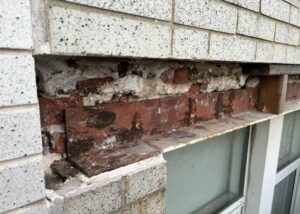
A senior forensic consultant I know was called to investigate a curtain wall failure on a completed mixed-use tower in a Zone 4A climate. The project’s AI-assisted hygrothermal model had predicted zero condensation risk at the spandrel zone.
Interstitial condensation had been occurring for 18 months. The model had been run with manufacturer-supplied vapor permeance values rather than field-verified data and the AI platform flagged no warning.
The tool performed exactly as instructed. Nobody questioned the instructions.
That distinction matters more than any feature list in a software brochure.
Why Building Envelope Failures Keep Generating Litigation: and Why the Industry Turned to AI
Envelope failures drive construction defect litigation in North America at a rate that should embarrass the profession. Water intrusion, air leakage, thermal bridging and interstitial condensation collectively account for 40 to 60 percent of construction defect claims by volume, a figure that has remained stubbornly consistent across market cycles.
The Hanover Research construction defect analyses and IRMI risk data both point to the same reality: we are not getting better at this fast enough.
Traditional design-phase tools made the problem worse in a specific way. Manual hygrothermal calculations, prescriptive code compliance checklists and siloed material submittals do not model system interactions under real climate variability.
ASTM E2266, which establishes baseline good practice for low-rise frame wall systems, describes a design process that is fundamentally reactive. You check boxes.
You do not model the assembly’s behavior across a thousand hours of actual weather data. The checklist approach also tends to evaluate individual components in isolation.
A vapor retarder that meets the prescriptive requirement for its climate zone can still produce interstitial condensation if the outboard insulation ratio is insufficient, a condition that no checklist catches but that a hygrothermal simulation will surface immediately.
The deeper problem with prescriptive compliance is that it creates a false sense of closure. A project team that has checked every box in the applicable energy code believes it has managed moisture risk.
It has not. It has confirmed that individual components meet minimum thresholds.
The system behavior under actual climate loading, with actual material properties and actual construction tolerances, remains unexamined. That gap between prescriptive compliance and system performance is where most envelope failures originate.
AI entered this space promising exactly what the profession needed: probabilistic failure prediction, earlier identification of climate-assembly mismatches and faster iteration across design alternatives. The appeal was real and the timing was right.
The problem is that the profession adopted the promise before establishing any meaningful validation protocols. We started using the outputs before we understood the inputs.
That sequencing error is not unique to AI. The profession made the same mistake with WUFI when it became widely available in the early 2000s, running simulations with default material libraries and treating the outputs as authoritative without verifying that the material properties in the model matched the materials in the specification.
AI has simply repeated that pattern at greater speed and with a more authoritative-sounding output format.
Under the Hood: How AI Envelope Tools Generate Predictions (and What They Cannot See)
The first thing practitioners need to get straight is terminology. EnergyPlus and WUFI are not AI.
They are physics-based simulation engines that apply deterministic equations to user-defined inputs. They are powerful and well-validated.
True machine learning platforms train on historical project datasets, sensor feeds or failure databases to generate probabilistic predictions. These are fundamentally different tools and conflating them creates dangerous misunderstandings about what a given output actually represents.
Current AI applications in envelope practice fall into several categories worth distinguishing. Hygrothermal risk scoring tools process climate data against proposed assembly configurations to flag high-risk combinations.
Computer vision platforms analyze thermal imaging from drone-based façade inspections to identify air barrier discontinuities and thermal anomalies. Predictive maintenance systems for existing buildings ingest real-time sensor data to identify moisture accumulation before it becomes visible damage.
What none of these tools can see is installation quality. Substituted materials, sequencing deviations, undocumented field changes and the gap between the specified assembly and the built assembly are invisible to any model that lacks field-verified input data.
ASHRAE 160-2021 establishes the criteria against which hygrothermal model inputs should be benchmarked, whether the analysis engine is AI-assisted or conventional. That standard exists precisely because input quality is the dominant variable in any moisture-control analysis.
Garbage in, garbage out applies with particular force when the output carries an aura of algorithmic authority that a hand calculation never would.
The machine learning distinction also matters for understanding how these tools fail. A physics-based engine fails predictably: if you give it wrong inputs, it applies correct physics to wrong conditions and produces a wrong answer that a knowledgeable reviewer can often identify as implausible.
A machine learning platform trained on a biased or incomplete dataset can produce wrong answers that look entirely plausible, because the output format reflects the statistical patterns in the training data rather than the physical behavior of the specific assembly being analyzed. A model trained predominantly on projects from the Pacific Northwest will have learned moisture dynamics that do not transfer cleanly to a Zone 2A Gulf Coast project and the output will not announce that limitation.
The practitioner has to know to ask.
The computer vision applications deserve particular scrutiny on this point. Thermal imaging interpretation has historically required significant practitioner expertise to distinguish meaningful anomalies from artifacts of solar loading, surface emissivity variation and equipment interference.
AI-assisted interpretation can accelerate that analysis, but the training data quality determines whether the platform has learned to make the same distinctions an experienced thermographer would make. ASTM C1060 and ASTM E1186 establish protocols for thermographic inspection of building envelopes.
A platform that was not trained on data collected in compliance with those protocols may be pattern-matching against a different set of conditions than the inspection at hand.
Legitimate Wins: The Envelope Applications Where Predictive AI Earns Its Place
There are real wins here. Dismissing AI tools entirely is as irresponsible as adopting them uncritically.
Early-stage climate-assembly mismatch detection is where AI delivers the clearest value. Tools that process NOAA historical climate data against proposed assembly vapor profiles can flag high-risk combinations before construction documents are issued.
A Zone 4A mixed-humid wall assembly with a Class II interior vapor retarder and inadequate outboard continuous insulation is a condensation problem waiting to happen. Catching that configuration at schematic design costs almost nothing.
Catching it during litigation costs a great deal. The same logic applies to roof assemblies in cold climates where the ratio of above-deck to below-deck insulation determines whether the vapor control layer stays above the dew point through a design winter.
AI tools that can run that ratio analysis across multiple assembly options simultaneously, flagging the combinations that fall below the threshold recommended in ASHRAE 160-2021, compress what used to be a multi-day calculation exercise into a screening step that happens before the assembly is even formally proposed.
Thermal bridge quantification at scale is another genuine advance. AI-assisted finite element modeling can evaluate hundreds of connection details faster than any manual calculation workflow, which means the probability that a high-conductance shelf angle embed or cladding attachment bracket goes unanalyzed drops significantly.
This matters because IECC 2021 Section C402 requires climate-zone-specific continuous insulation minimums and CI reduces but does not eliminate thermal bridging at discrete fasteners and structural connections. Having a documented analysis trail for every significant detail has litigation-defense value that is difficult to overstate.
A project that can produce a finite element analysis for every through-wall penetration and every cladding attachment point is in a fundamentally different legal position than one that relied on a single representative detail and assumed the rest of the facade performed similarly.
Post-occupancy sensor integration represents the most mature current application. Buildings instrumented with relative humidity and temperature sensors at strategic assembly locations can feed real-time data into AI dashboards that identify anomalous moisture accumulation patterns months before visible damage appears.
That early warning window is the difference between targeted remediation and a full envelope strip-and-replace. The sensor placement strategy matters enormously here.
Sensors located at the interior face of the sheathing in a wood-frame wall will detect moisture accumulation from both vapor diffusion and air leakage. Sensors located only at the interior finish surface will detect damage after it has already progressed through the assembly.
The AI dashboard is only as useful as the sensor network feeding it and sensor network design requires the same assembly-specific thinking that good envelope design always has.
Large owners and insurers are also using AI to identify recurring failure modes across building portfolios, contractor relationships and geographic regions. That pattern recognition across hundreds of projects is something no individual consultant can replicate manually.
A regional insurer that has processed claims data from five hundred mixed-use projects over fifteen years can train a model to identify the contractor practices, specification patterns and climate-assembly combinations that correlate with early claims. That information, fed back to design teams at project inception, has the potential to break the cycle of repeated failures that the industry has not managed to break through code updates and professional education alone.
The Liability Trap: When Algorithmic Outputs Substitute for Practitioner Judgment
The “model said so” defense is not a defense. Courts and arbitration panels are beginning to scrutinize whether practitioners exercised independent professional judgment or delegated it to a computational tool.
The standard of care doctrine does not change because the tool is sophisticated. If anything, the sophistication of the tool raises the expectation that the practitioner understood its limitations before relying on its outputs.
The false precision problem is the one that concerns me most. An AI platform that outputs “12% condensation risk” implies a quantitative rigor that may not be warranted given the uncertainty in the underlying inputs.
Practitioners and owners treat those numbers as engineering certainties. They are not.
They are probabilistic estimates derived from training data whose quality, scope and validation methodology most commercial platforms have never published. You cannot assess model reliability without knowing the error rate.
You cannot know the error rate if the vendor has not disclosed it. A practitioner who presents a percentage-point risk figure to an owner without disclosing that the underlying model’s validation history is unknown has made a representation that the litigation record may eventually evaluate very harshly.
This is not a hypothetical concern. The curtain wall failure described at the opening of this article is one of several I am aware of where AI-assisted hygrothermal analysis was used to justify a design decision that a more skeptical manual review would have flagged.
In each case, the model performed as instructed. In each case, the instructions were wrong.
The common thread across these cases is not software failure. It is the absence of a review step in which someone with assembly-level expertise asked whether the model inputs reflected the actual project conditions rather than the idealized conditions that populate most default material libraries.
The specification-to-field gap compounds every one of these risks. An AI model trained on specified assemblies cannot account for the vapor permeance of a substituted air barrier membrane, the effective R-value reduction from compressed batt insulation or the thermal bridging introduced by an unanticipated structural connection.
These are not edge cases. They are routine construction realities.
A fluid-applied air barrier with a published vapor permeance of 0.04 perms and a substituted self-adhered membrane with a vapor permeance of 0. 3 perms represent a sevenfold difference in vapor drive through the assembly.
That substitution, approved by a project manager who treated the two products as functionally equivalent air barriers, can shift an assembly from acceptable hygrothermal performance to chronic condensation risk. No AI model running on the original specification will detect that change.
Input Validation: The Professional Obligation That AI Does Not Eliminate
If AI tools are only as reliable as their inputs, then input validation becomes the critical professional obligation. This sounds obvious.
In practice, it is routinely skipped.
Vapor permeance values should be verified against third-party tested data, not manufacturer marketing literature. ASTM E96 test reports should be requested and reviewed.
The distinction between Method A (desiccant, dry cup) and Method B (water, wet cup) results matters significantly for materials whose permeance varies with relative humidity, including many self-adhered membranes and closed-cell spray polyurethane foam products. Using a dry-cup value for a material that will spend most of its service life in high-humidity conditions produces an input error that systematically underestimates vapor drive.
Thermal conductivity values used in finite element models should reflect installed conditions, not nominal values from product data sheets. Effective R-value for a continuous insulation assembly with Z-girt cladding attachment is materially lower than nominal R-value; the difference is not trivial in a Zone 6 or 7 climate analysis.
Published research from the Building Science Corporation and Oak Ridge National Laboratory has quantified Z-girt correction factors that reduce effective R-value by 30 to 50 percent depending on girt spacing and gauge. Those correction factors belong in the model inputs.
The nominal value does not.
Air barrier continuity assumptions deserve the same level of scrutiny as material property values. Most hygrothermal models, AI-assisted or otherwise, treat the air barrier as continuous and effective unless the user explicitly models a breach.
Field reality is different. ASTM E2357 whole-assembly air leakage testing and ASTM E783 field window installation testing both document the gap between specified and achieved air barrier performance.
A model that assumes a continuous air barrier in a building where the air barrier transitions between substrates at every floor line, every window rough opening and every penetration is modeling a building that does not exist.
Climate data inputs deserve the same scrutiny. NOAA historical averages are a reasonable starting point, but they do not capture microclimate conditions at specific sites.
An urban heat island effect, a coastal exposure category or a high-altitude site can shift the moisture balance of an assembly in ways that a generic climate file will not reflect. The ASHRAE 160-2021 standard allows for site-specific climate data when it is available and appropriate and practitioners working on projects in locations with significant microclimate variation should treat that provision as a professional obligation rather than an optional enhancement.
A project on a south-facing slope at 7,000 feet elevation in a Zone 5 classification is not the same moisture environment as a Zone 5 project in a flat urban context and the model inputs should reflect that difference.
The practitioners who use AI tools responsibly treat them as hypothesis generators, not answer machines. The model produces a result.
The practitioner then asks whether the inputs were right, whether the assembly in the model matches the assembly in the documents and whether the assembly in the documents matches what will actually be built. That three-step verification is not optional.
It is the job.
What Forensic Practice Is Already Seeing
The forensic side of this profession is accumulating a body of cases that should inform how design-side practitioners think about AI reliance. The pattern is consistent: AI-assisted analysis was performed, the output was favorable, the favorable output reduced scrutiny of the assembly and the assembly failed.
In several cases I have reviewed, the AI platform was used to justify eliminating a redundant drainage plane in a rainscreen assembly on the grounds that the hygrothermal model showed acceptable moisture accumulation without it. The model was correct for the specified assembly.
The built assembly had air barrier laps that were not taped, which the model could not see. Air leakage transports orders of magnitude more moisture than vapor diffusion.
A drainage plane is not redundancy for its own sake; it is the second line of defense when the air control layer fails in the field, which it does with regularity. The forensic record on this point is unambiguous.
Assemblies with functional drainage planes survive air barrier installation defects that would produce chronic moisture damage in assemblies without them. Eliminating the drainage plane based on a model that cannot account for installation quality removes the margin that compensates for the gap between design intent and field execution.
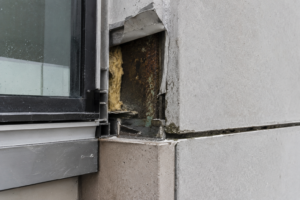
A related pattern involves window-to-wall interface detailing. AI tools that evaluate wall assembly hygrothermal performance in the field of the wall do not evaluate the interface conditions at window perimeters, where the air barrier transitions from the wall substrate to the window frame and where most water intrusion events originate.
Favorable model outputs for the field-of-wall assembly have been used in several cases I am aware of to support the conclusion that the envelope system was adequately designed, when the actual failure mechanism was entirely at the interface and entirely outside the model’s scope. That scope limitation was not disclosed in the project documentation.
The design team apparently did not recognize it.
The four control layers, water, air, vapor and thermal, do not perform independently. An AI tool that models vapor diffusion accurately but cannot account for air leakage at unsealed penetrations is solving the wrong problem with high precision.
The forensic cases accumulating in this space share a common characteristic: the AI analysis was technically correct within its defined scope and the defined scope excluded the conditions that actually caused the failure. Expanding the scope of AI analysis to include air leakage pathways, interface conditions and construction sequence dependencies is technically achievable with current tools.
The profession has not yet established the expectation that it is required.
A Calibrated Standard of Practice for AI-Assisted Envelope Analysis
The profession needs a validation framework before AI envelope tools become embedded in standard practice the way they are becoming embedded in standard workflows. That framework does not exist yet in any codified form.
ASHRAE 160-2021 gets us partway there on hygrothermal inputs. It does not address ML model validation, training data disclosure or error rate benchmarking.
Until that framework exists, the practical standard of care should require the following: document every input source and the basis for selecting it; verify that material property values are supported by third-party test data; confirm that the modeled assembly matches the construction documents and that the construction documents reflect what will actually be built; and treat AI outputs as one data point among several rather than as a final answer. Peer review of AI-assisted analyses by a practitioner who did not run the model is a reasonable expectation for projects above a certain complexity threshold. That reviewer’s job is not to rerun the analysis but to evaluate whether the inputs are defensible and whether