




Artificial intelligence is rapidly becoming part of the building industry’s daily workflow. While much of the attention has focused on AI-generated images, automated content creation, and design assistance, the technology’s long-term impact on the building envelope may be far more significant.
The modern building envelope sits at the intersection of architecture, engineering, construction, sustainability, operations, and risk management. Decisions made during design can affect energy consumption, durability, maintenance costs, occupant comfort, and building resilience for decades.
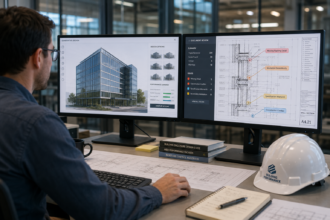
As buildings become increasingly complex and performance expectations continue to rise, AI is emerging as a tool that can help project teams make better-informed decisions throughout the entire lifecycle of the enclosure.
The greatest opportunity may not be automation itself, but the ability to transform large amounts of fragmented information into actionable insights.
The Growing Complexity of Modern Enclosures
Building envelopes have evolved dramatically over the past several decades.
Historically, enclosure design focused primarily on separating interior and exterior environments. Today, facade systems are expected to satisfy a much broader range of performance objectives, including:
- Energy efficiency
- Thermal comfort
- Moisture control
- Air tightness
- Carbon reduction
- Climate resilience
- Acoustic performance
- Daylighting
- Fire safety
- Long-term durability
These requirements are often interconnected.
A decision that improves one performance characteristic may negatively affect another. Increasing insulation thickness may improve thermal performance while creating attachment challenges. Larger glazing areas may improve daylighting while increasing solar heat gain and cooling demand.
As project teams evaluate these competing priorities, the amount of information required to support decision-making continues to grow.
This is where AI has the potential to provide significant value.
Moving Beyond Traditional Design Analysis
Building envelope professionals have always relied on analytical tools.
Energy models, thermal simulations, condensation studies, and daylight analyses have been standard components of performance-based design for years.
AI differs because it can evaluate relationships across multiple datasets simultaneously.
Rather than analyzing a single performance variable, AI systems can compare and interpret information from:
- Climate data
- Energy models
- Building codes
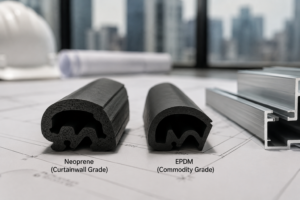
- Product databases
- Historical project records
- Operational performance data
- Maintenance histories
- Inspection reports
This broader perspective allows project teams to evaluate decisions within a larger performance context.
Instead of asking whether a facade system meets a single requirement, teams can begin asking how a design choice may influence long-term building performance across multiple categories.
AI as a Knowledge Management Tool
One of the least discussed but potentially most valuable applications of AI is knowledge management.
Many building envelope firms possess decades of accumulated experience distributed across project files, reports, specifications, photographs, and technical documents.
Unfortunately, much of this information remains difficult to access efficiently.
Experienced consultants often carry valuable institutional knowledge that may not be fully documented or easily transferred throughout an organization.
AI tools can help organize and search these large information repositories.
For example, consultants may eventually be able to query internal databases to identify:
- Similar facade conditions from previous projects
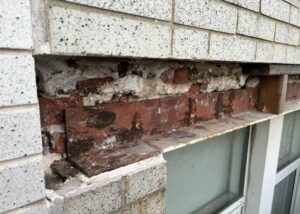
- Historical failure patterns
- Common detailing issues
- Product performance histories
- Climate-specific design challenges
- Lessons learned from forensic investigations
This capability could significantly improve knowledge sharing and reduce the likelihood of repeating known mistakes.
For firms facing workforce transitions and retirements, preserving institutional knowledge may become one of the most important benefits of AI adoption.
Supporting Better Risk Management
At its core, building envelope consulting is largely about risk management.
Professionals work to identify vulnerabilities before they become failures.
Many enclosure issues result from predictable patterns:
- Incomplete air barrier continuity
- Improper drainage design
- Material incompatibility
- Inadequate movement accommodation
- Sequencing conflicts
- Workmanship deficiencies
AI systems are particularly effective at identifying recurring patterns across large datasets.
As firms accumulate more performance information, AI may help consultants recognize elevated risk conditions earlier in the project lifecycle.
Potential applications include:
- Identifying assemblies associated with recurring failures
- Highlighting coordination-sensitive details
- Flagging constructability concerns
- Predicting maintenance requirements
- Evaluating climate-related exposure risks
This does not eliminate the need for professional judgment.
Rather, it provides additional information that can support more informed decision-making.
Improving Communication Between Stakeholders
Building envelope projects involve numerous participants, including:
- Architects
- Engineers
- Consultants
- Contractors
- Manufacturers
- Owners
- Facility managers
Each group approaches projects from a different perspective.
Miscommunication remains a common source of enclosure problems.
AI may improve communication by helping teams organize and interpret project information more effectively.
For example, AI-assisted systems may eventually help:
- Summarize technical reports
- Organize project correspondence
- Track unresolved issues
- Identify conflicting requirements
- Maintain documentation consistency
As projects become increasingly data-intensive, these capabilities could improve collaboration and reduce information gaps.
AI and Building Performance After Occupancy
The building envelope industry has traditionally focused heavily on design and construction.
However, the majority of a building’s life occurs after occupancy.
Owners are increasingly interested in understanding how enclosure systems perform over time.
AI may significantly expand post-occupancy performance monitoring through the analysis of:
- Energy-use data
- Building automation systems
- Leak detection sensors
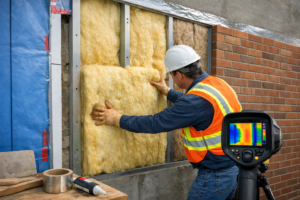
- Thermal imaging
- Maintenance records
- Occupant feedback
This information can help identify trends that might otherwise remain unnoticed.
For example, gradual increases in energy consumption may indicate deteriorating thermal performance. Repeated moisture events may reveal enclosure vulnerabilities that require further investigation.
By identifying patterns earlier, owners may be able to reduce repair costs and improve long-term building performance.
AI and Sustainability Goals
Sustainability requirements continue to influence building envelope design.
Owners and design teams are increasingly evaluating:
- Operational carbon
- Embodied carbon
- Energy efficiency
- Material life cycles
- Climate resilience
AI can support these efforts by helping project teams evaluate large quantities of performance data more efficiently.
Potential applications include:
- Comparing material alternatives
- Evaluating carbon reduction strategies
- Optimizing facade performance
- Forecasting lifecycle impacts
- Supporting retrofit planning
As sustainability reporting requirements become more sophisticated, data-driven decision-making will become increasingly important.
AI may help bridge the gap between performance objectives and practical implementation.
The Limits of Artificial Intelligence
Despite its potential, AI has important limitations.
Building envelope performance depends on factors that are often difficult to quantify accurately.
These include:
- Construction quality
- Installer skill
- Weather exposure
- Maintenance practices
- Occupancy conditions
- Human behavior
AI systems can analyze data, but they cannot replicate professional accountability or field experience.
They cannot physically inspect a substrate, evaluate workmanship, or fully understand the practical realities of construction sequencing.
There is also a risk of excessive reliance on automated recommendations.
Technical outputs should always be reviewed by qualified professionals who understand both the capabilities and limitations of the technology.
In building envelope practice, poor decisions can create significant long-term consequences.
The need for experienced judgment will not disappear.
The Future of AI in Building Envelope Practice
The future of AI in the building envelope industry will likely be defined by augmentation rather than replacement.
The most successful professionals will not be those who compete against AI, but those who learn how to use it effectively.
AI will increasingly help teams:
- Analyze information faster
- Improve consistency
- Reduce administrative workload
- Identify hidden patterns
- Support performance-based decision-making
At the same time, expertise in building science, constructability, materials, and forensic investigation will remain essential.
The industry’s greatest challenge is not adopting AI technology. It is learning how to integrate that technology responsibly while maintaining the technical rigor required for durable, high-performing buildings.
Conclusion
Artificial intelligence is becoming an increasingly important tool within the building envelope industry. Its greatest value lies not in replacing professionals but in helping them process information, manage risk, and make more informed decisions.
As enclosure systems become more complex and performance expectations continue to rise, AI has the potential to improve how buildings are designed, constructed, operated, and maintained.
However, successful implementation will depend on balancing technological capability with professional judgment.
The future of the modern building envelope will likely combine advanced data analysis with the expertise, experience, and accountability that only skilled building envelope professionals can provide.