Wood Cladding on Commercial Facades: Where It Fails
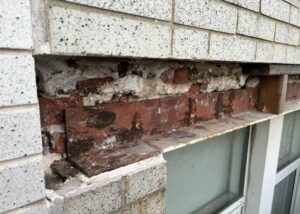
A thermally modified ash rainscreen installation on a four-story mixed-use building in the Pacific Northwest showed visible fastener bleed-through, cupping and end-grain blackening within 18 months of substantial completion. The specifier had followed the manufacturer’s residential installation guide verbatim.
The failure traced back to three compounding decisions: a 3/4-inch ventilation cavity, standard stainless-adjacent fasteners without verified corrosion ratings for thermally modified substrates and zero end-grain sealer on field-cut boards. This is not an outlier.
It is a pattern repeating across commercial wood cladding projects where residential logic meets mid-rise exposure reality.
Why Wood Cladding Is Back on the Commercial Specification Table
Biophilic design demand and mass timber adjacency are putting wood facades back on the commercial specification table for 4-to-8 story mixed-use and office projects. Thermally modified wood (TMW) and pressure-treated alternatives are being positioned by manufacturers as low-maintenance, dimensionally stable substitutes for fiber cement and metal panel systems.
The marketing is effective. The technical documentation is not keeping pace.
The problem is that manufacturer literature for these products overwhelmingly references residential case studies. Warranty language is written around single-family exposure conditions.
When specifiers encounter a four-story mixed-use project with a design team pushing for a warm, natural facade material, they reach for that literature because it is what exists. The gap between what is published and what commercial exposure conditions actually require is where failures originate.
As of the current ICC Evaluation Service publication cycle, there are no TMW-specific entries in ICC-ES evaluation reports for commercial rainscreen assemblies. That absence matters.
It means specifiers have no independently verified performance baseline for these products in commercial applications. They are working from residential data, manufacturer claims and professional judgment.
That combination is insufficient for a mid-rise building envelope.
The mass timber movement has accelerated this problem. As cross-laminated timber and glulam structural systems gain acceptance in mid-rise commercial construction, design teams are treating wood cladding as a natural aesthetic extension of those structural systems.
The logic is understandable. The technical leap it encourages is not.
A CLT floor plate is engineered, tested and evaluated under a defined code compliance pathway. A TMW rainscreen cladding board on the same building is not.
Treating them as equivalent in terms of documentation rigor is a specification error that does not become visible until the building has been in service for two rainy seasons.
Manufacturer sales representatives are filling the documentation gap with case study photography and project reference lists. Those references are almost exclusively residential or low-rise commercial.
When a specifier asks for performance data specific to a six-story building in IECC Climate Zone 5, the answer is typically a restatement of general product properties. That response should trigger additional scrutiny.
It rarely does, because the design schedule does not allow time for it and because the specifier has no independent technical standard to point to as a baseline requirement.
How Thermally Modified and Pressure-Treated Wood Behave Differently
These two product categories are routinely conflated in specifications under the generic label “treated wood cladding.” That conflation creates downstream fastener selection errors that are difficult to catch in submittal review and expensive to correct in the field.
Thermal modification at 180-230°C reduces equilibrium moisture content and improves decay resistance. Those are real benefits.
The tradeoff is reduced density and fiber cohesion, which directly affects fastener holding power. Research from VTT Technical Research Centre of Finland has documented measurable reductions in mechanical properties following thermal modification, including the bending strength and hardness values that determine how well a fastener retains load after repeated thermal and moisture cycling.
That data exists in European technical literature. It has not been incorporated into U.
S. product evaluation reports or ICC-ES criteria.
Pressure-treated wood retains its density but introduces a different problem: chemical corrosion risk to fasteners. ACQ (alkaline copper quaternary) and CA (copper azole) preservative treatments are highly corrosive to standard 304 stainless steel.
AWPA Standard U1 addresses fastener compatibility requirements for pressure-treated wood through its Use Category System and it is explicit about this. Dimensional stability claims for TMW are valid at low moisture exposure but degrade at sustained relative humidity above 80 percent, which is exactly the condition a ventilated cavity assembly in IECC Climate Zones 4 through 6 will see during shoulder seasons.
The practical consequence of conflating these two product categories shows up most clearly in the submittal process. A contractor submits a fastener product data sheet showing 304 stainless steel construction.
The specifier reviews it against a generic “stainless steel fasteners required” note in the specification and approves it. No one has checked whether the fastener is appropriate for ACQ-treated wood specifically or whether the TMW product on the same project has published pull-out strength data after wet-dry cycling.
Both approvals happen in the same submittal package, often on the same day, without distinguishing between the two chemically distinct substrates they will contact.
The European technical framework handles this more systematically. ETA (European Technical Assessment) documents for thermally modified wood products include specific fastener compatibility guidance and mechanical property tables that account for post-modification property changes.
No equivalent document exists in the U. S.
evaluation framework. Until it does, specifiers need to request that manufacturers provide the underlying VTT or equivalent test data and evaluate it against the project’s specific exposure conditions rather than accepting generic product literature as sufficient documentation.
Specifiers should also be aware that the thermal modification process is not standardized across manufacturers. The Thermowood process developed in Finland operates at defined temperature and duration parameters.
Other manufacturers use proprietary processes with different temperature profiles and steam environments. The resulting products have different residual mechanical properties even when marketed under similar performance claims.
Requesting third-party test data rather than relying on manufacturer-reported values is the only way to evaluate these differences at the specification stage.
The Ventilation Cavity Problem: Residential Assumptions in Commercial Assemblies
This is where the most consequential specification errors occur and it deserves the most direct treatment.
Residential rainscreen guidelines, including the BC Housing Rainscreen Guide, typically specify 3/4-inch to 1-inch drainage and ventilation cavities. Those dimensions are adequate for one-to-three story exposure with a limited wind-driven rain index.
They are not adequate for mid-rise commercial facades. The physics are not the same.
Buildings above four stories experience significantly higher wind-driven rain (WDR) loads. ASHRAE 160-2021 Section 5.7 establishes criteria for moisture analysis of building envelope assemblies and accounts for WDR as a function of building height and exposure.
ASTM E331 test pressures for water penetration resistance reflect these elevated loads. Wood cladding assemblies are rarely tested to these standards before specification.
Specifiers are approving assemblies for mid-rise exposure based on test data generated at residential pressure differentials.
Cavity depth directly affects drying rate. A 3/4-inch cavity behind a closed-joint wood cladding profile can trap moisture for days after a rain event.
Hygrothermal modeling in WUFI or equivalent tools consistently shows that 1.5-inch minimum cavities with open-joint profiles perform measurably better in terms of drying potential. ASTM E2925, the standard specification for manufactured polymeric drainage and ventilation materials used to provide a rainscreen function, provides a useful benchmark for cavity performance expectations.
Most specifiers are not requiring manufacturers to demonstrate compliance with it.
The deeper problem is how cavity depth gets decided on commercial projects. Specifiers frequently inherit the cavity dimension from the structural framing module or the insulation thickness decision rather than designing it from a moisture management performance target.
The water control layer and air control layer get specified with care. The cavity that allows those layers to function gets specified by default.
That sequence is backwards.
Transition detailing at floor lines, window heads and base conditions is where cavity continuity breaks down most often in commercial wood rainscreen assemblies. Shelf angles interrupt cavity continuity at every floor line.
Fenestration head conditions require careful integration of the drainage plane with the window flashing. These transitions are detailed on residential projects with a single story of exposure.
On a six-story building, the cumulative effect of inadequate transition details at every floor line is a moisture management assembly that functions well on paper and fails in service.
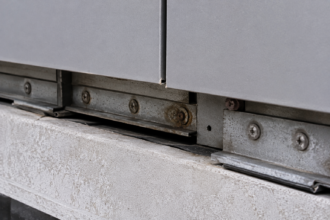
The shelf angle problem is worth examining in detail because it is so consistently underaddressed. A standard shelf angle at a floor line creates a horizontal obstruction that interrupts vertical cavity airflow and collects water at the back of the cladding.
Properly detailing this condition requires either a sloped angle cap that directs water to the face of the cladding or a through-cavity drainage gap above the angle that maintains continuity of the ventilation path. Neither solution appears in residential installation guides.
Both require explicit detailing by the design team and explicit scope assignment in the specification to ensure the contractor executes them correctly.
Open-joint profiles at base conditions are equally important and equally underspecified. The base of a wood rainscreen assembly on a commercial building is the lowest point of the drainage plane and the point of highest moisture accumulation from splash-back and ground-level humidity.
Closed-joint profiles at the base trap moisture against the back of the cladding and against the drainage mat or building wrap. Open-joint profiles with a sloped base trim condition allow water to exit the cavity and allow the cavity to dry between rain events.
This detail costs nothing additional to specify and is consistently absent from commercial wood cladding assemblies that fail within the first three years of service.
Require WUFI modeling as a deliverable from manufacturers before specifying wood cladding on mid-rise commercial projects. If they cannot provide it, that tells you something.
Fastener Corrosion and Pull-Out: The Underdocumented Failure Mode
Fastener corrosion in wood cladding is a two-variable problem: the wood treatment chemistry and the atmospheric exposure category of the project site. Both variables must be evaluated simultaneously.
Most specifications address neither one explicitly.
For pressure-treated wood with ACQ or CA preservatives, AWPA E12 and IRC Table R317.3.1 require hot-dipped galvanized or stainless steel fasteners. That guidance exists in the residential code.
IBC 2021 Section 2304.9.5 addresses fastener requirements for preservative-treated wood in commercial applications, but there is no equivalent prescriptive table for commercial cladding-specific applications. Specifiers are left to extrapolate from residential requirements and manufacturer recommendations, neither of which is independently verified for commercial exposure conditions.
For thermally modified wood, the situation is worse. No standardized fastener compatibility testing protocol currently exists in the U.
S. Manufacturer recommendations vary widely.
Pull-out strength reduction in TMW after repeated wet-dry cycling is a documented concern in European technical literature but has not been incorporated into any U. S.
product evaluation framework.
The 304 versus 316 stainless steel distinction is not academic. In coastal exposure zones, as defined under AAMA 501 exposure classifications, 304 stainless corrodes.
Specifiers working on projects within several miles of salt water need to specify 316 stainless as a minimum and should request ASTM B117 salt spray testing data from fastener manufacturers to validate that claim. Most will not have it.
That gap in documentation should be a red flag, not an acceptable condition.
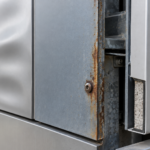
Hidden fastener clip systems introduce a secondary failure mode that deserves its own attention. Clip corrosion at the board-clip interface is difficult to inspect and often goes undetected until cladding movement becomes visible.
By the time the boards are moving, the clips have been corroding for months or years. Inspection access is typically not designed into these assemblies because no one anticipated needing it.
The pull-out failure mode in TMW is particularly problematic because it is progressive and invisible. A fastener that retains adequate pull-out strength at installation may lose 20 to 30 percent of that capacity after two or three years of seasonal moisture cycling, based on European test data for thermally modified Scots pine and ash.
The boards do not fall off immediately. They begin to cup and bow as the fastener grip relaxes, allowing the board to move independently of the substrate.
That movement accelerates moisture infiltration at the fastener penetration, which accelerates corrosion, which further reduces pull-out strength. The failure sequence is self-reinforcing and by the time it is visible from grade, replacement is the only remediation option.
Specifiers should require pull-out testing data conducted on the specific TMW species and modification process proposed for the project, not generic wood species data. Fastener spacing requirements derived from that data should be incorporated into the specification as a prescriptive requirement, not left to contractor judgment or manufacturer field guidance.
On projects in Climate Zones 5 through 7, requiring a minimum of two fasteners per board at each bearing point rather than the single-fastener detail common in residential applications is a reasonable precaution that adds minimal cost and measurably reduces the risk of progressive pull-out failure.
End-Grain Sealing: The Step Everyone Skips
Field cuts happen on every commercial project. A board gets trimmed at a window jamb, a base condition or a transition detail.
The cut end goes unprotected because the installation guide assumes factory-finished edges and because end-grain sealer is not in the contractor’s scope unless the specification explicitly requires it.
End grain absorbs moisture at a rate approximately ten times higher than face grain on the same board. On a thermally modified product, where the modification process has already reduced the wood’s natural decay resistance at the cellular level, an unsealed field cut is an accelerated failure point.
The end-grain blackening visible on the Pacific Northwest project referenced at the opening of this article was directly traceable to field cuts at window jambs and base trim conditions, all left unsealed.
This is a specification gap, not a contractor error. The specifier did not require end-grain sealer as a submittal item, did not include it in the quality control inspection checklist and did not identify field cuts as a hold point in the special inspection program.
The contractor followed the scope as written. The assembly failed as built.
End-grain sealer requirements belong in the specification section, the pre-installation conference agenda and the field observation checklist. All three.
If it appears in only one place, it will be missed.
The product selection for end-grain sealer matters as much as requiring it. Penetrating oil-based sealers and wax-based end-grain treatments perform differently on thermally modified wood than on untreated wood because the modification process changes the cell structure and reduces the wood’s natural oil content.
Some penetrating sealers that perform well on untreated hardwoods do not achieve adequate penetration depth on TMW due to the collapsed cell structure that results from the modification process. Specifiers should require the manufacturer to identify a compatible end-grain sealer product by name and provide application rate data specific to the TMW species and modification process on the project.
Generic “apply end-grain sealer per manufacturer recommendations” language is not sufficient because many TMW manufacturers do not publish end-grain sealer compatibility data at all.
On commercial projects, field cuts are more numerous and more varied than on residential installations. A six-story building with multiple window types, varying floor-to-floor heights and complex base conditions at grade transitions will generate field cuts at dozens of distinct locations.
Identifying those locations in advance during the shop drawing review phase, flagging them as inspection hold points and confirming that the sealer product and application tools are on site before installation begins in each area is the only way to ensure consistent execution. Relying on the installer to self-identify and seal field cuts without that structure produces the result visible on the Pacific Northwest project: selective sealing at obvious locations and missed cuts at less visible conditions that fail first.
IBC Chapter 14 and the Code Compliance Gap Nobody Discusses
The SEO question driving search traffic to this topic is whether thermally modified wood cladding is code-compliant for commercial rainscreen facades. The honest answer is: it depends on how the authority having jurisdiction interprets IBC Chapter 14 and that interpretation varies.
IBC 2021 Chapter 14 governs exterior wall coverings and requires that cladding materials meet specific flame spread and smoke-developed index requirements when tested to ASTM E84. It also requires that combustible cladding on buildings of certain construction types meet fire-resistance requirements or be limited to specific configurations. Wood cladding is combustible.
On a Type III or Type V construction building, that may be acceptable by prescriptive compliance. On a Type I or Type II building, the path to compliance requires a tested assembly or a code alternate request.
Most TMW manufacturers do not publish tested assembly data under NFPA 285, which is the standard for evaluating fire propagation characteristics of exterior non-load-bearing wall assemblies containing combustible components. Some jurisdictions require NFPA 285 compliance for combustible cladding on buildings above 40 feet regardless of construction type.
Others do not. Specifiers need to confirm the local adoption status and any amendments before the design development phase, not during permit review.
The absence of ICC-ES evaluation reports for TMW in commercial rainscreen applications means specifiers cannot point to a code-compliance pathway that has been independently reviewed. That is a significant liability exposure for the design team.
The ASTM E84 test result for a TMW product is not a complete picture of its fire performance in a rainscreen assembly. The E84 test evaluates the surface burning characteristics of a material in isolation.
It does not evaluate the behavior of the full assembly, including the air cavity behind the cladding, the building wrap or drainage mat and the insulation layer. The air cavity in a rainscreen assembly acts as a chimney during a fire event, accelerating flame spread in ways that the E84 test does not capture.
NFPA 285 evaluates the full assembly behavior, which is why some jurisdictions require it and why its absence from TMW manufacturer documentation is a substantive gap rather than a paperwork formality.
Specifiers working on projects in jurisdictions that have adopted the 2021 IBC with local amendments should also check whether the local fire marshal has issued interpretive guidance on combustible cladding above 40 feet. Several major metropolitan jurisdictions, including those in California under CBC amendments, have taken positions on this question that go beyond the base IBC language.
Discovering a local interpretation requirement during permit review, after the cladding system has been specified and the owner has approved the facade material, creates a project schedule and budget problem that is entirely avoidable with a pre-design code research step.
What Specifiers Should Require Before Wood Cladding Goes on a Commercial Facade
The failure pattern described throughout this article is preventable. It requires treating wood cladding on a mid-rise commercial project as the technically complex assembly it is, not as a residential product scaled up.
Before specifying thermally modified or pressure-treated wood cladding on any commercial project above three stories, require the following from the manufacturer as a condition of specification: WUFI hygrothermal modeling for the specific climate zone and cavity depth proposed; ASTM B117 salt spray test data for the fastener system; confirmation of IBC Chapter 14 compliance pathway including NFPA 285 test data if required by the AHJ; and written fastener compatibility guidance specific to the wood treatment chemistry, not generic stainless steel language. If the manufacturer cannot provide these four items, the product is not ready for commercial specification regardless of how the marketing materials are written.
Specify 1.5-inch minimum cavity depth on projects in IECC Climate Zones 4 through 7. Require end-grain sealer as a hold point in the special inspection program.
Specify 316 stainless fasteners on coastal projects without exception. And require open-joint profiles at base and floor-line transitions to maintain cavity continuity where the assembly is most likely to trap moisture.
The pre-installation conference is the last practical opportunity to close specification-to-field gaps before installation begins. It should include the cladding installer, the waterproofing subcontractor responsible for the drainage plane, the window installer and the special inspector.
The agenda should cover end-grain sealing requirements at field cuts, fastener type verification against the approved submittal, cavity depth confirmation at the first course of installation and transition detailing at shelf angles and window heads. That conference should be documented with meeting minutes that identify responsible parties for each item.
Without that documentation, the pre-installation conference is a conversation. With it, it is a contractual record.
Manufacturers who are serious about commercial applications will have this documentation ready or will develop it when asked. The request itself is a useful filter.
A manufacturer that responds to a request for WUFI modeling data with a revised product brochure is communicating something important about how they have positioned their product and who they expect to be accountable when it fails. The wood facade failures accumulating across the Pacific Northwest, the Mid-Atlantic and the Gulf Coast are not random.
They share a common origin: residential assumptions applied to commercial exposure conditions without the technical verification that commercial construction demands.