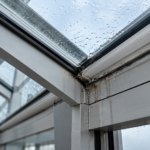
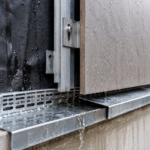
- Zinc soffit panels on a Toronto canopy developed corrosion within 18 months because vertical rain screen drainage details were applied without adjustment to a horizontal condition.
- Horizontal orientation eliminates the wet/dry cycle zinc needs to form its protective carbonate patina causing a destructive process called patina reversal.
- Textured panel surfaces create micro-reservoirs that extend water dwell time dramatically accelerating corrosion rates beyond IZA warranty thresholds.
- Substrate damage from drainage failures typically precedes visible panel distress by 12 to 24 months driving remediation costs 6 to 9 times the original installation cost.
- No current ASTM AAMA or SMACNA standard addresses zinc soffit drainage geometry leaving specifiers without a prescriptive safety net for this common assembly.
Zinc Soffit Panels: Corrosion and Drainage Risk
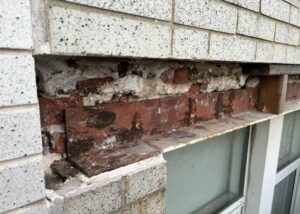
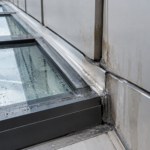
A facade consultant called to investigate premature staining and surface pitting on a newly completed mixed-use canopy in Toronto found something that should have been caught at the specification stage. The zinc soffit panels had developed white zinc hydroxide deposits and localized corrosion within 18 months of installation.
The drainage slots specified for vertical rain screen applications were carried over unchanged to the horizontal soffit condition, leaving water with nowhere to go. The failure was not a material defect.
It was a geometry defect that the specification never addressed.
Zinc Is Not the Same Material on a Soffit as It Is on a Wall
Zinc’s corrosion behavior is orientation-dependent in ways that most North American specifiers do not encounter until something fails. On vertical surfaces, water sheds continuously.
That cyclical wet/dry exposure allows the stable zinc carbonate patina (ZnCO₃) to form progressively, building a self-limiting protective layer that is the entire basis for zinc’s reputation as a low-maintenance cladding material. Horizontal surfaces interrupt that chemistry entirely.
When water dwells rather than drains, the stable carbonate layer dissolves back into zinc hydroxide (Zn(OH)₂), a process called patina reversal. Bare metal is exposed.
The cycle restarts from scratch, but without the drainage geometry to complete the dry phase, it never stabilizes.
European manufacturer data sheets embed climatic assumptions that do not transfer cleanly to North American conditions. Atlantic European humidity is moderate and relatively consistent; freeze-thaw cycling follows reliable seasonal patterns.
North American continental climates deliver far more aggressive thermal cycling and coastal zones from Halifax to Vancouver add chloride loading that European product literature rarely accounts for.
EN 988 governs zinc alloy composition and mechanical properties for rolled zinc products. It does not address installation geometry.
Specifiers frequently treat compliance with EN 988 as a performance guarantee, when in fact it only confirms what the metal is made of, not how it will behave when water sits on it for six hours after a summer storm.
What makes this gap particularly consequential is that zinc’s reputation in North America is built almost entirely on vertical facade performance. Specifiers who have seen zinc weather correctly on a curtain wall or rain screen panel system carry that experience directly into soffit applications without adjusting the underlying assumptions.
The material looks the same in the product catalog. The alloy designation is identical.
The installation crew is often the same crew that installed the wall panels on the same project. Nothing in the procurement or construction process signals that the geometry change is a performance-critical variable.
That absence of a signal is where the failure originates.
Field observations from forensic investigations in Toronto, Chicago and Seattle consistently show the same pattern: the vertical zinc on the same building performs as expected while the horizontal soffit panels on the same canopy show active corrosion within two years. The delta in performance is not explained by material variation.
It is explained entirely by orientation and the drainage geometry decisions that followed from it.
How Standing Water Triggers Patina Reversal Corrosion
The electrochemical sequence that destroys zinc soffit panels is straightforward once you understand the chemistry the patina depends on. Stable ZnCO₃ formation requires carbon dioxide from the atmosphere to react with zinc hydroxide at the surface during the dry phase of a wet/dry cycle.
Prolonged saturation eliminates the dry phase entirely. Surface chemistry shifts toward acidic zinc hydroxide dissolution and the protective layer never fully reconstitutes between rain events.
Textured panel surfaces make this dramatically worse. Embossed and rolled textures create micro-reservoirs across the entire panel face.
A smooth zinc sheet sheds residual water within minutes of rain stopping; a deeply textured panel retains water in every valley and groove for hours or days, depending on orientation and ambient conditions. The dwell time differential is not marginal.
It is the variable that separates acceptable long-term performance from visible surface degradation within two years.
The corrosion rate data supports this directly. ASTM G85 modified salt spray testing shows zinc in continuously wet conditions corroding at 2 to 5 times the rate of zinc exposed to cyclical wet/dry conditions.
International Zinc Association (IZA) atmospheric corrosion classification data for North American urban and coastal zones confirms that local corrosion rates in continuously wetted micro-environments exceed IZA’s C4 classification thresholds, which most zinc manufacturer warranties assume will not be exceeded in standard architectural applications.
Organic debris accumulation in textured surfaces compounds the problem further. Leaf tannins, bird waste and airborne particulates accumulate in the same micro-reservoirs that trap water.
Tannin-laden water has a pH as low as 4.5. At that pH, anodic dissolution of zinc accelerates sharply and the corrosion you see at 18 months reflects damage that began within the first seasonal cycle. The texture that architects specify for aesthetic depth is the same geometry that holds the chemistry against the metal surface.
What the warranty documentation does not communicate is that IZA’s C4 corrosivity classification assumes standard atmospheric exposure, meaning a surface that wets and dries with normal precipitation cycles. A textured soffit panel in a sheltered canopy condition that traps organic debris is not a C4 exposure environment in any meaningful sense.
It is a C5 or CX micro-environment created by the assembly geometry itself, not by the surrounding atmosphere. The manufacturer’s warranty was written for a condition that the installation detail made impossible to achieve.
Specifiers reviewing warranty terms for zinc soffit applications should ask explicitly whether the warranty applies to horizontal textured surfaces with the proposed drainage slope and cavity configuration. In most cases, the manufacturer’s written response to that question will be more informative than the warranty document itself.
Drainage Geometry: What the Standard Details Get Wrong
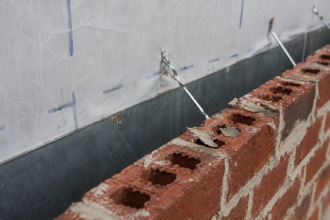
The standard vertical rain screen drainage slot detail places a 3 to 6mm open joint at the base of each panel. Gravity drives water down the panel face and out through that joint.
The detail works precisely because the drainage path aligns with the force driving water movement. Rotate that assembly 90 degrees to a horizontal soffit condition and the joint is now at the panel edge, perpendicular to gravity and water has no directional motivation to find it.
Three distinct drainage failure modes appear consistently in soffit applications. First: insufficient slope across the drain field.
A soffit specified at level or with less than 1/8 inch per foot slope will pond water regardless of how well the edge joints are detailed. Second: drainage slots oriented perpendicular to the actual water flow path, which is the direct result of copying vertical facade details without geometric analysis.
Third: absence of a positive drainage plane behind the panel, meaning water that penetrates the face joint has no path to exit and instead migrates toward the subframing.
SMACNA’s Architectural Sheet Metal Manual, 3rd Edition, recommends a minimum slope of 1/8 inch per foot for metal soffit systems, with 1/4 inch per foot preferred where textured surfaces are specified. Those numbers exist for exactly the conditions described here.
Most zinc manufacturer installation manuals reference vertical facade details only; SMACNA’s soffit guidance does not appear in the zinc product literature that North American specifiers are working from.
Thermal expansion gaps create a secondary problem that is rarely detailed correctly. On a vertical wall, expansion joints provide movement relief and incidentally drain any water that reaches them.
On a horizontal soffit, those same joints can act as water dams if the adjacent panel edges turn up even slightly, which thermal cycling will cause over time. Expansion joint geometry in soffit applications requires explicit directional intent: the joint must slope to drain, not merely accommodate movement.
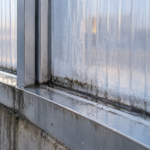
The field consequence of getting this wrong is visible in the pattern of staining that develops on failed soffit assemblies. Corrosion does not distribute evenly across the panel field.
It concentrates at panel edges adjacent to expansion joints and at low points where slope transitions create momentary flat zones. A forensic investigator reading that stain pattern can reconstruct the drainage geometry failure without removing a single panel.
The staining is a map of where water stopped moving. When that map shows corrosion concentrated at joints that a detail drawing labeled as expansion relief, the specification error is self-documenting.
Contractors installing zinc soffit panels from vertical facade detail packages rarely flag the geometry problem because nothing in the installation sequence makes it visible. The panels go up flat or with minimal slope because the structural framing was designed that way, the drainage slots face the wrong direction because the shop drawings reproduced the vertical detail and the assembly looks correct at substantial completion.
The drainage failure only becomes apparent after the first full seasonal cycle delivers standing water to a surface that was never designed to drain it.
Substrate Degradation Beneath the Panel: The Hidden Consequence
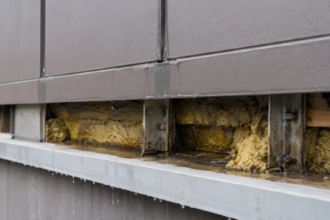
The corrosion risk does not stop at the zinc face. Water that bypasses drainage geometry reaches the subframing, sheathing and the water control layer, where it causes secondary damage that costs an order of magnitude more to remediate than panel replacement alone.
Steel subframing presents a specific galvanic risk. Zinc is anodic to steel in the galvanic series (MIL-STD-889), which means zinc sacrifices itself to protect steel under normal conditions.
That relationship inverts when acidic zinc runoff, pH-lowered by organic contamination, acts as an aggressive electrolyte in the galvanic couple. Under continuous saturation with low-pH water, the zinc corrodes faster than it would in isolation and the steel subframing corrodes faster than it would without the acidic electrolyte present.
ASTM B117 salt spray testing of zinc-to-steel galvanic couples confirms accelerated corrosion rates under these conditions compared to neutral-pH exposure.
Wood blocking at canopy edges is similarly vulnerable. Fluid-applied water-resistive barriers are not rated for continuous immersion; most manufacturer approvals assume intermittent exposure.
A soffit assembly that traps water against a fluid-applied WRB for extended periods is operating outside the tested performance envelope of that product.
Forensic investigations of zinc soffit failures consistently find substrate damage that predates visible panel surface distress by 12 to 24 months. The panels look acceptable at the 12-month inspection.
The framing behind them is already compromised. By the time the zinc surface shows visible pitting and white staining, the remediation scope has expanded from a cladding problem to a structural subassembly problem.
The cost differential between early intervention and late-stage remediation is significant. Replacing zinc soffit panels before substrate damage occurs is a cladding trade scope.
Replacing zinc soffit panels after the steel subframing has corroded and the sheathing has delaminated is a structural repair scope that involves multiple trades, extended scheduling and, in occupied buildings, temporary protection systems for the space below. Project records from two canopy remediations completed in Vancouver between 2019 and 2022 show total remediation costs running 6 to 9 times the original panel installation cost once subframing replacement and water control layer repair were included.
Neither project owner had been advised at the specification stage that the drainage detail carried that level of latent risk.
The inspection protocol matters here as well. Standard one-year warranty inspections for metal cladding systems focus on visible surface conditions.
An inspector looking at a zinc soffit that shows no visible staining at 12 months will typically sign off on the assembly. The substrate damage developing behind that surface is not accessible without invasive investigation and no standard warranty inspection protocol requires it.
Specifiers who understand this gap sometimes include a provision requiring the contractor to open a minimum number of inspection ports at the one-year inspection, allowing direct visual confirmation of cavity drainage performance and subframing condition before the warranty period closes.
What North American Codes and Standards Currently Require (and Don’t)
The current IBC and IECC do not prescribe zinc-specific soffit drainage geometry. IBC Section 1404 addresses exterior wall coverings and requires that cladding systems be designed to resist water penetration, but it delegates the geometry of compliance to the designer without prescriptive detail for metal soffit applications specifically.
AAMA 508 covers pressure-equalized rain screen wall cladding systems and includes drainage provisions that are well-developed for vertical assemblies. Those provisions do not translate directly to soffit conditions because the pressure equalization and drainage assumptions both depend on vertical orientation.
Applying AAMA 508 drainage logic to a horizontal soffit application is a category error.
The standards gap is real and currently unfilled. No ASTM, AAMA or SMACNA standard addresses zinc soffit panel drainage geometry as a distinct condition.
Specifiers working on canopy and soffit applications are operating without a prescriptive safety net, relying on general metal soffit guidance from SMACNA and material-specific corrosion data from IZA that was not developed for this specific assembly configuration.
The Canadian National Building Code 2020, Section 5.4, addresses cladding drainage requirements and is somewhat more prescriptive than IBC on positive drainage geometry, but it does not address zinc-specific patina chemistry or the corrosion acceleration that results from textured surface water retention. Canadian specifiers have a slightly better regulatory framework and still lack the material-specific guidance they need.
The practical consequence of this standards gap is that the burden of technical judgment falls entirely on the specifier, with no code official or third-party reviewer positioned to catch a drainage geometry error before construction. A building permit reviewer examining a canopy soffit detail is checking for structural adequacy and fire resistance compliance.
The drainage slope and slot orientation on a zinc soffit panel detail are not items that trigger plan review comments under any current North American code framework. The error passes through every review gate without resistance.
SMACNA’s Technical Subcommittee on Architectural Sheet Metal has the organizational standing to address this gap through a dedicated soffit drainage supplement and the IZA has the corrosion data to support it. Until that guidance exists in a form that specifiers can cite in construction documents and contractors can follow in the field, the specification-to-field gap will continue producing the same failures on new projects.
Specifying Zinc Soffits Without Repeating This Failure
The specification fix is not complicated, but it requires the specifier to make decisions that the manufacturer’s standard detail library will not make for them.
Minimum slope of 1/4 inch per foot across the soffit drain field is the starting point for any textured zinc panel application. That exceeds SMACNA’s minimum recommendation and is appropriate given the water retention characteristics of embossed zinc surfaces.
Drainage slots must be oriented parallel to the slope direction, not perpendicular to it and must be sized to pass debris-laden water without bridging. A 6mm slot that closes to 3mm under thermal expansion does not drain adequately when organic debris is present.
The subframing cavity behind the panel must be a drained and vented cavity in the SMACNA definition: water that enters the cavity has a clear, gravity-driven path to exit and air can circulate to complete the dry phase that zinc carbonate formation requires. A drained cavity without ventilation path will not dry between rain events in a soffit condition.
Both elements are necessary.
Specifiers who are working with zinc for the first time on North American projects should treat the European manufacturer’s detail library as a starting point for material selection, not as a construction document resource. The alloy is the same.
The geometry problem is entirely different. Eighteen months and a forensic investigation is an expensive way to learn that distinction.
The specification should also address panel texture selection explicitly in relation to the drainage condition. Smooth or lightly textured zinc panels shed residual water significantly faster than deeply embossed profiles.
Where the design program requires a textured surface, the specification should increase the minimum slope requirement and reduce the maximum panel dimension in the drainage direction to limit the total dwell time of water traveling across the panel face to an exit joint. A 900mm panel dimension in the drainage direction at 1/4 inch per foot slope performs differently than a 1,800mm panel at the same slope.
Both dimensions appear routinely in zinc soffit specifications. Only one of them gives the drainage geometry a reasonable chance of keeping the surface dry between rain events.
Shop drawing review for zinc soffit applications should include explicit confirmation that drainage slot orientation, slope direction and cavity vent path are shown and consistent with the specification. That review step is not standard practice for metal soffit submittals and adding it to the specification’s submittal requirements section is the most direct way to ensure it happens.
The contractor who receives a shop drawing rejection for incorrect drainage slot orientation on a zinc soffit panel will not make the same error on the next project. That is how the specification-to-field gap closes: one reviewed submittal at a time.