



Brazed vs. Pressure-Fit Gasket Corners in Unitized Curtainwall
A 14-story mixed-use tower in the Mid-Atlantic region reported water intrusion at 23 separate unitized panel corners within 18 months of occupancy. Every failure traced to pressure-fit gasket splices that had partially disengaged following the first full seasonal thermal cycle.
The contractor had submitted a compliant gasket material specification. The shop drawings never addressed corner construction method.
The facade engineer of record approved the submittal without flagging the omission.
That project cost the glazing contractor 11 weeks of remediation and a six-figure settlement. The owner never got full confidence in the assembly.
The failure was not a material failure. It was a fabrication method decision that nobody made explicitly, so the field made it by default.
Why Gasket Corner Construction Is the Weakest Link in Unitized Curtainwall
Unitized panels achieve a continuous perimeter seal only when gasket corners maintain full contact geometry through thermal movement, racking and differential deflection between adjacent units. The straight gasket runs are straightforward: extrusion length, durometer and compression depth are all controllable at the factory.
The corner is different. It is the single location where gasket continuity cannot be achieved by extrusion alone.
It requires a deliberate fabrication decision and that decision has to be made before the panel ships.
Most water intrusion failures in unitized systems originate at corners and splices, not along straight gasket runs. Field experience across hundreds of investigations confirms this pattern consistently.
The straight runs hold. The corners open.
The critical distinction that submittal reviewers consistently miss is this: gasket material is a specification item and gasket corner construction is a fabrication method decision. They are two separate submittals and they are frequently conflated into one cut sheet review.
AAMA 501.1 establishes the dynamic pressure water penetration test condition that the completed corner must survive. Passing that test with a factory-brazed sample and then installing field splices in the field is not compliance.
It is a substitution nobody caught.
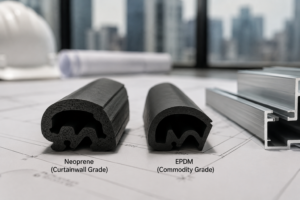
The conflation happens because most specification sections treat gasket performance as a material property question. Section 08 44 13 in a typical project manual will reference AAMA 800 series standards, call out EPDM compound, specify durometer range and move on.
Corner construction gets no line item. The fabricator reads that specification, prices field splices because they are faster and cheaper to execute and submits a cut sheet showing a compliant EPDM extrusion.
The submittal reviewer checks the material properties against the specification, finds them compliant and stamps the submittal approved. At no point in that sequence does anyone ask how the corner is being made.
The specification did not require an answer, so no answer was given.
How Brazed Corner Gaskets Are Fabricated and Why the Method Works
Vulcanized or thermally bonded corners are factory-molded or heat-welded to form a monolithic 90-degree transition. There is no field splice.
There is no mechanical interlock dependency. The fabrication process involves compression-molding corner gasket blanks or hot-vulcanizing them to the straight leg extrusions under controlled temperature and pressure, creating a chemically continuous EPDM or silicone matrix at the turn.
The resulting corner has no seam at the highest-stress location. The gasket cross-section remains consistent through the turn, maintaining designed compression against the frame.
That geometric consistency is the performance advantage. It is not a material advantage.
A pressure-fit gasket made from identical EPDM compound will still fail at the splice while a brazed corner from the same compound holds.
Compression set is the long-term performance variable. ASTM C864 establishes compression set limits for dense elastomeric compression seal gaskets; brazed corners are designed to distribute relaxation uniformly across the monolithic cross-section.
There is no joint interface to concentrate stress. After 10 years of thermal cycling, the brazed corner has lost some sealing force uniformly.
The spliced corner has lost sealing force preferentially at the miter, which is exactly where the pressure differential is highest during a wind-driven rain event.
The AAMA 800 series governs gasket material classification and performance requirements. Meeting AAMA 800 on material alone does not address corner construction.
Fabricators who understand this distinction call it out proactively in their submittals. Those who do not are telling you something about their shop practice.
The vulcanization process itself warrants a closer look because it explains why the method produces a genuinely different material condition at the corner, not just a geometrically cleaner one. During hot vulcanization, the elastomer chains at the bond interface cross-link under heat and pressure in the same way they cross-link through the body of the extrusion.
The result is a corner that has no bond line in the conventional adhesive sense. The polymer network is continuous.
Pull-apart testing on factory-vulcanized corners consistently shows failure in the parent material rather than at the corner joint, which is the correct failure mode. A field splice with sealant backup, by contrast, will always show adhesive or cohesive failure at the splice interface under sufficient load because the sealant modulus and bond width cannot replicate the tensile capacity of the continuous elastomer cross-section.
How Pressure-Fit Field-Spliced Gaskets Are Installed and Where They Fail
Pressure-fit splices rely on a mitered or butt-cut gasket end being pushed into a corner key or T-connector or simply butted and sealed with a compatible sealant bead. The joint is mechanical, not chemical.
That distinction matters at the molecular level and at the performance level.
Field installation variability is the first failure driver. Splice quality depends on installer technique, ambient temperature at installation and whether the gasket has been pre-stretched or compressed during handling.
A gasket installed at 40°F that is in tension at installation will contract further in winter service, pulling the splice open before the first heating season ends. This is not speculation.
It is basic thermal mechanics applied to a joint with no tensile capacity.
The primary failure mechanism is thermal contraction pulling the splice open at the miter. Once the gap exceeds the sealant bridge capacity, typically 0.5 to 1.
0 mm depending on sealant modulus and bond width, the pressure differential drives water through the corner. At that point the water control layer is breached.
The air control layer may still be intact further inboard, but in many unitized systems the gasket is doing double duty on both layers.
A secondary failure mode deserves equal attention: gasket lip rollover at the splice point under wind load cycling. Repeated pressure fluctuations at the corner cause the gasket lip to deform permanently at the splice, preventing re-engagement even if the splice gap closes during warmer weather.
AAMA 501.2 field hose testing routinely exposes these splice failures post-occupancy. The problem is that AAMA 501.2 is a diagnostic protocol, not a commissioning standard.
By the time the hose test confirms the failure, the panel has already admitted water through multiple thermal cycles. Thermal movement calculations per ASCE 7-22 Chapter 2 load combinations should be driving the corner detail decision at design, not confirming failure after occupancy.
A third failure mode that receives less attention in post-occupancy investigations is sealant incompatibility at the splice backup. Many field splice details call for a compatible sealant bead at the miter as a secondary seal.
In practice, the sealant selection is often left to the installer and silicone sealant applied directly to an EPDM gasket surface without surface preparation or a confirmed bond test will not develop adequate adhesion. ASTM C794 adhesion-in-peel testing is the correct method for confirming sealant-to-gasket bond performance and it is almost never specified or executed at the splice detail level.
The result is a sealant bead that appears intact visually but peels cleanly from the gasket face under the first significant negative pressure event, leaving no secondary seal at the corner.
Reading Shop Drawings and Gasket Submittals to Identify the Corner Method
The information you need is almost always present in the submittal package if you know where to look and what its absence means. On shop drawings, look for corner gasket detail callouts that explicitly distinguish “factory corner” from “field splice.
” Look for fabrication notes on the gasket schedule. Look for whether the gasket schedule cross-references a corner construction specification or simply lists a straight-run extrusion part number with no corner companion part number.
That last point is the most reliable red flag. A factory-brazed corner assembly has its own part number.
It is a distinct manufactured component. If the submittal lists one gasket part number for the entire perimeter, the corner is being addressed in the field, not the factory.
Questions to push through the RFI process: Is the corner gasket factory-fabricated or field-assembled? What is the splice method at panel corners?
Is a sealant backup specified at splices and if so, what is the compatibility with the gasket compound? Silicone sealant applied to an EPDM gasket without a confirmed bond test is not a backup.
It is a liability.
The most effective submittal requirement I have used consistently is this: require the fabricator to submit a physical sample of the corner gasket assembly, not just a cut sheet, before approval. A cut sheet proves material compliance.
A physical sample proves fabrication method. AAMA CW-13 provides a submittal requirements framework for structural sealant glazing systems that translates directly to gasket submittals by analogy.
Project specification Section 08 44 13 should codify this requirement explicitly.
Beyond the physical sample, the shop drawing review should include a specific check for gasket termination details at panel corners and at the stack joint between adjacent units. The stack joint termination is a second location where field splicing is common and where the same failure mechanism applies.
A submittal package that shows factory-brazed corners but field-spliced stack joint terminations has closed half the gap and left the other half open. Reviewers who focus only on the 90-degree corner and miss the stack joint termination are approving a partial solution.
The RFI question should explicitly address both locations: “Confirm whether corner gasket fabrication method applies equally to panel corner transitions and to stack joint gasket terminations at the head and sill of each unit.
Thermal Cycling, Compression Set and the Physics of Gasket Corner Degradation
Unitized aluminum frames expand and contract at approximately 0.0000128 inches per inch per degree Fahrenheit. Over a 100-degree Fahrenheit seasonal range on a 60-inch panel, that produces roughly 0.077 inches of movement per frame member.
At a corner, two members are moving simultaneously in perpendicular directions. The gasket at that corner is absorbing biaxial strain, not uniaxial strain.
A field splice has zero capacity to distribute that biaxial load. It simply opens.
Compression set is the material variable that compounds the problem over time. EPDM gaskets lose sealing force as the polymer relaxes under sustained compression.
ASTM C1115 addresses thermal cycling requirements for dense elastomeric silicone rubber gaskets and accessories, requiring gaskets to maintain sealing force after 1,000 hours of heat aging. The critical point is that splice joints are not independently tested under this protocol.
The test specimen is a continuous gasket section. Approving a continuous gasket test result and then installing a spliced corner is not a valid extrapolation.
A brazed corner distributes compression set relaxation uniformly across the monolithic cross-section. A spliced corner concentrates stress at the joint interface, which is also the location of lowest material continuity.
The degradation accelerates at exactly the wrong location.
The biaxial strain condition at the corner also interacts with interstory drift under lateral load. ASCE 7-22 drift limits for curtainwall systems are typically expressed as H/400 to H/200 depending on occupancy and system type.
At those drift levels, a unitized panel corner is experiencing simultaneous in-plane shear deformation and out-of-plane thermal movement. The gasket at that corner must accommodate both simultaneously.
A factory-brazed corner, because it is a continuous elastomeric body, distributes that combined deformation across the full cross-section of the turn. A field splice, because it has no tensile continuity across the miter, responds to in-plane shear by rotating the splice faces relative to each other, which opens the gap in a different axis than thermal contraction alone.
Post-occupancy investigations on buildings in seismically active zones have documented splice failures that occurred not during winter thermal contraction but during moderate wind events that induced racking in the panel frame. The splice gap opened under shear, not tension and the failure mode was misdiagnosed initially as a sealant failure rather than a gasket corner failure.
Specifying Brazed Corners Without Creating a Single-Source Situation
The legitimate concern fabricators raise about specifying brazed corners is lead time and cost. Both are real.
Factory-molded corner gaskets require tooling and that tooling is gasket-profile-specific. Changing the frame profile late in design means new corner tooling.
The schedule impact is measurable.
The answer is not to accept field splices as an equivalent alternative. The answer is to lock the gasket profile decision earlier in the design process and treat corner gasket fabrication as a long-lead item alongside the aluminum extrusions themselves.
This is a procurement sequencing issue, not a technical limitation of the brazed corner method.
Specifying the performance outcome rather than the fabrication method is one approach: require that corner gasket construction maintain water control layer continuity through 1,000 thermal cycles per ASTM C1115 without measurable gap formation at the corner joint and require the fabricator to demonstrate compliance by method. In practice, only factory-vulcanized corners meet that requirement.
The specification does not name a single source. It names a performance threshold that the field splice cannot reach.
The cost differential between factory-brazed corners and field splices is real but frequently overstated in value engineering discussions. The tooling cost for a corner gasket mold is a fixed cost amortized across the full panel count for the project.
On a project with 400 or more unitized panels, each with four corners, the per-corner tooling premium is small relative to the installed cost of the panel. The labor cost difference at the fabrication shop is more significant: factory vulcanization requires press time and quality control inspection that field splicing does not.
A realistic cost comparison, however, must include the expected callback and remediation cost for field-spliced corners over the first five years of occupancy. When that number is included, the factory-brazed corner is consistently the lower total cost option.
The industry’s reluctance to make that calculation explicitly is a procurement culture problem, not an engineering problem. Facade engineers who present the full lifecycle cost comparison to owners during design development consistently find that owners choose the brazed corner when they understand what they are buying.
What the Submittal Gap Is Actually Costing the Industry
The pattern from the Mid-Atlantic tower is not an isolated case. It represents a systematic gap between material specification and fabrication method specification that is producing a measurable rise in water intrusion callbacks on unitized projects within the first two years of occupancy.
The gasket material passes the specification. The corner fails in service.
The facade engineer approved the submittal. The glazing contractor installed what the shop drawings showed.
Nobody is clearly wrong and the owner has a leaking building.
Close the gap at the submittal stage. Require a separate corner gasket fabrication detail on every unitized curtainwall project.
Require a physical sample. Require a part number that is distinct from the straight-run extrusion.
If the fabricator cannot produce those three items, the corner is being field-spliced and the first winter will confirm it.
The thermal cycle does not care about submittal compliance. It cares about joint continuity.
Specify accordingly.
The industry cost of this gap extends beyond individual project settlements. Building envelope consultants who track callback data across their project portfolios report that unitized curtainwall water intrusion claims are disproportionately concentrated in the 12-to-36-month post-occupancy window, which corresponds precisely to the first two full seasonal thermal cycles.
Insurance carriers writing wrap-up policies on large curtainwall projects are beginning to ask questions about gasket corner construction method during underwriting, which is a reliable indicator that the actuarial data is catching up to the field pattern. When underwriters start pricing the risk of field-spliced corners into wrap-up premiums, the cost differential between brazed and spliced corners will become visible to owners in a way that value engineering conversations currently obscure.
The specification gap is not just a technical problem. It is a financial exposure that the industry is currently distributing to owners who do not know they are carrying it.