
TPO and PVC as Wall Cladding: Where Roofing Logic Fails
A mid-rise office project in Phoenix reaches substantial completion when the building official flags the exterior wall assembly during final inspection: the TPO membrane specified as a rainscreen cladding layer carries no NFPA 285 test compliance documentation and the roofing manufacturer’s warranty explicitly excludes vertical applications. The substitution had been made six weeks prior to save $0.40/SF over an approved cladding product.
What follows is a three-week schedule delay, a redesign cost that dwarfs the original savings and a specifier who assumed roofing-grade meant building-envelope-grade.
That assumption is the problem. It is showing up on projects across climate zones with increasing frequency and the consequences range from warranty voids to code violations that stop a certificate of occupancy cold.
Why Roofing Membranes Are Showing Up on Walls
Cost pressure on mid-rise commercial envelopes is relentless and procurement teams increasingly treat TPO and PVC as commodity materials. When a roofing distributor has rolls in stock at a lower price point than a listed wall cladding product, the substitution request lands on the design team’s desk framed as a simple material equivalency.
The chemistry looks the same. The product names overlap.
The price difference is real.
Design-assist delivery models accelerate this problem. When contractors participate in design development, substitution conversations happen earlier and with less consultant oversight than in traditional delivery.
A value-engineering review at 60% documents can generate a substitution that bypasses the specification review process that would otherwise catch the product line distinction. In integrated project delivery and construction manager at-risk arrangements, the contractor’s purchasing team may have already committed to a roofing distributor relationship before the wall assembly specification is finalized, creating institutional pressure to make the cheaper product work on paper even when it does not work in code.
Distributor consolidation in the single-ply membrane market has made this worse. Regional distributors who historically stocked separate roofing and wall product lines have rationalized their inventories.
A contractor calling for a TPO membrane may receive a roofing-grade product simply because that is what the distributor carries, with no flag that a wall-specific product line exists or that the distinction matters. Sales representatives at the distributor level are not always trained to ask about application orientation and the burden of catching that gap falls entirely on the design team’s submittal review.
The core issue is this: TPO and PVC roofing membranes and their wall cladding counterparts share base chemistry but operate under entirely different performance regimes. IBC Section 1404 governs exterior wall coverings and imposes requirements that have no parallel in IBC Section 1507, which covers roof coverings.
These are structurally separate regulatory frameworks. A product that satisfies one does not automatically satisfy the other and no amount of material similarity changes that jurisdictional boundary.
The IBC does not provide a crosswalk between these sections and it does not need to. They govern different building systems with different exposure conditions, different fire propagation risks and different service life expectations.
Treating them as interchangeable is a reading error, not a gray area.
Material Chemistry Is Similar; Application Demands Are Not
Both TPO (thermoplastic polyolefin) and PVC (polyvinyl chloride) are single-ply thermoplastic membranes. Their base chemistries are broadly similar, which is exactly why procurement conversations conflate them.
That similarity is real at the polymer level. It evaporates at the performance specification level.
Roofing membranes are formulated and tested for horizontal drainage, intermittent ponding tolerance and foot traffic resistance. None of those performance criteria appear in the demands placed on a vertical cladding layer.
Vertical orientation changes the UV dose geometry fundamentally. South- and west-facing walls in Phoenix, Las Vegas or any high-solar-gain climate receive direct solar impingement at angles that accelerate surface oxidation relative to low-slope roof planes, where the membrane sees diffuse radiation at a shallower angle of incidence for most of the day.
A rooftop membrane in Phoenix may see peak surface temperatures of 160 to 170 degrees Fahrenheit under summer conditions. A south-facing wall panel in the same city, without the benefit of reflective geometry and with direct perpendicular solar exposure during afternoon hours, can exceed those temperatures at the membrane surface while also experiencing convective cooling cycles that the rooftop assembly does not.
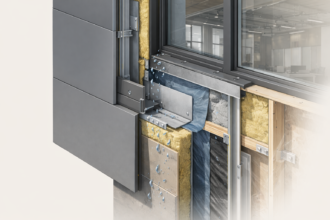
Thermal expansion in vertical cladding is also constrained differently. Fastener patterns, termination bars and seam geometry designed for roof decks do not translate directly to stud-framed or sheathed wall substrates.
The substrate deflection characteristics differ. The attachment geometry differs.
The gravity load path differs entirely. A roofing membrane attached to a rigid cover board over a concrete deck behaves mechanically as a system with very low substrate compliance.
A wall membrane attached to gypsum sheathing over metal stud framing sits on a substrate that deflects under wind load, expands and contracts with moisture cycling and does not provide the uniform bearing surface that roofing details assume.
ASTM G154 covers UV weathering cycles for non-metallic materials and roofing product certifications typically reference it. The problem is that facade applications require evaluation under extended cycle counts that most roofing datasheets do not publish.
A product certified to a standard cycle count for roofing may be entirely untested at the exposure durations relevant to a 30-year facade service life expectation. When a specifier asks a roofing product technical representative for G154 data beyond 5,000 hours, the answer is frequently that the data does not exist.
That absence is diagnostic. It tells you the manufacturer has not considered the application and has not invested in characterizing the product’s behavior over the service life the facade owner expects.
UV Degradation Timelines Differ from Roofing Expectations
Roofing-grade TPO is typically warranted for 15 to 20 years in horizontal application. Manufacturer data on vertical UV performance is sparse, inconsistently published and rarely extrapolated to facade service life expectations of 30 years or more.
That documentation gap is itself a red flag. If a manufacturer cannot provide vertical orientation weathering data, the specifier is flying without instruments.
Chalking, surface embrittlement and seam adhesion loss occur earlier on vertical surfaces because UV stabilizer packages in roofing membranes are optimized for low-slope geometry and reflectivity assumptions that do not hold on walls. A white TPO roof reflects a significant portion of incident solar radiation back to the sky.
A white TPO wall panel on a south elevation absorbs and re-radiates differently, with higher localized surface temperatures during peak insolation hours. The stabilizer depletion rate is not linear with UV dose; it accelerates as the stabilizer package is consumed, meaning the last third of a membrane’s service life degrades faster than the first third.
Roofing warranties account for this in horizontal applications. They do not account for it in vertical ones because the manufacturers have not modeled it.
Color retention and gloss degradation matter on visible facades. They are aesthetic performance metrics that roofing warranty language does not track.
When a specifier crosses a roofing product into a facade application, they inherit a documentation gap that will surface either at the warranty claim stage or at a future building sale when due diligence review flags the non-conforming installation. Commercial real estate transactions increasingly include building envelope condition assessments and a facade assembly that cannot produce compliant product documentation becomes a negotiating liability.
The $0.40/SF saved during construction can translate to a six-figure escrow holdback or a price reduction at disposition.
Thermal cycling on vertical cladding involves greater diurnal delta-T swings on exposed south and west faces compared to rooftop assemblies insulated from below. Most roofing assemblies have continuous insulation between the membrane and the conditioned interior, which moderates the membrane’s temperature range.
Vertical cladding in a rainscreen configuration does not benefit from that thermal buffer in the same way. The result is accelerated fatigue at seams and terminations over time.
Field observations on projects in IECC Climate Zones 2 and 3 that used roofing-grade TPO on west-facing rainscreen applications have documented seam lifting and termination bar separation within five to seven years of installation, well short of the 20-year roofing warranty period and far short of any reasonable facade service life expectation.
ASTM D4434 is the standard specification for PVC sheet roofing. It is roofing-specific.
No equivalent ASTM standard exists for PVC vertical wall membrane. Most TPO roofing datasheets publish accelerated weathering data to 5,000 hours under ASTM G154. Facade applications on high-exposure orientations in IECC Climate Zones 2 and 3 may require 10,000-hour or longer evaluations that are simply not available from roofing product lines.
The absence of a wall-specific ASTM standard for these materials is not a regulatory oversight that permits their use in wall applications. It reflects the fact that the materials were not developed for that application and the standards bodies have not needed to address a product category that does not yet exist in compliant form from most manufacturers.
Thermal Expansion Tolerances and Detailing Conflicts
TPO carries a coefficient of thermal expansion of approximately 100 to 150 times 10 to the negative sixth power in/in/°F. That is significantly higher than metal cladding panels or fiber cement.
Detailing that accommodates rooftop movement does not automatically transfer to wall joint design and the consequences of getting this wrong are visible: buckled seams, pulled terminations and open joints that compromise the water control layer. For comparison, aluminum carries a coefficient of approximately 13 times 10 to the negative sixth power in/in/°F and fiber cement sits near 8. TPO moves at roughly ten times the rate of fiber cement across the same temperature differential.
Joint widths and relief point spacing that work for fiber cement panels will not contain TPO movement and roofing details were never designed to contain it in vertical runs.
Vertical runs of membrane cladding over multi-story heights accumulate expansion movement that exceeds what standard termination bar and batten fastening systems are designed to absorb. A three-story uninterrupted vertical run in a climate with a 100-degree seasonal temperature differential generates movement that must be accommodated at defined relief points.
Roofing details do not include those relief points because horizontal runs are broken by drains, penetrations and field seams at intervals that naturally limit accumulation. On a wall, the membrane may run continuously from a base termination at grade to a parapet cap, with no intermediate relief.
The accumulated movement in that run has nowhere to go except into the seams and fasteners, which fail progressively under cyclic loading.
Roofing attachment details, whether mechanically fastened to deck or adhered to cover board, do not map cleanly onto wall substrate conditions. Stud framing deflects under lateral load.
Sheathing panels have their own differential movement relative to the framing. The interaction between cladding movement and structural movement in a wall assembly requires facade-specific engineering that roofing product technical representatives are not equipped to provide.
A roofing manufacturer’s technical support line can help a contractor detail a drain sump or a penetration flashing. They cannot provide engineering guidance on how their product behaves when the substrate deflects 1/240 of the span under design wind pressure while the membrane is simultaneously at peak thermal expansion.
That is a facade engineering question and it requires facade engineering data that roofing product lines do not generate.
Seam placement strategy on walls must also account for gravity-induced creep in adhered systems. This failure mode is absent from horizontal roofing applications entirely.
An adhered roofing membrane sits on a horizontal substrate; gravity acts perpendicular to the bond plane and does not induce shear stress at the adhesive interface. An adhered wall membrane sits on a vertical substrate; gravity acts parallel to the bond plane and induces continuous shear stress at the adhesive interface over the full height of the panel.
Over time, under sustained thermal softening during summer peak temperatures, adhered roofing membranes on walls have exhibited downward creep that opens the top edge of the panel and compresses the bottom termination. AAMA 501.5 covers thermal cycling of exterior walls and applies directly to wall assemblies.
Roofing membrane manufacturers do not typically test or certify products to AAMA 501.5. That gap in certification is a direct signal that the product was not engineered for this application.
Fire Classification Requirements: The Critical Gap
This is where a roofing-to-wall substitution moves from a performance risk to a code violation with potential life-safety consequences.
Roofing fire classifications under UL 790 and ASTM E108 test flame spread on a horizontal slope. Class A, B and C ratings from those tests are entirely inapplicable to vertical wall fire performance requirements.
A TPO membrane with a Class A roofing rating carries zero presumption of NFPA 285 compliance. Zero.
These are different tests measuring different phenomena in different orientations. UL 790 applies a flame source to a sloped roof deck specimen and measures spread across the horizontal surface.
NFPA 285 applies a fire source at a window opening and measures vertical propagation up the face of a two-story wall assembly and lateral propagation into the wall cavity. The physical mechanisms are different, the specimen geometry is different, the measurement criteria are different and the pass/fail thresholds are different.
A Class A rating from UL 790 tells you nothing about how the material behaves in the NFPA 285 scenario.
IBC Section 1402.5 and NFPA 285 govern fire propagation in exterior wall assemblies for buildings over 40 feet in height or assemblies containing combustible components. NFPA 285 is a full-scale assembly test conducted on a two-story wall section with a fire source at the first-floor window opening.
It measures vertical flame spread and lateral flame spread across the exterior face and within the wall cavity. No roofing membrane manufacturer tests their product to this standard because the standard does not apply to roofing.
When a roofing product is substituted into a wall application on a building subject to NFPA 285 requirements, the assembly has no compliant fire test documentation. The Phoenix scenario at the top of this article is not hypothetical.
It is a pattern.
The compliance path requires either a full NFPA 285 test on the specific assembly configuration or a tested assembly from a manufacturer who has developed and listed a wall-specific product. Tested assembly listings are configuration-specific: changing the insulation type, thickness or cladding attachment method can invalidate the listing.
Specifiers need to verify that the exact assembly, not just the membrane, carries the listing. A manufacturer who has tested one assembly configuration with 3-inch mineral wool continuous insulation and a specific air barrier product does not automatically provide NFPA 285 coverage for a substituted assembly using 2-inch polyisocyanurate and a different air barrier.
The listing number must match the proposed assembly and that match must be confirmed in writing from the manufacturer before the submittal is approved.
PVC introduces additional complexity because plasticizer migration under sustained heat can change the material’s flame spread characteristics over time. Roofing-grade PVC formulations are not optimized for the vertical fire exposure scenario that NFPA 285 models.
As plasticizers migrate out of the PVC matrix over years of thermal cycling, the material’s flexibility decreases and its combustion behavior changes. A PVC formulation that passes a fire test at installation may not behave identically after ten years of plasticizer loss in a high-temperature wall application.
Wall-specific PVC products address this through formulation choices that roofing-grade products do not make because roofing applications do not present the same sustained vertical fire exposure risk.
What a Compliant Specification Path Looks Like
Manufacturers who have developed TPO and PVC products specifically for vertical wall applications have done the work: NFPA 285 assembly testing, extended ASTM G154 weathering data, AAMA 501.5 thermal cycling certification and warranty language that explicitly covers vertical orientation. Those products exist.
They cost more than roofing-grade rolls. That cost difference reflects the testing and engineering investment required to make the application defensible.
When a contractor’s value-engineering memo frames the price difference as margin that the manufacturer is extracting, the correct response is to ask the contractor to produce equivalent test documentation for the cheaper product. That request ends the conversation quickly.
The specification path starts with requiring the submittal package to include the NFPA 285 tested assembly listing number, the specific assembly configuration that was tested and written confirmation from the manufacturer that the proposed installation matches that configuration. If the submittal cannot produce a listing number, the product is not compliant regardless of what the contractor’s value-engineering memo claims.
The specification should state this requirement explicitly in Division 07 under the submittal requirements article, not buried in a performance paragraph where it can be overlooked during submittal review. List the required documentation as a condition of submittal acceptance, not as a post-approval verification item.
If the documentation requirement appears before the product is purchased, the contractor has the information needed to source a compliant product. If it appears only at submittal review, the contractor has already committed to the non-compliant product and the schedule pressure to approve it is already in place.
Warranty language deserves equal scrutiny. A roofing manufacturer’s warranty that excludes vertical applications is not a technicality.
It is the manufacturer’s own statement that the product was not designed for the use being proposed. Courts and insurance adjusters read warranty exclusions literally.
When a building owner pursues a warranty claim on a failed wall assembly and the manufacturer’s warranty document contains a vertical application exclusion, the claim is denied on page one. The design professional who approved the substitution then becomes the next party in the claim sequence.
Professional liability exposure from a single approved substitution can exceed the total fee for the project. That arithmetic should inform how much schedule pressure is acceptable when a substitution request arrives.
The Specification-to-Field Gap Is Where This Fails
Experienced specifiers write the right language. The failure occurs between the project manual and the field.
A substitution request approved under time pressure, a submittal reviewer who does not recognize the product line distinction, a GC who interprets “TPO membrane” as a generic material rather than a specific product category: any one of these breaks the chain. The submittal review process is the last checkpoint before non-compliant material reaches the wall and it is frequently staffed by junior project architects or specification consultants who have not encountered this specific substitution pattern before.
A clear written record of the rejection reason, citing specific code sections and warranty exclusion language, protects the design team and gives the contractor unambiguous direction.
Pre-construction meetings offer a practical intervention point that many design teams underuse. A fifteen-minute agenda item at the pre-construction conference that specifically addresses the roofing-versus-wall membrane distinction, names the approved products and states the documentation required for any substitution request, puts the contractor on notice before purchasing decisions are made.
That conversation, documented in the meeting minutes, establishes that the design team communicated the requirement clearly and early. It removes the contractor’s ability to claim that the product line distinction was not understood.
The $0.40/SF savings in Phoenix cost the project owner a three-week delay, a redesign fee and a damaged relationship with the building official’s office. The specifier who approved that substitution will not make the same mistake again.
The goal is to make sure you do not have to learn it the same way.
When a substitution request arrives framing roofing-grade TPO or PVC as equivalent to a listed wall cladding product, the correct response is not a request for more information. It is a rejection with a clear written explanation citing IBC Section 1404, NFPA 285 and the warranty exclusion.
Put that in writing before the schedule pressure arrives, because it always does.