- The 2017 Grenfell Tower fire reshaped how U.S. code officials require fire test documentation for exterior wall assemblies.
- NFPA 285 is an assembly test and a passing result applies only to the exact tested configuration of components.
- ACM core type must be explicitly designated in specifications to prevent dangerous and costly value engineering substitutions.
- Steel panels require distinct thermal movement calculations and corrosion protection protocols that aluminum specifications cannot cover.
- A lifecycle cost model frequently reverses apparent savings from lower-cost panel selections when remediation risk is included.
A facade consultant is called to a mid-rise mixed-use project in Atlanta where the authority having jurisdiction has halted construction after discovering the specified ACM panels carry a polyethylene core, not the FR core documented in the project’s NFPA 285 assembly submission. The substitution occurred during value engineering.
The product data sheets looked nearly identical. Nobody caught the discrepancy until the panels were already on the wall.
This scenario is not hypothetical; it is a composite of documented submittal failures that reveal exactly how marketing language, incomplete specification language and procurement shortcuts collapse into a single, expensive problem. The remediation cost exceeded the original panel delta by a factor of six.
Why the Post-Grenfell Regulatory Environment Changed the Specifier’s Burden
The 2017 Grenfell Tower fire killed 72 people and fundamentally altered how U. S.
code officials approach exterior wall assembly combustibility documentation. The direct causal link was ACM cladding with a polyethylene core.
U. S.
jurisdictions had no obligation to respond to a UK tragedy, but they did. AHJs in major metros began demanding assembly-specific fire test evidence rather than accepting manufacturer declarations at face value.
IBC 2021 Section 1402.5 and Section 1403. 5 now require panel-specific, assembly-specific fire test evidence for buildings exceeding 40 feet in height.
Generic product approvals are no longer sufficient. The code demands that the tested assembly match the proposed assembly.
That distinction carries professional liability implications that specifiers cannot afford to ignore. In practice, this means the submittal package must include the full NFPA 285 test report, a side-by-side comparison of the tested assembly against the project assembly and a written statement from the manufacturer confirming that no substitutions have been made to components that would invalidate the test result.
AHJs in jurisdictions including New York City, Los Angeles and Chicago have begun issuing pre-construction checklists that require exactly this documentation before a facade permit is issued. Specifiers who are unaware of local amendments to IBC 2021 face an additional layer of exposure, because several jurisdictions have adopted more stringent combustibility thresholds than the base code requires.
NFPA 285:2019 is an assembly test. Not a product test.
The passing result belongs to a specific combination of panel, insulation type and thickness, air and vapor barrier and substrate wall construction. Many project teams still treat it as a product certification.
That misunderstanding is precisely what produced the Atlanta scenario described above. The confusion is partly a marketing problem.
Manufacturers publish compliance matrices that list their panels as “NFPA 285 compliant” without clearly communicating that compliance is conditional on every other assembly component remaining consistent with the tested configuration. A specifier who reads that matrix entry and stops there has not completed due diligence.
The professional standard of care now requires reading the test report, not the compliance matrix.
Understanding the Three Panel Types: Core Composition and Structural Behavior
ACM consists of two aluminum skins, typically 0.020 inches per skin, bonded to a core material. The core type is the critical variable.
Polyethylene core, fire-retardant core and mineral-filled core have fundamentally different combustion profiles. Specifying by brand name alone is professionally indefensible.
The specification must designate core type explicitly. A specification that reads “ACM panels as manufactured by [Brand X] or approved equal” without naming the core type creates a substitution pathway wide enough to drive the Atlanta scenario through without anyone technically violating the specification language.
The correct approach is to write the core type designation directly into the product specification section, cross-reference it in the submittal requirements section and require the contractor to certify in writing that the delivered product matches the specified core designation. That three-point documentation chain closes the substitution gap that value engineering exploits.
Solid aluminum is monolithic sheet stock, typically ranging from 0.090 inches to 0. 250 inches in thickness.
There is no core combustibility risk. However, fabrication behavior differs significantly from ACM.
Bending radii, flatness tolerances and panel-to-panel alignment at reveals all behave differently when you are working with a homogeneous material versus a composite. Detailers who migrate directly from ACM shop drawings to solid aluminum without adjusting joint and reveal geometry produce assemblies that telegraph every substrate imperfection.
The stiffness differential between the two materials means that solid aluminum panels at equivalent thickness will deflect more under wind load than ACM panels of the same nominal dimension, which affects attachment point spacing and clip design. A fabricator experienced with ACM who takes on a solid aluminum scope without recalibrating their shop drawing standards will produce panels that look correct on paper and perform poorly in the field.
Specifiers should require fabricator qualifications specifically for the panel material type being specified, not just for metal panel fabrication generally.
Steel panels use galvanized, Galvalume or stainless substrates with PVDF or polyester coatings applied over a zinc-based primer system. Steel carries the highest strength-to-thickness ratio of the three.
It is also the heaviest and that weight drives attachment engineering in ways that aluminum does not. Thermal movement coefficients for steel differ from aluminum by roughly 35 percent, which requires distinct clip design and attachment spacing calculations.
A specifier who copies an aluminum attachment schedule onto a steel panel system without recalculating thermal movement will produce cracked sealant joints within two heating seasons. In a climate like Minneapolis or Chicago, where the annual temperature swing from design winter to design summer can exceed 120 degrees Fahrenheit, that thermal movement differential is not a rounding error.
It is a primary design variable. The attachment engineer of record must receive the correct thermal expansion coefficient for the specified panel substrate material before producing the clip spacing calculations and the specification must require that confirmation in writing as part of the submittal package.
ASTM E84 surface burning characteristics testing is frequently cited in submittals as evidence of fire performance. It is supplementary information at best and dangerously misleading at worst when presented as a substitute for NFPA 285 assembly compliance.
Fire Classification: Reading Test Reports Without Getting Misled
Request the actual NFPA 285 test report. Not the compliance letter.
Not the product data sheet summary. The report itself.
Then compare the tested assembly configuration against your project’s actual wall assembly, component by component.
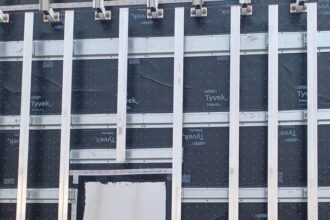
Manufacturers routinely use “NFPA 285 compliant” language on product data sheets that refers to one specific tested configuration, which may include a particular mineral wool insulation thickness, a specific fluid-applied air barrier membrane and a concrete masonry substrate. If your project uses polyisocyanurate insulation, a self-adhered membrane and a steel stud substrate, that tested assembly result does not transfer.
IBC 2021 Section 2603.5 addresses foam plastic insulation interaction with exterior wall assemblies and requires specific assembly compliance, not product-level compliance. This is where projects fail.
The insulation substitution is the most common assembly mismatch in submitted NFPA 285 documentation. Mineral wool and polyisocyanurate behave differently in the test furnace and a passing result achieved with mineral wool does not predict passing performance with polyisocyanurate.
Some manufacturers have invested in multiple tested configurations to address this, but many have not. The specifier’s job is to confirm that the manufacturer’s tested configuration inventory actually includes a configuration that matches the project’s wall assembly before the product is specified, not after the submittal arrives.
FR-core ACM achieves NFPA 285 compliance in specific assemblies, but it still contains combustible material. The FR designation means the core has been modified to retard ignition and flame spread, not to eliminate combustibility.
Mineral-filled (A2-rated) core is non-combustible per ASTM E136 testing and provides a more defensible specification position for buildings subject to heightened AHJ scrutiny or insurance underwriting requirements. The cost premium for A2 core over FR core is real but modest, typically in the range of 8 to 15 percent on the panel material cost alone.
The cost premium for remediation after a submittal rejection is not modest. Insurance underwriters for large commercial properties have begun asking for panel core documentation as part of property risk assessments, which means the specification decision made during design phase has downstream implications for the building owner’s insurance costs over the life of the asset.
That context is worth communicating to owners who push back on the A2 core premium during value engineering conversations.
Solid aluminum and steel panels present a more straightforward NFPA 285 compliance pathway because the substrate materials are inherently non-combustible. The assembly variables that still require evaluation are coatings, joint fillers, tapes and insulation.
Non-combustible panels do not automatically produce a compliant assembly. They simply eliminate one major combustibility variable from the equation.
Butyl-based joint tapes and closed-cell foam backer rods used at panel joints introduce combustible material into the assembly cavity and some tested configurations specify particular tape products by type or manufacturer. Substituting a generic butyl tape for the tape product named in the test report is the same category of error as substituting PE-core ACM for FR-core ACM.
The principle is identical: the tested assembly is the tested assembly and every component substitution requires engineering justification or a new test.
Coating Systems and Long-Term Durability: What the Warranty Language Actually Covers
PVDF coatings marketed under the Kynar 500 and Hylar 5000 trade names are the industry benchmark for commercial facade longevity. Specifiers must require a minimum 70 percent PVDF resin content by weight.
Below that threshold, you are specifying a blended or polyester-heavy formulation that will not perform comparably over a 20-year service horizon, regardless of what the product literature implies. The resin content requirement belongs in the specification as a minimum threshold, not as a reference to a trade name alone.
Trade name references without resin content minimums create the same substitution vulnerability that core type references without explicit designation create for ACM. A coatings applicator who substitutes a 50 percent PVDF blend for a 70 percent PVDF formulation has not technically violated a specification that only names Kynar 500 without defining the resin content floor.
Writing the number into the specification closes that gap.
Warranty language deserves line-by-line scrutiny. Most manufacturer finish warranties cover chalk and fade thresholds, typically a color shift no greater than 5 delta-E units per AAMA 2605. What they explicitly exclude matters more.
Exclusions typically cover film adhesion failure caused by substrate movement, improper fabrication, coastal or industrial atmospheric exposure without an upgraded coating specification and any damage attributable to installation practices. That last exclusion is broad enough to void a warranty claim on almost any field-reported failure.
Specifiers working on projects within one mile of a marine environment should require AAMA 2605 compliance with a supplemental salt spray test result per ASTM B117, minimum 3,000 hours and should confirm that the warranty language does not exclude coastal exposure as a standard carve-out. Some manufacturers offer coastal-specific warranty endorsements for an additional premium.
That endorsement should be a specification requirement on any project where the building owner expects warranty protection to mean something.
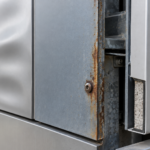
Steel panels introduce cut-edge corrosion risk at fabricated openings, attachment penetrations and panel perimeters. The zinc primer system must remain intact through fabrication, shipping and installation.
It rarely does without a field touch-up protocol written into the specification. This risk does not exist with aluminum substrates.
Specifiers who treat steel and aluminum coating specifications as interchangeable are setting up a corrosion failure at every drilled hole and saw cut. The field touch-up protocol should specify the primer product, the application method, the minimum dry film thickness after touch-up and the inspection requirement before the panel is installed.
Without those four elements in the specification, the touch-up protocol becomes a suggestion that installers follow when convenient and skip when they are behind schedule.
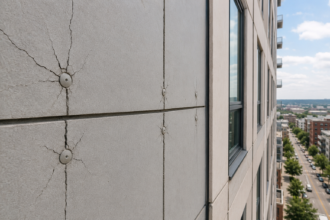
ACM-specific delamination risk under thermal cycling is significant in dark color selections. Surface temperatures on dark ACM panels in full sun exposure can exceed 180 degrees Fahrenheit.
At those temperatures, the bond between the aluminum skin and the core is working hard. Peel strength test data per ASTM D1876 should be required in the specification, not accepted as an optional submittal.
Minimum acceptable peel strength values vary by manufacturer and core type, but a reasonable specification threshold for FR-core ACM is 40 pounds per linear inch at ambient temperature, with a retained strength requirement of at least 80 percent of that value after thermal aging per the manufacturer’s published test protocol. Requiring the data does not guarantee performance, but it creates a documented baseline against which field failures can be evaluated and warranty claims can be supported.
Fabrication Tolerances and the Specification-to-Field Gap
This is where the most expensive problems live. Specifiers write tolerances.
Fabricators work to shop drawing standards. Installers work to what fits.
Those three sets of expectations rarely align without explicit contractual language tying them together.
ACM fabricates predictably. The composite structure resists oil-canning better than solid aluminum at equivalent panel sizes because the core adds stiffness.
Solid aluminum at large panel formats requires careful attention to flatness tolerances; panels exceeding roughly 5 square feet in surface area without internal stiffening are prone to visible oil-canning that no amount of attachment adjustment will correct after the fact. This is not a defect in the material.
It is a predictable outcome of physics that the specification must address proactively by setting maximum panel size limits or requiring stiffener schedules. The stiffener schedule requirement should include minimum stiffener depth, attachment method and spacing and should require the fabricator to submit a flatness certification for each panel size in the project matrix before fabrication begins.
A flatness certification requirement shifts the burden of proof to the fabricator and creates a contractual record that supports rejection of non-conforming panels before they reach the job site rather than after they are installed.
Steel panels are stiffer per unit thickness than aluminum and resist oil-canning more effectively at large formats. The tradeoff is weight and the thermal movement differential discussed earlier.
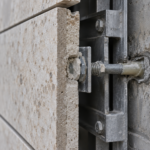
Attachment clip design must account for the full range of seasonal movement without transferring stress into panel face fasteners or sealant joints. In practice, this means the clip system must provide a defined slip plane that allows panel movement in the plane of the wall without binding.
Fixed-point and floating-point attachment logic that is standard practice for aluminum panel systems applies to steel as well, but the movement calculations that determine which attachment points are fixed and which are floating must use steel’s thermal expansion coefficient, not aluminum’s. A clip system designed for aluminum thermal movement installed on a steel panel system will bind at the fixed points during temperature extremes and the resulting stress will find the weakest path out, which is usually the sealant joint or the panel face fastener hole.
The specification-to-field gap is widest at corners, returns and fenestration perimeters. These are the locations where panel systems require the most fabrication precision and where installers face the most pressure to improvise.
A specification that defines flatness tolerances for field panels but says nothing about corner return fabrication tolerances has left the most failure-prone locations uncontrolled. Corner return tolerances should address the angle of the return relative to the face plane, the consistency of the reveal dimension at the corner and the maximum allowable gap between the return panel and the adjacent field panel at the joint.
Those three dimensions, written as explicit tolerances in the specification, give the inspector a measurable standard to apply during installation observation and give the contractor a clear target to fabricate toward. Without them, corner quality becomes a matter of installer judgment, which varies widely across the trades.
Total Installed Cost: What the Bid Number Does Not Tell You
Material cost comparisons between ACM, solid aluminum and steel panels are almost always misleading when presented without installed cost context. ACM typically carries the lowest material cost per square foot.
Solid aluminum sits in the middle. Steel varies widely depending on substrate specification and coating system.
What the bid number obscures is fabrication complexity, attachment system cost and long-term maintenance exposure. Solid aluminum requires more fabrication labor per panel than ACM for equivalent geometry because you are working with a stiffer, heavier material that does not bend as forgivingly.
Steel attachment systems require engineering that accounts for thermal movement differentials and corrosion protection at every bracket location; that engineering cost is real and often excluded from early budget comparisons. A more complete cost model should include the attachment engineering fee, the cost of corrosion-resistant hardware at every bracket location, the field touch-up material and labor for steel panel cut edges and the cost of the additional submittal documentation required to satisfy NFPA 285 assembly compliance review.
On a 50,000 square foot facade, those line items can shift the apparent cost relationship between panel types by 15 to 25 percent relative to a material-only comparison. Owners and project managers who make panel selection decisions based on material cost per square foot alone are working from an incomplete model and the specifier has a professional responsibility to present the complete picture.
Maintenance exposure over a 20-year horizon is where FR-core ACM and PE-core ACM diverge most sharply from solid aluminum and steel. A panel system that requires re-coating or replacement due to coating adhesion failure at year 12 costs more than a system with higher first cost and a 25-year coating warranty that holds.
Specifiers who allow value engineering to drive panel selection without a lifecycle cost framework are transferring future remediation cost to the building owner without disclosure. A straightforward net present value comparison, using a 5 percent discount rate applied to projected maintenance and replacement costs at years 10, 15 and 20, will frequently show that the higher first-cost panel option produces a lower total cost of ownership over the building’s service life.
That analysis takes approximately two hours to prepare and can be the deciding factor in a value engineering conversation where the owner is being asked to approve a $40,000 material substitution that carries a $240,000 remediation risk.