- Elastomeric coatings applied to aging masonry are producing widespread spalling and interior water damage while remaining visually intact at the surface.
- Three substrate conditions guarantee failure: active efflorescence, carbonated mortar and existing paint layers that create weak bond planes.
- Manufacturer perm ratings measured on clean film specimens can drop below 1 perm on real-world substrates, converting a permeable coating into a vapor retarder.
- A defensible pre-application protocol requires pull-off adhesion testing, carbonation depth assessment and IRA testing before any coating specification is written.
- On one Minneapolis building, coating failure drove remediation costs to three times the original facade restoration budget within eighteen months.
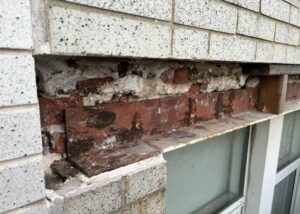
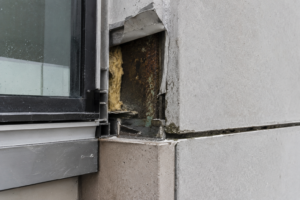
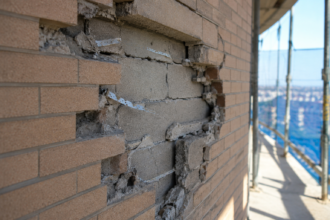
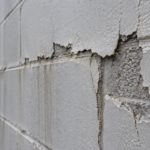
A forensic investigation on a 1960s-era brick multifamily building in Minneapolis reveals widespread spalling and interior water staining eighteen months after an elastomeric coating was applied as a cost-effective waterproofing upgrade. The coating is intact.
Visually unblemished. The damage is entirely behind it.
This scenario is no longer an outlier; it is becoming a pattern that envelope consultants are being called to explain after the fact, usually under litigation pressure and always at significant cost to building owners who believed they were solving a problem.
Why Elastomeric Coatings Keep Getting Specified: And Why That’s a Problem
The market logic is straightforward. Aging institutional and multifamily building stock is entering renovation cycles with constrained capital budgets and surface-applied elastomeric coatings position themselves as a fraction of the cost of full facade remediation.
Manufacturers market these products as vapor-permeable and crack-bridging, which creates a perception of universal suitability across substrate conditions. That perception is doing real damage.
Specifiers frequently rely on product data sheets rather than substrate-specific forensic assessment before writing the specification. The data sheet lists perm ratings, elongation percentages and bond strength values measured under controlled laboratory conditions.
None of those numbers account for what is actually on the wall face. ASTM D6083 governs liquid-applied acrylic coatings in roofing applications; elastomeric wall coating standards are considerably less prescriptive, which contributes directly to loose specification practices.
Manufacturer-cited perm ratings typically fall between 10 and 20 perms, but those values are almost never verified under field conditions on actual substrates. The gap between product capability and substrate condition is not a gray area.
It is where failures originate.
The procurement model accelerates the problem. On design-build and construction management at-risk projects, the coating specification is frequently written by a general contractor’s estimating team referencing a prior project’s product list rather than by an envelope consultant with current substrate data.
The owner receives a line item that reads “elastomeric waterproofing coating, applied per manufacturer instructions” and has no mechanism to evaluate whether that specification is appropriate for the actual facade condition. Peer review of coating specifications on remedial projects is uncommon.
When it does occur, the review typically focuses on product selection rather than substrate suitability criteria, which means the fundamental question of whether any surface-applied coating is appropriate for this assembly goes unasked until the forensic investigation begins.
How Elastomeric Coatings Are Supposed to Work: The Ideal Substrate Assumption
The mechanism is legitimate in theory. A flexible polymer film bridges hairline cracks, sheds bulk water at the facade surface and allows some vapor diffusion outward through the coating.
On the right substrate, under the right conditions, the system performs as advertised. The problem is the substrate assumption embedded in every product data sheet.
The system functions correctly only on clean, sound, uncoated, non-contaminated masonry with no active moisture drive from either direction. That substrate condition is rare on any building over twenty years old.
Vapor permeance ratings generated per ASTM E96 are measured on clean film specimens suspended across a test cup. Those specimens do not replicate layered, contaminated or previously painted masonry surfaces.
A coating that tests at 12 perms on a clean film specimen may deliver effective system permeance below 1 perm when applied over existing paint or salt-contaminated brick. That is not a marginal difference; it crosses the threshold from vapor-permeable membrane into vapor retarder territory.
Uncoated CMU typically tests between 5 and 15 perms. Sealing that assembly face with a coating that drops effective permeance below 1 perm fundamentally alters the moisture control layer behavior of the entire assembly.
Adhesion compounds the issue: the coating’s bond strength depends entirely on substrate preparation quality and no product can compensate for a compromised bond plane.
The elongation performance claims require the same scrutiny. Manufacturers cite elongation values of 100 to 300 percent measured on clean film specimens under ASTM D412 tensile testing conditions.
Those values describe the coating film in isolation, not the coating bonded to a substrate undergoing differential thermal movement. A brick facade with a dark coating color in a high solar exposure orientation can experience surface temperatures exceeding 150 degrees Fahrenheit in summer and drop below zero in winter.
That thermal range generates movement at mortar joints and brick unit faces that the coating must accommodate while remaining bonded to the substrate. If the bond plane is compromised by existing paint, salt contamination or carbonation, elongation capacity is irrelevant.
The film separates from the substrate before it ever reaches its elongation limit.
The Three Substrate Conditions That Guarantee Failure
Three substrate conditions, individually or in combination, make elastomeric coating application a liability rather than a repair.
Active efflorescence is the first. Soluble salts migrating to the wall face are sealed in by the coating before they can exit the assembly.
Salt crystallization pressure, documented in BIA Technical Note 23A, generates tensile stress at the coating-to-masonry interface that exceeds both coating bond strength and mortar tensile capacity. The result is subflorescence: salt crystals forming behind the coating face rather than on it, producing the spalling and delamination pattern that forensic investigations find repeatedly.
The coating looks fine from the street. The brick face is fracturing behind it.
The salt species present matters significantly to the failure timeline. Sodium sulfate, one of the most common efflorescence salts in brick masonry, undergoes a phase transition between its anhydrous form (thenardite) and its hydrated form (mirabilite) at approximately 32 degrees Fahrenheit.
That phase transition involves a volumetric expansion of roughly 315 percent. In a coated assembly where salts cannot migrate to the surface and dissolve, that expansion occurs within the pore structure of the brick face shell.
The crystallization pressure generated by sodium sulfate phase cycling has been measured in laboratory studies at values exceeding 1,000 psi, which is well above the tensile strength of most brick units. A single winter season is sufficient to initiate spalling in a high-salt, coated assembly.
By the second winter, the damage is extensive and the coating remains visually intact.
Carbonation of mortar and CMU is the second condition. Carbonated substrate has reduced alkalinity and altered surface chemistry that compromises coating adhesion at a molecular level.
Carbonation depth testing using the phenolphthalein indicator method, referenced in EN 14630 and applied in North American forensic practice, identifies the depth of this compromised zone. When carbonation exceeds 10mm, the bond zone is effectively unreliable.
This test is almost never performed pre-application on remedial coating projects. ASTM C67 absorption testing can identify moisture-saturated units, but carbonation assessment requires a separate protocol that most pre-application inspections skip entirely.
Existing paint layers are the third condition and arguably the most common. Prior latex or oil-based paint creates a weak bond plane between the coating and the masonry.
The elastomeric coating adheres to the paint, not the brick or CMU. Under thermal cycling or moisture pressure, the entire assembly, coating plus paint layer, delaminates as a unit.
Adhesion pull-off testing before specification would identify this condition. It rarely happens.
On buildings constructed before 1978, existing paint layers also introduce lead content that affects both surface preparation requirements under EPA RRP rules and disposal classification for removed coating material. That regulatory dimension is frequently overlooked in pre-application planning and it adds cost and schedule impact to any remedial preparation work that the original specification budget did not anticipate.
The Moisture Trap Mechanism: What Happens Inside the Wall After Coating
Once the coating is applied over a compromised substrate, the assembly physics shift in a direction the building owner does not expect. The coating reduces outward vapor drive at the exterior face.
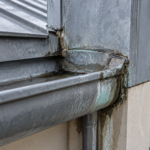
Moisture that enters through cracked mortar joints, window perimeter gaps, parapet base conditions or fenestration sill flashing failures cannot exit through the coated face. It accumulates in the masonry assembly.
In IECC Climate Zones 5, 6 and 7, that trapped moisture undergoes freeze-thaw cycling within the brick or CMU face shell. ASTM C666 establishes freeze-thaw resistance parameters for concrete, but coated masonry assemblies are not tested under this standard.
The data that exists assumes uncoated, freely draining conditions. Masonry units with initial rates of absorption above 17g per 30 minutes, per ASTM C67, are high-risk candidates for freeze-thaw spalling when coated; the coating prevents the surface drying that would otherwise occur between freeze events.
Interior vapor drive compounds the problem. Heated buildings in cold climates push moisture vapor toward the exterior face.
With the coating acting as an exterior vapor retarder, the dew point shifts into the masonry assembly itself. ASHRAE 160 provides the moisture control design analysis framework for evaluating this condition and when you run the numbers on a coated brick assembly in Minneapolis with interior relative humidity at 35 percent and exterior temperatures at minus 10 degrees Fahrenheit, the dew point lands squarely in the outer wythe.
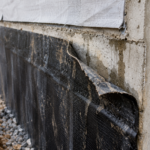
Hydrostatic pressure buildup behind the coating film eventually exceeds adhesion strength. Delamination presents as bubbling, tenting or full-sheet loss.
By that point, the spalling has already been occurring for months.
The parapet condition deserves specific attention because it concentrates every failure mechanism simultaneously. Parapets are exposed on three sides, receive direct precipitation on the top surface, experience the most extreme thermal cycling of any wall element and are frequently the location of the most deteriorated mortar joints on the building.
When an elastomeric coating is applied continuously from the field of the wall up and over the parapet cap, it creates a sealed enclosure around the most moisture-loaded masonry element on the facade. Drainage is eliminated.
Vapor cannot exit. Salt concentrations are highest in this zone because capillary rise from the roof membrane termination and wind-driven rain both deliver soluble minerals to the parapet assembly continuously.
Forensic investigations on failed coating projects almost always find the most severe spalling concentrated at the parapet and at the first two to three courses of brick below it. That spatial pattern is diagnostically significant: it tells the investigator that moisture loading, not coating adhesion failure in isolation, is driving the damage.
What Forensic Investigations Actually Find: Failure Patterns and Diagnostic Indicators
Forensic findings on failed elastomeric coating assemblies follow a consistent pattern. Investigators remove sections of intact, visually unblemished coating and find spalled brick face beneath it.
Efflorescence deposits are visible at the coating-to-masonry interface on removed samples, confirming that salt migration continued after coating application. Interior gypsum board staining appears with no visible exterior breach, which consistently misleads building management into assuming fenestration failure before the envelope consultant arrives.
Because the coating masks visual indicators at the facade surface, non-destructive investigation is essential before any destructive sampling. Infrared thermography maps moisture distribution behind intact coatings by identifying thermal anomalies associated with evaporative cooling and thermal mass differences.
Nuclear moisture meters provide quantitative readings through the coating film. Together, these tools let the investigator develop a moisture map of the assembly before cutting a single core.
Core sampling followed by petrographic examination per ASTM C856 provides the definitive substrate assessment: carbonation depth, salt content, existing paint layer stratigraphy and the condition of the mortar-to-unit interface. Claims patterns from post-application spalling typically manifest 12 to 36 months after coating installation, almost always following the first or second winter freeze-thaw cycle.
That timeline is long enough that building owners rarely connect the damage to the coating application without a forensic consultant making the case explicitly.
Infrared thermography requires specific conditions to produce reliable data on coated masonry. The facade must be undergoing a thermal transition, either warming after a cold night or cooling after solar loading, to generate the differential that the camera detects.
Surveys conducted at midday on an overcast day with no prior solar loading produce ambiguous results. Experienced investigators schedule thermographic surveys for early morning after a clear cold night, when the thermal gradient between wet and dry masonry zones is at its maximum.
ASTM C1153 provides the standard practice for infrared thermography of building envelopes and should be referenced in the investigation protocol. Findings from a thermographic survey that does not meet the thermal delta requirements specified in C1153 are not defensible in a claims context and opposing counsel on construction defect litigation will challenge survey methodology as a matter of course.
Documentation of the failure pattern in three dimensions, mapping spalling locations by elevation, orientation and proximity to penetrations, frequently reveals the moisture entry path that the coating concealed. North-facing facades in cold climates show more severe damage than south-facing facades on the same building because they receive less solar-driven drying.
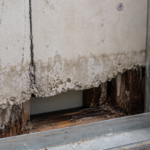
Spalling concentrated within 18 inches of window perimeter conditions identifies sill flashing failure as the primary moisture entry mechanism rather than diffuse wall absorption. That spatial analysis is what separates a forensic investigation from a simple damage assessment and it is the foundation of the remediation scope that follows.
What Pre-Application Assessment Should Actually Include
The specification gap on elastomeric coating projects is not primarily a product selection problem. It is a substrate assessment problem.
A defensible pre-application protocol includes, at minimum: pull-off adhesion testing on representative substrate locations per ASTM D4541, initial rate of absorption testing per ASTM C67 to screen for moisture-saturated units, phenolphthalein carbonation depth testing at multiple facade locations and visual plus probe assessment for active efflorescence. If any existing paint layers are present, the protocol must include bond strength testing of that layer independently before assuming the elastomeric coating can bridge over it.
The sampling density for pre-application assessment matters as much as the test selection. A single pull-off test on a representative wall section does not capture the variability that exists across a facade with multiple prior paint applications, localized salt concentrations and differential weathering by orientation.
ASTM D4541 pull-off testing should be conducted at a minimum of one test location per 500 square feet of facade area, with additional tests at any location showing visible efflorescence, staining or prior repair. Carbonation depth testing should include samples from each primary facade orientation and from the parapet zone independently, since carbonation rates vary with exposure.
IRA testing per ASTM C67 requires extracted units, which means the protocol must include core extraction at locations identified as high-risk by the absorption and carbonation screening. That extraction scope should be written into the assessment contract before the field work begins, not added as a change order after the initial findings identify the need.
None of this is exotic. All of it is executable within a reasonable assessment budget.
The barrier is not cost; it is the expectation, set by the renovation project delivery model, that a coating specification requires only a product data sheet review and a surface cleaning specification. That expectation needs to change before the coating goes on the wall, not after the spalling shows up.
The Specification Decision No Data Sheet Can Make for You
Elastomeric coatings are not inherently defective products. Applied over a genuinely sound, clean, uncontaminated masonry substrate with no active moisture drive and no existing coating layers, they can extend facade service life and reduce bulk water intrusion at the surface.
The product is not the problem. The problem is applying a product with a narrow range of suitable substrate conditions to a building stock that almost never presents those conditions without significant remedial preparation first.
If the substrate assessment reveals active efflorescence, carbonation beyond 5mm or any existing paint layer with marginal adhesion, the elastomeric coating specification should be rejected in favor of a system that addresses the underlying condition rather than sealing over it. That may mean full repointing, masonry cleaning and salt neutralization treatment before any coating is considered.
It may mean accepting that this particular facade requires a different water control strategy entirely, including a drained cavity rainscreen approach that does not rely on a surface-applied film as the primary water control layer. The coating option is not always on the table.
Recognizing that early is the difference between a successful remedial project and a forensic investigation eighteen months later.
The cost comparison that makes elastomeric coating specifications attractive in the first place deserves a more complete accounting. A coating application on a 20,000-square-foot facade might be priced at $3 to $6 per square foot installed, against $15 to $25 per square foot for full repointing and masonry restoration.
That differential is real. What the comparison omits is the cost of failure: spalling brick removal and replacement, interior water damage remediation, mold assessment and abatement where applicable, the coating removal cost itself and the professional fees associated with the forensic investigation and any resulting claims process.
On the Minneapolis building that opened this article, the remediation cost after coating failure exceeded the original facade restoration budget by a factor of three. The coating specification saved money for approximately sixteen months.
After that, it became one of the more expensive decisions the building owner had made in a decade of property management.