Data Centers and the Building Envelope: Why Enclosure Performance Has Become Mission-Critical
Introduction
Data center construction has become one of the fastest-growing sectors in commercial building development. Driven by cloud computing, artificial intelligence, edge computing, and increasing digital infrastructure demands, owners are investing billions of dollars into new facilities across North America.
While discussions often focus on power availability, cooling systems, and IT equipment, the building envelope plays a critical role in data center performance, reliability, and long-term operational costs. Unlike many commercial buildings where occupant comfort drives design decisions, data centers prioritize environmental control, uptime, resiliency, and risk mitigation.
For building envelope consultants, architects, and contractors, data centers present a unique set of challenges that differ significantly from traditional office, healthcare, or educational facilities. The consequences of enclosure failures can extend far beyond repair costs, potentially affecting mission-critical operations and creating substantial financial exposure.
Why the Building Envelope Matters More in Data Centers
The primary purpose of a data center enclosure is to maintain a highly controlled interior environment while protecting sensitive equipment from external conditions.
Servers, networking equipment, and electrical infrastructure generate significant heat and require carefully managed temperature and humidity conditions. Any uncontrolled air leakage, moisture intrusion, or thermal inconsistency can place additional strain on mechanical systems designed to maintain those conditions.
Envelope performance directly affects:
- Cooling efficiency
- Energy consumption
- Moisture management
- Indoor environmental stability
- Equipment reliability
- Operational resilience
As operators pursue lower Power Usage Effectiveness (PUE) metrics, enclosure performance becomes increasingly important. Air leakage and thermal inefficiencies force cooling systems to work harder, increasing operational costs over the life of the facility.
In many cases, relatively small improvements in enclosure performance can translate into substantial energy savings due to the continuous nature of data center operations.
Airtightness Is a Primary Design Objective
For most commercial buildings, air leakage is one component of overall envelope performance. In data centers, airtightness often becomes a primary design objective.
Uncontrolled air infiltration can introduce:
- Heat gain
- Heat loss
- Humidity fluctuations
- Airborne contaminants
- Additional cooling loads
Data centers typically operate 24 hours a day, 365 days a year. Even minor leakage pathways can create persistent inefficiencies that accumulate over time.
As a result, many owners establish aggressive air barrier performance requirements and often require whole-building air leakage testing as part of project acceptance.
Successful projects typically focus on:
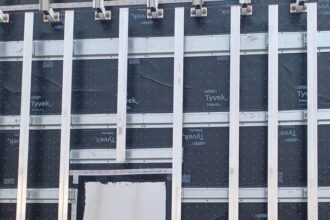
- Continuous air barrier design
- Detailed transition conditions
- Penetration management
- Mockup validation
- Quality assurance during construction
Mechanical and electrical penetrations deserve particular attention. Data centers contain extensive infrastructure systems, creating numerous opportunities for discontinuities in the air barrier if coordination is inadequate.
Moisture Control and Condensation Risk
Moisture management remains one of the most significant building enclosure concerns for data centers.
While the facility may not have occupants sensitive to comfort issues, moisture intrusion can threaten critical equipment, electrical systems, and operational continuity.
Key risks include:
Exterior Water Intrusion
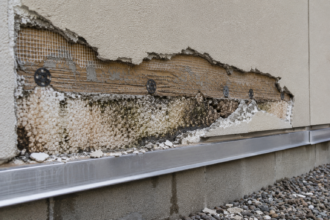
Data centers are often large structures with expansive wall and roof areas. Any weakness in the water management strategy can create opportunities for leakage.
Common risk areas include:
- Roof penetrations
- Equipment curbs
- Expansion joints
- Facade transitions
- Mechanical intake locations
Because many facilities contain extensive electrical infrastructure, even minor water intrusion events can become serious operational concerns.
Condensation Within Assemblies
Data centers frequently maintain interior temperatures that differ substantially from exterior conditions. Combined with varying humidity levels, this can create elevated condensation potential within wall and roof assemblies.
Envelope designers must carefully evaluate:
- Dew point location
- Thermal bridging
- Vapor control strategies
- Insulation continuity
- Climate-specific enclosure behavior
Traditional assembly details may not always perform as expected under data center operating conditions.
Roofing Systems as Critical Infrastructure
For many building types, roofing systems are viewed primarily as weather barriers. In data centers, roofs function as critical infrastructure components.
The roof often supports:
- Mechanical equipment
- Cooling systems
- Electrical infrastructure
- Communications equipment
- Solar installations
The concentration of rooftop systems creates numerous penetrations and coordination challenges.
Design teams should focus on:
Long-Term Durability
Owners typically expect data centers to operate continuously for decades. Roofing assemblies should be selected with lifecycle performance in mind rather than initial cost alone.
Maintainability
Facilities personnel require ongoing access to rooftop equipment. Roofing systems must accommodate maintenance traffic without accelerated deterioration.
Redundancy and Resilience
Many owners prioritize assemblies that reduce the likelihood of operational disruption. Enhanced roof durability can be a key component of broader resiliency strategies.
Resiliency Against Extreme Weather Events
Data centers increasingly support critical business functions, government operations, healthcare systems, and cloud infrastructure. As a result, resiliency has become a central design consideration.
Building enclosure systems must often withstand:
- Severe wind events
- Hurricanes
- Tornadoes
- Hail storms
- Wildfires
- Flooding
- Extreme temperature fluctuations
Regional risk profiles significantly influence enclosure design decisions.
For example:
High-Wind Regions
Facilities located in hurricane-prone areas often require enhanced roof attachment, impact-resistant assemblies, and robust facade systems.
Wildfire-Prone Areas
Exterior materials, ventilation strategies, and ember resistance become important considerations in wildfire exposure zones.
Cold Climate Facilities
Thermal performance, condensation resistance, and snow management become dominant concerns.
Rather than relying solely on code minimums, many data center operators establish performance criteria that exceed baseline regulatory requirements.
Security Considerations and Facade Design
Unlike conventional office buildings, data centers often have limited fenestration and highly controlled access points.
Security requirements frequently influence enclosure design decisions.
Common characteristics include:
- Minimal glazing
- Hardened exterior walls
- Controlled entry points
- Blast-resistant considerations
- Enhanced perimeter security
The resulting buildings may appear relatively simple from an architectural perspective, but enclosure detailing often becomes more demanding due to performance expectations.
Reduced glazing can improve thermal performance and security while simplifying environmental control. However, designers must still address thermal bridging, moisture management, and constructability at facade transitions.
Constructability Challenges
Data center schedules are often aggressive.
Owners seek rapid deployment to meet growing demand, and contractors frequently work under compressed timelines. These conditions can increase building enclosure risks if quality control processes are not carefully maintained.
Common challenges include:
Trade Coordination
Numerous building systems intersect with the enclosure, including:
- Electrical infrastructure
- Backup power systems
- Mechanical systems
- Communications systems
- Security systems
Poor coordination can compromise air barriers, waterproofing, and thermal continuity.
High Penetration Density
The quantity of penetrations often exceeds that of many traditional commercial buildings. Every penetration represents a potential performance vulnerability.
Rapid Construction
Accelerated schedules may limit opportunities for inspection, testing, and corrective work unless quality assurance processes are established early.
Testing and Commissioning the Enclosure
Many sophisticated data center projects now incorporate enclosure commissioning as part of broader facility commissioning programs.
Testing may include:
- Air leakage testing
- Water penetration testing
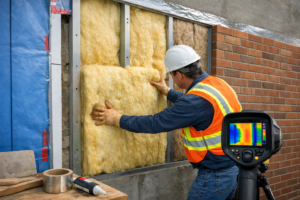
- Infrared thermography
- Roof inspections
- Mockup performance testing
These activities help identify deficiencies before occupancy and reduce the likelihood of operational disruptions later.
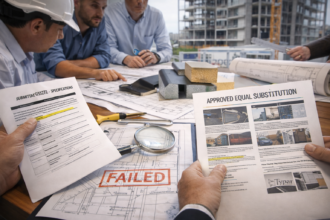
Mockups are particularly valuable because they allow project teams to evaluate complex interfaces before large-scale installation begins.
For mission-critical facilities, discovering enclosure deficiencies after commissioning can be significantly more expensive than addressing them during construction.
Common Building Envelope Mistakes in Data Center Projects
Several recurring issues appear across data center developments:
Treating the Envelope as Secondary Infrastructure
Power and cooling systems understandably receive significant attention. However, enclosure deficiencies can undermine the performance of those systems.
Inadequate Air Barrier Coordination
Discontinuities often occur at transitions between trades and building systems.
Overlooking Condensation Analysis
Assemblies that perform adequately in conventional buildings may experience unexpected moisture behavior under data center operating conditions.
Excessive Rooftop Complexity
As equipment density increases, roofing systems become more vulnerable to long-term maintenance and leakage issues.
Limited Quality Assurance
Compressed schedules sometimes reduce inspection opportunities, increasing the likelihood that deficiencies remain hidden until after occupancy.
The Future of Data Center Enclosure Design
The rapid expansion of artificial intelligence and cloud infrastructure is driving unprecedented demand for data center construction. As facilities become larger, more energy-intensive, and more critical to business operations, expectations for enclosure performance will continue to increase.
Several trends are likely to shape future projects:
- More stringent airtightness requirements
- Greater emphasis on energy efficiency
- Increased enclosure commissioning
- Enhanced resilience standards
- Greater use of prefabricated envelope components
- Expanded lifecycle performance analysis
Owners increasingly recognize that the building envelope is not merely an exterior skin. It is a critical operational system that directly influences energy consumption, reliability, maintenance costs, and facility resilience.
Conclusion
Data centers present a unique challenge for building envelope professionals. While power and cooling systems often dominate project discussions, enclosure performance remains fundamental to operational success.
Air leakage, moisture intrusion, thermal deficiencies, and durability issues can all affect mission-critical environments where downtime carries significant financial consequences. As demand for data center construction continues to accelerate, owners and design teams that prioritize building enclosure performance from the earliest stages of design will be better positioned to deliver facilities that are efficient, resilient, and reliable over the long term.
For modern data centers, the building envelope is no longer simply a protective shell. It has become an integral component of the infrastructure that supports continuous operation and long-term performance.