Zinc Cladding in North American Commercial Facades: Corrosion Compatibility, Substrate Requirements and the Specification Gaps That Create Long-Term Risk
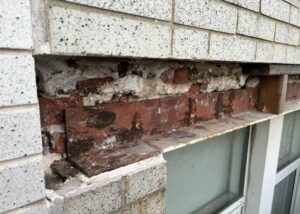
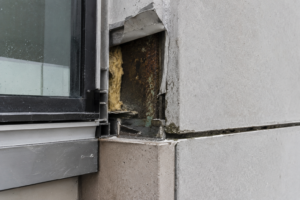
A civic library project in the mid-Atlantic region, completed in 2019, began showing aggressive white-rust streaking and underside pitting on its zinc rainscreen panels within 18 months of occupancy. The failure did not appear on the exposed weather face.
It appeared on the concealed cavity side, facing a pressure-treated plywood substrate. The mechanism was acetic acid off-gassing from the plywood reacting with the zinc in a poorly ventilated 3/4-inch cavity during summer humidity cycles.
The project architect had specified zinc based on a manufacturer’s standard detail with no substrate compatibility notation and no cavity depth guidance beyond “provide ventilation. ” That phrase, “provide ventilation,” appears in more zinc specifications than it should.
It tells an installer nothing and protects no one.
Why Zinc Is Arriving on North American Facades Without Its European Instruction Manual
Zinc facade systems carry a 60-plus year performance record in Belgium, Germany and France. That record exists because specifier education, product standards and detailing conventions are embedded in professional practice and national technical documents.
DTU 40.41, the French technical document governing zinc roofing and cladding, establishes substrate compatibility requirements, cavity geometry and fastener material restrictions as baseline conditions, not optional guidance. Germany’s DIN EN 988 does the same for material properties.
There is no direct North American equivalent to either document.
North American adoption is being driven almost entirely by aesthetic demand. Architects want the pre-weathered matte gray and the natural patina progression.
That is a legitimate design objective. The problem is that the aesthetic arrives without the accompanying transfer of substrate discipline or cavity design rigor from European technical literature.
Domestic product representatives and CSI-formatted specification guides frequently omit or minimize substrate compatibility warnings. The burden of discovery falls on the specifier, who may be encountering zinc for the first time on a project.
This is not a material failure. Zinc performs exceptionally when detailed correctly.
It is a specification and education failure specific to the North American market context and it is producing field failures that were entirely preventable.
The gap between European practice and North American practice is not theoretical. European zinc installers complete formal apprenticeship programs that include substrate compatibility training as a core module.
North American installers typically learn zinc panel installation by transferring skills from aluminum composite or fiber cement work, where substrate chemistry is not a primary concern. The installer who set the panels on the library project described above had installed zinc on two previous projects without incident, both of which used fiber cement sheathing.
The third project used pressure-treated plywood because the structural engineer of record had specified it for racking resistance and no one in the project communication chain flagged the incompatibility. The specification did not prohibit it.
The submittal review did not catch it. The pre-installation conference, if one occurred, did not address it.
That sequence of missed checkpoints is not unusual. It is the standard failure pattern in North American zinc projects that go wrong.
Zinc Corrosion Fundamentals: What the Material Actually Needs to Perform
Zinc’s long-term durability depends on the formation of a stable zinc carbonate patina on the exposed face. That patina, technically a zinc hydroxycarbonate layer, requires cyclic wetting and drying with access to atmospheric CO2. The process takes two to five years to complete on a well-exposed surface in a temperate climate.
The result is a dense, adherent layer that dramatically reduces the ongoing corrosion rate.
None of those conditions exist on the concealed cavity face. That surface cannot form a protective patina.
It accumulates condensation. It sits in proximity to substrate materials that may be chemically incompatible.
The concealed underside of a zinc panel is the most vulnerable surface in the assembly and most specifications treat it as an afterthought.
Galvanic corrosion risk is real and frequently underestimated. Zinc is anodic relative to copper, carbon steel fasteners and the copper compounds found in treated lumber preservatives.
Even indirect ionic contact through moisture bridging can initiate corrosion at rates that outpace any protective mechanism the material can generate on a concealed face.
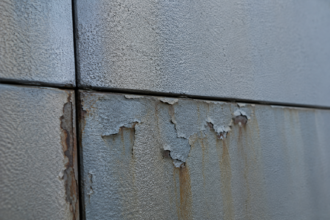
The distinction between white rust and pitting corrosion matters for assessment and remediation decisions. White rust is zinc hydroxide, early-stage and sometimes reversible if the moisture source is eliminated and the surface can dry.
Pitting corrosion driven by zinc chloride or zinc acetate attack is irreversible and structurally progressive. By the time pitting is visible on a concealed face, the panel has already lost meaningful section.
ASTM B69 governs rolled zinc for North American supply and EN 988 sets mechanical property minimums for architectural-grade strip that ASTM B69 does not fully replicate. Specifying to ASTM B69 alone is not sufficient for facade-grade material.
Understanding the electrochemical sequence helps specifiers make better decisions about assembly design. When zinc sits in a humid cavity adjacent to an incompatible material, the corrosion process does not wait for liquid water contact.
Relative humidity above approximately 70 percent sustained over extended periods is sufficient to form an electrolytic film on the zinc surface. That film, even at microscopic thickness, is enough to complete a galvanic circuit if ionic species from an incompatible material are present in the cavity air.
Acetic acid vapor from off-gassing wood products dissolves into that film and creates the electrolyte. The zinc becomes the anode.
The corrosion current flows. None of this requires a visible water event, which is why cavity-side failures on zinc projects frequently surprise project teams who believe the assembly is performing well because no bulk water intrusion has been detected.
The assembly can be completely watertight at the weather face and still be destroying the zinc panel from the back side through vapor-phase chemistry alone.
The Substrate Compatibility Problem: Materials That Should Never Touch Zinc
Pressure-treated lumber is the single most common incompatible substrate in North American rainscreen construction. ACQ, CA and copper azole treatments all contain copper compounds.
Copper ions migrate via moisture and create galvanic attack on zinc at contact or near-contact points. The zinc is anodic in that pairing and corrodes preferentially.
This is not a subtle or slow process in a humid cavity. It is aggressive and it is irreversible.
OSB and certain plywood products off-gas acetic acid as they cure and during humidity cycling. In a poorly ventilated cavity, acetic acid concentration reaches levels sufficient to initiate zinc acetate corrosion on the panel underside.
That is precisely the mechanism behind the library failure described above. The plywood was not in direct contact with the zinc.
It did not need to be. The chemistry traveled through the air in a cavity that could not flush itself.
Concrete and masonry substrates present an alkalinity risk that is less commonly discussed but equally real. Fresh or carbonating concrete releases calcium hydroxide, which attacks zinc in wet conditions.
Zinc is amphoteric; it corrodes in both acidic and strongly alkaline environments. Specifiers who assume that masonry is a safe substrate for zinc are working from incomplete information.
Compatible substrate materials include fiber cement sheathing, glass-mat gypsum sheathing when kept dry, aluminum subframing and stainless steel or hot-dip galvanized fasteners. ICC-ES AC235, the acceptance criteria for rainscreen wall cladding systems, does not address substrate-to-cladding chemical compatibility.
That omission is a meaningful specification gap. The de facto guidance documents currently filling that void are technical bulletins published by zinc material suppliers, which creates an obvious conflict of interest that specifiers should account for when evaluating the guidance.
The practical implication for project specifications is that substrate material selection cannot be left to the structural engineer or the general contractor without explicit constraints in the facade specification. On many commercial projects, the sheathing type is determined by the structural engineer of record based on diaphragm and shear wall requirements and the facade specification is written independently by the architect or facade consultant.
Those two documents frequently do not cross-reference each other. The structural engineer specifying ACQ-treated plywood blocking at base conditions or at penetration framing is not thinking about zinc panel chemistry.
The facade specifier writing the zinc panel section is not reviewing the structural drawings for blocking material callouts. That coordination gap is where the library failure originated and it is where a significant percentage of North American zinc facade failures originate.
The fix is not technically complex. It requires a single line in the zinc specification that reads, in substance: pressure-treated lumber, OSB and untreated plywood are prohibited as substrates or blocking materials within 12 inches of the zinc panel cavity.
That line does not currently appear in most project specifications.
Cavity Depth, Ventilation and Drainage: Where North American Details Fall Short
European practice consistently specifies a minimum 20mm cavity depth (approximately 3/4 inch) as an absolute floor, with 30 to 40mm (1-1/4 to 1-1/2 inch) recommended in humid or coastal climates. North American details routinely show 3/4-inch cavities as standard without any climate-zone adjustment.
A 3/4-inch cavity in IECC Climate Zone 4A or 5A is not equivalent to a 3/4-inch cavity in a dry continental climate. The moisture loading is categorically different.
Ventilation ratio matters as much as cavity depth. The ratio of open inlet area at the base to open outlet area at the top must be sufficient to drive convective drying.
Undersized or obstructed weep and vent conditions trap moisture against the panel underside for extended periods. This is not a zinc-specific problem, but zinc is less forgiving of prolonged underside moisture exposure than fiber cement or aluminum composite panels.
Horizontal panel joints and Z-girt framing configurations create moisture dams within the cavity that interrupt vertical drainage and ventilation paths. This detail problem is endemic in North American rainscreen practice regardless of cladding material.
With zinc, it is particularly consequential because the trapped moisture accumulates against a surface that cannot develop a protective patina.
Cavity insulation placement directly affects dew point location and condensation risk on the back face of the zinc panel. In Climate Zones 5 and above per ASHRAE 90.1-2022, continuous exterior insulation within the cavity can push the dew point to the panel’s interior face under winter design conditions.
The water, air, vapor and thermal control layers must be sequenced to keep the zinc panel back-face temperature above the dew point during the design heating season. Specifiers who add cavity insulation to improve the assembly’s effective R-value without rechecking dew point location are trading one risk for another.
The ventilation ratio question deserves more specific treatment than it typically receives in North American project documents. German practice under the guidelines associated with DIN 18516-1 for ventilated facade cladding establishes a minimum open inlet area of 50 square centimeters per linear meter of wall base, with an equivalent open area at the top.
Translating that to North American units gives approximately 0.93 square inches of open area per linear foot of wall base. A standard 3/4-inch by 3/4-inch weep slot at 24 inches on center provides approximately 0.56 square inches per linear foot, which falls short of that threshold.
Specifiers who are detailing zinc rainscreens in Climate Zones 4 through 6 and relying on standard weep slot patterns from generic rainscreen details are likely underventilating the cavity. The correction is straightforward: increase weep slot frequency, increase slot dimensions or specify a continuous vented base channel product designed to meet the open-area requirement.
Any of those solutions works. The problem is that the calculation is almost never performed, because the specification language says “provide ventilation” and the detail shows a generic weep slot and no one on the project team has been assigned responsibility for verifying that the combination actually meets a defined performance threshold.
Fastener and Subframing Material Selection: The Detail That Ends Careers
Zinc panel systems require fastener and subframing materials that will not initiate galvanic corrosion at the attachment point. This sounds straightforward.
In practice, it fails constantly because project specifications call for “corrosion-resistant fasteners” without specifying the alloy and field crews install carbon steel or electroplated zinc fasteners that are not appropriate for the application.
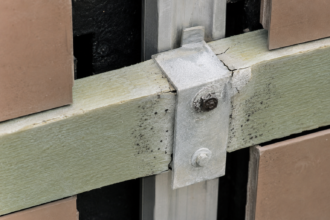
Stainless steel fasteners, minimum 304 alloy and 316 in coastal environments, are the correct choice for direct zinc contact. Hot-dip galvanized fasteners are acceptable in some configurations but require verification that the zinc coating weight meets ASTM A153 Class C minimums.
Electroplated zinc fasteners are not acceptable. The coating is too thin to prevent galvanic interaction over a 30-year service life.
Aluminum subframing is compatible with zinc. Steel subframing requires a thermal break material between the steel and the zinc panel that also serves as a galvanic isolation layer.
Specifying a thermal break pad for thermal performance without confirming its chemical compatibility with zinc is a detail gap that appears in more project documents than it should.
The field substitution problem compounds the specification gap. A specification that correctly calls for 304 stainless fasteners will frequently see electroplated or mechanically galvanized fasteners substituted during procurement because they are cheaper and more readily available through standard fastener distributors.
The substitution may appear on a submittal as “corrosion-resistant fasteners per specification,” and a reviewer who does not know to check the coating type and thickness will approve it. ASTM F593 covers stainless steel bolts and screws and ASTM F594 covers stainless steel nuts.
Referencing those standards by designation in the specification, rather than using the generic phrase “corrosion-resistant,” gives the submittal reviewer a specific compliance benchmark to check against. It also gives the contractor a clear standard that cannot be met by an electroplated substitute, which closes the substitution pathway before it opens.
The additional cost of 304 stainless fasteners over electroplated alternatives on a typical commercial zinc rainscreen project is measurable in hundreds of dollars. The cost of remediating a fastener-point corrosion failure across a building facade is measurable in hundreds of thousands.
That arithmetic should appear in every owner conversation about value engineering the fastener specification.
What a Defensible Zinc Specification Actually Contains
A specification that protects the project and the specifier addresses four things that most current zinc specs omit or understate. First, it identifies prohibited substrate materials by treatment type and product category, not just by generic name.
Second, it establishes minimum cavity depth by IECC climate zone, not as a single universal dimension. Third, it requires ventilation ratio calculations or prescriptive open-area minimums at base and top of cavity.
Fourth, it specifies fastener and subframing alloys by ASTM designation, not by performance description.
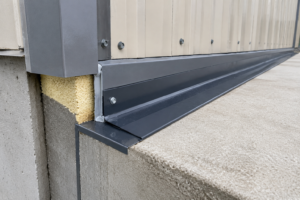
The specification should also require a pre-installation conference that includes the zinc installer, the sheathing installer and the waterproofing subcontractor. The water control layer transition at the base of the zinc rainscreen assembly is where most of the moisture intrusion failures I have investigated originate.
Getting those three trades in the same room before work starts costs nothing compared to the remediation cost of a failed assembly.
Beyond those four core requirements, a defensible specification addresses two additional items that are consistently absent from standard zinc spec sections. The first is a mockup requirement with a defined observation period.
A full-scale field mockup of the base condition, a horizontal joint condition and a penetration condition, observed after the first full heating and cooling season, will reveal cavity drainage and ventilation deficiencies before they are replicated across the entire building face. Most zinc specifications either omit the mockup requirement entirely or specify a mockup for aesthetic approval only, with no performance observation period.
Aesthetic mockups are evaluated within days of installation. Performance problems in the cavity take months to manifest.
The mockup requirement needs to distinguish between those two evaluation objectives and assign a responsible party for each. The second absent item is a maintenance protocol.
Zinc rainscreen assemblies require periodic inspection of the cavity base condition, weep slot clearance and fastener head condition. That inspection protocol should be written into the specification as a contractor deliverable, handed to the owner at substantial completion as part of the operations and maintenance manual.
Owners who receive no maintenance guidance for a zinc facade will not inspect the cavity base condition until water appears inside the building, at which point the assembly has already been failing for an extended period.
The Longer View on Zinc in North American Practice
Zinc will continue to appear on institutional and mixed-use facades. The aesthetic is genuinely distinctive and the material’s long-term performance, when detailed correctly, is difficult to match.
The European track record is real. The problem is that the North American market is importing the finish without importing the technical framework that makes the finish sustainable over a 50-year service life.
The specifiers who will get this right are the ones who treat the concealed cavity face of a zinc panel with the same level of attention they give the exposed weather face. The patina you can see is not the performance risk.
The surface you cannot see, sitting in a 3/4-inch cavity against a pressure-treated substrate with inadequate ventilation in Climate Zone 4A, is where the project fails. Design for that surface first.