
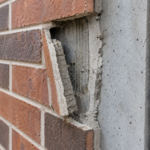
- A two-sentence submittal approval for an EPDM gasket substitution led to $2.1 million in water intrusion remediation on a 12-story tower.
- Matching Shore A durometer numbers do not indicate equal compression set resistance or long-term sealing performance.
- Commodity EPDM compounds can reach 35 to 50% compression set under ASTM D395 conditions while curtainwall-grade neoprene typically achieves 15 to 25%.
- Specifications must require ASTM D2000 compound designations and compression set test data at both 70 and 100 degrees Celsius.
- Reviewers who cannot obtain compound-specific test data from a manufacturer should treat that absence as a rejection criterion.
A forensic investigation on a 12-story commercial tower in the mid-Atlantic region revealed that 340 linear feet of pressure plate gaskets had compressed to less than 40% of their original cross-section within four years of occupancy. Not from design error.
From an approved substitution of EPDM for neoprene that no one flagged during submittal review. The water intrusion claims that followed exceeded $2.1 million in remediation costs.
The substitution request had been approved in two sentences.
Why Gasket Material Selection Is Not a Minor Submittal Decision
Glazing gaskets are the primary air and water seal at pressure plate interfaces and glazing pockets. They are not secondary components.
They are not redundant. In a pressure plate curtainwall assembly, the gasket carries the entire contact-stress burden that keeps water from migrating past the aluminum framing into the interior.
When that contact stress drops below the threshold needed to resist hydrostatic pressure during a wind-driven rain event, the water control layer fails at the first line of defense.
Substitution requests for gasket materials are routinely processed as “equal or better” during construction administration without any material-specific performance comparison. A contractor submits a cut sheet showing matching durometer.
The reviewer approves it. That approval is not technically defensible.
The phrase “equal or better” has no enforceable meaning unless the specification defines which performance properties are being compared and at what threshold. Durometer alone does not define those thresholds.
A reviewer who approves a gasket substitution based on a matching Shore A number has not evaluated the substitution. They have evaluated the label.
The consequences are latent. Compression set failure does not produce a leak on day one.
Leaks typically surface three to seven years post-occupancy, well past the standard construction warranty period. By the time the owner files a claim, the contractor is gone and the submittal log is the only record.
This pattern repeats across the forensic literature on curtainwall failures. The Building Envelope Technology Symposium proceedings document multiple case studies where water intrusion traced directly to gasket compression set failure was not detected until the second or third year of occupancy and in several cases not until a tenant improvement triggered an investigation of persistent interior moisture.
The gap between failure initiation and failure detection is wide enough that the responsible party is rarely identifiable by the time the claim is filed.
This article addresses pressure plate gaskets and glazing pocket gaskets in aluminum curtainwall and storefront systems in the North American commercial construction context. AAMA 501.2 field water testing can confirm an active leak, but it cannot retroactively validate a gasket material that has already failed dimensionally.
Prevention happens at the submittal stage.
Material Fundamentals: What Neoprene and EPDM Actually Are
Neoprene or polychloroprene, is a synthetic rubber built on a chlorine backbone. It has been the default curtainwall gasket material for decades because it offers oil resistance, moderate UV resistance and predictable compression behavior across a range of service temperatures.
Fabricators and installers know how it handles. It extrudes consistently and its dimensional stability under compressive load is well-documented.
The curtainwall industry’s long experience with neoprene means that failure modes are well-characterized, compound formulations are mature and the performance envelope is understood by most glazing contractors and system fabricators. That institutional familiarity has practical value during installation, quality control and field troubleshooting.
EPDM is an ethylene propylene diene monomer terpolymer with a saturated backbone. That saturated backbone is the source of its genuine advantage over neoprene in UV and ozone resistance.
EPDM weathers exceptionally well in exposed conditions and it does not surface-crack the way neoprene does over long service lives in high-ozone environments. Those are real performance benefits.
EPDM is also widely used in roofing membrane systems and automotive weatherstripping, which means the material is manufactured at high volume and available at lower cost than neoprene. That cost differential is part of why substitution requests favor EPDM.
A contractor sourcing gaskets from a roofing or automotive supply chain can undercut a neoprene curtainwall gasket on price while presenting a product that looks equivalent on a cut sheet.
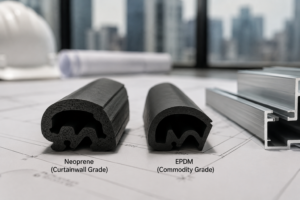
Both materials are available in extruded and molded forms. Both are specified by Shore A durometer hardness, typically 50 to 70 for curtainwall applications.
Durometer is where the comparison usually stops. That is the problem.
Same durometer does not mean same compression set resistance. It does not mean same recovery behavior under thermal cycling.
Two gaskets with identical Shore A readings can behave completely differently after 2,000 thermal cycles in a continental climate. A 60 Shore A neoprene compound formulated specifically for curtainwall service and a 60 Shore A commodity EPDM compound formulated for automotive door seals share a hardness number and nothing else that matters for pressure plate performance.
ASTM D2000 provides the classification system, with designations such as M2AA, M3BC and similar alphanumeric codes, that defines compound requirements beyond hardness including heat resistance, compression set limits and fluid resistance. Specifying only durometer without an ASTM D2000 designation leaves the actual performance of the compound undefined.
Most curtainwall specifications do exactly that.
Compression Set: The Property That Determines Seal Longevity
Compression set is the permanent deformation retained by a rubber compound after a sustained compressive load is removed. It is expressed as a percentage of original deflection.
A gasket with a 20% compression set has permanently lost 20% of its original cross-sectional height after the test load is released. A gasket with a 45% compression set has lost nearly half.
Neoprene compounds formulated for curtainwall service typically achieve compression set values of 15 to 25% per ASTM D395 Method B, which runs 22 hours at 70 degrees Celsius at 25% compression. That is the standard test.
Commodity EPDM compounds can reach 35 to 50% compression set under equivalent conditions. High-performance EPDM formulations can match neoprene.
The range within the EPDM category is wide enough that “EPDM” as a specification term is nearly meaningless without compound-specific test data. A glazing contractor who sources gaskets from three different suppliers over the course of a large project may unknowingly install three different EPDM compounds with three different compression set values, all of which pass a durometer check on the jobsite.
The critical failure mode works like this: as compression set accumulates through repeated thermal cycling, the gasket no longer returns to its original cross-section after each cycle. The aluminum framing moves.
The gasket does not fully follow. Contact stress at the glass-to-frame interface drops.
The seal opens incrementally. No single event causes the leak.
The assembly degrades across hundreds of cycles until the contact stress falls below what the hydrostatic head of a wind-driven rain event requires. The AAMA 501.1 standard test method for water penetration uses a static pressure of 6.
24 psf as a baseline, but actual wind-driven rain events in coastal and high-rise exposures can generate dynamic pressures well above that threshold. A gasket that maintained adequate contact stress at initial installation may fall below the 6.24 psf resistance threshold after three years of thermal cycling if the compound’s compression set is in the 40 to 50% range.
A curtainwall pressure plate gasket in IECC Climate Zones 4 through 6 may experience 2,000 to 3,000 meaningful thermal cycles over a 10-year service life. Each cycle degrades a high-compression-set compound faster than a low-compression-set compound.
Submittal data must include ASTM D395 Method B results at both 70 degrees Celsius and 100 degrees Celsius. Surface temperatures on dark anodized aluminum in direct sun can exceed 80 degrees Celsius in southern U.
S. climates.
Testing only at 70 degrees Celsius understates the actual service condition. Projects in IECC Climate Zones 1 through 3 with dark-colored aluminum framing should treat the 100-degree test as the governing condition, not a supplementary data point.
UV and Ozone Resistance: Where EPDM Has an Advantage
EPDM’s saturated polymer backbone makes it genuinely superior to neoprene in UV and ozone resistance. This is not marketing language.
It is chemistry. Neoprene’s chlorine backbone is susceptible to surface oxidation and ozone cracking over time, particularly in exposed locations at building perimeters in high-UV or high-ozone environments.
That degradation is real and it shortens service life. In urban environments with elevated ground-level ozone concentrations, neoprene gaskets at exposed perimeter conditions can develop surface cracking within five to eight years.
That cracking does not immediately destroy the seal, but it creates pathways for accelerated UV degradation and reduces the material’s long-term recovery capacity.
The substitution argument fails because it conflates two different failure modes. UV and ozone degradation is a surface and material integrity issue.
Compression set failure is a dimensional and contact-stress issue. EPDM’s UV advantage does not offset its compression set risk if the compound is not properly specified.
Approving a substitution based on UV resistance while ignoring compression set data is the equivalent of approving a structural connection based on tensile strength while ignoring shear capacity. The right property for the wrong failure mode.
Context matters here. Glazing pocket gaskets in drained-and-back-ventilated curtainwall assemblies have limited direct UV exposure.
The glass lites shade the pocket. The UV advantage of EPDM is most relevant at exposed perimeter conditions: sill gaskets at open-joint conditions, cap gaskets on sloped glazing and perimeter seals at parapet transitions.
At interior glazing pocket locations, compression set dominates performance and UV resistance is largely irrelevant. The specification should reflect that distinction.
A single gasket specification applied uniformly across all locations in a curtainwall system treats exposed perimeter conditions and shaded interior pocket conditions as equivalent, which they are not. Require ASTM D1171 ozone cracking data for both materials under evaluation at exposed conditions.
At interior pocket conditions, require ASTM D395 compression set data and nothing less. A specification that differentiates by location forces the submittal to address the right failure mode for each condition rather than allowing a single favorable test result to stand in for a complete performance evaluation.
Thermal Cycling Behavior at the Pressure Plate Interface
Curtainwall pressure plates apply a defined compressive load to the gasket during installation. The fastener torque determines initial compression.
The gasket must maintain sufficient contact stress throughout its service life to prevent air and water infiltration at the glass-to-frame interface. That contact stress is not fixed.
It changes with every thermal cycle.
At low temperatures, aluminum contracts and gasket compression increases. At high temperatures, aluminum expands and the compressive load on the gasket decreases.
This creates a ratcheting degradation mechanism. The gasket is repeatedly compressed beyond its design deflection during cold conditions and then asked to recover during warm conditions.
A compound with high compression set recovers less with each cycle. The cumulative effect is a gasket that has permanently lost cross-sectional height and no longer maintains the contact stress the system was designed around.
In a 12-story tower in a continental climate, the differential between a January night at minus 10 degrees Celsius and a July afternoon at 35 degrees Celsius ambient, with aluminum surface temperatures potentially reaching 75 to 85 degrees Celsius in direct sun, represents a thermal excursion that the gasket must survive thousands of times across a 20-year service life. A compound with a 45% compression set does not survive that service life with its sealing function intact.
The specification-to-field gap compounds this problem. Design documents typically specify gasket geometry and durometer.
They rarely specify minimum contact stress requirements or require the gasket manufacturer to demonstrate that the specified compound maintains adequate contact stress after accelerated thermal cycling. ASTM C1401, which covers structural sealant glazing, includes thermal cycling protocols that are instructive for gasket evaluation even though the standard is not written specifically for pressure plate gaskets.
The cycling methodology, which subjects assemblies to repeated temperature excursions between minus 29 degrees Celsius and 88 degrees Celsius, provides a more realistic simulation of service conditions than a static compression set test at a single temperature. Some curtainwall system manufacturers have developed proprietary thermal cycling test protocols for gasket qualification, but those protocols are not consistently required in project specifications and are rarely requested during submittal review.
Pressure plate gasket specifications should require compression set data, thermal cycling test data and a clear statement of minimum acceptable contact stress at end of service life. Most do not.
The submittal reviewer ends up comparing two cut sheets with matching Shore A numbers and calling it equivalent. That comparison does not evaluate the property that determines whether the gasket will still be sealing in year seven.
Reading Submittals and Evaluating Substitution Requests
A gasket substitution submittal that shows only durometer, color and extrusion profile is incomplete. Reject it.
The submittal must include the ASTM D2000 compound designation, ASTM D395 Method B compression set results at 70 degrees Celsius and 100 degrees Celsius and documentation of the compound’s service temperature range. If the substitution is EPDM for neoprene, the submittal must demonstrate that the specific EPDM compound achieves compression set values within the range established for the originally specified neoprene compound.
A submittal that provides the ASTM D2000 designation but omits the compound-specific test data is still incomplete. The designation tells you the classification category.
The test data tells you where within that category the actual compound falls. Both are required.
“Equal or better” cannot be evaluated without performance data. That phrase has no technical meaning unless the reviewer defines the performance properties being compared and requires test data for each.
In practice, substitution approvals are processed under time pressure during construction administration and the path of least resistance is to accept the cut sheet and move on. That is how a $2.1 million water intrusion claim starts.
The time pressure is real. A glazing contractor waiting on a submittal approval before ordering material for a scheduled installation window creates schedule pressure that the construction administrator feels directly.
That pressure does not change the technical requirements, but it changes the decision environment in ways that produce approvals that would not survive a forensic review.
The reviewer’s obligation is to require compound-specific data, not product-category equivalence. EPDM is not a compound.
It is a polymer family with a wide performance range. A high-performance EPDM gasket with a 20% compression set is a legitimate substitution for a neoprene gasket with a 20% compression set, provided the UV and ozone exposure conditions are also evaluated.
A commodity EPDM gasket with a 45% compression set is not. The substitution request does not tell you which one you are getting unless you ask for the test data.
If the manufacturer cannot provide ASTM D395 Method B results for the specific compound being submitted, that absence of data is itself a rejection criterion. Curtainwall gasket compounds formulated for commercial building service have that data.
Compounds that do not have it were not formulated for that application.
What the Specification Should Require Before Construction Starts
The substitution problem is a specification problem before it is a submittal problem. Curtainwall gasket specifications that define requirements only by durometer and material category create the conditions for uninformed substitutions.
Tighten the specification and the submittal review becomes straightforward.
Specify the ASTM D2000 compound designation. Require ASTM D395 Method B compression set results as a submittal requirement, not a post-approval verification.
Set a maximum acceptable compression set value at 70 degrees Celsius and 100 degrees Celsius. For projects in IECC Climate Zones 1 through 3, where surface temperatures on dark aluminum regularly exceed 80 degrees Celsius, the 100-degree test is not conservative.
It is the minimum relevant condition. A specification that sets a maximum compression set of 25% at 70 degrees Celsius and 30% at 100 degrees Celsius gives the submittal reviewer a clear, testable threshold.
A submittal either meets it or it does not. The reviewer does not need to make a judgment call about whether two materials are “equivalent.
” The data makes that determination.
Require the gasket manufacturer to certify that the submitted compound meets the specified compression set limits. If a substitution is requested, require the same certification for the proposed compound.
That one requirement eliminates most uninformed substitutions before they reach the reviewer’s desk. The contractor cannot submit a commodity EPDM cut sheet and call it equivalent if the specification requires compound-specific compression set data.
The documentation either exists or it does not. Manufacturers who supply curtainwall-grade gasket compounds maintain that data and can provide it without delay.
The absence of that data in a submittal package is diagnostic. It tells the reviewer that the compound being proposed was not selected with curtainwall service conditions in mind.
For projects with exposed perimeter gasket conditions, add an ASTM D1171 ozone resistance requirement to the specification for those locations. For glazing pocket conditions, that requirement is secondary to compression set performance.
Differentiate the requirements by location in the specification and the submittal review will reflect those distinctions automatically. The forensic record on curtainwall water intrusion failures is consistent: gasket material failures are almost always traceable to a specification that did not define performance beyond durometer and a submittal review that did not ask for anything more.
Fix the specification on the next project. The one after that will not end up in a forensic investigation.




Excellent article. All of us in the curtainwall business need an awareness of material science in order to properly guide our projects from specification through completion.