Recessed Window Pockets: Thermal and Water Risk
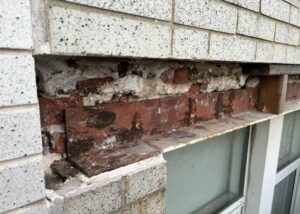
A forensic investigation on a seven-story precast concrete office building in the Mid-Atlantic region revealed that 34 of 48 punched window openings on the north and west elevations had active water intrusion at the sill, despite a continuous sill flashing membrane installed per the manufacturer’s written instructions. The root cause was not flashing failure.
It was pocket geometry: a 4-inch recess created a horizontal ledge that pooled water, compressed the sill flashing termination and eliminated any meaningful drainage slope. The detail had been reviewed and approved by three separate parties before construction.
Nobody caught it because everybody assumed the flashing specification solved the problem. It did not.
What Makes a Recessed Window Pocket Geometrically Different
The recessed pocket condition places the window plane behind the exterior face of the wall, creating a three-sided enclosure at each opening: a horizontal sill surface, two vertical jamb returns and a head condition at the top. That geometry is fundamentally different from a flush or projected window installation and the difference matters for every one of the four control layers.
In a flush condition, water hitting the window unit drains directly to the wall face. In a recessed pocket, that same water lands on a horizontal ledge first.
The pocket intercepts water that a flush frame never sees. The head condition above the pocket also creates a shadow zone that retains moisture longer than an exposed wall face, which extends the wetting cycle and increases the cumulative water load on the sill.
This condition appears most often in three assembly types: precast concrete with punched openings cast into the panel, CMU backup with an attached cladding system and metal panel assemblies with a subframe that sets the window back from the panel face. Pocket depths in commercial construction typically run 2 to 6 inches, but even a 2-inch recess changes drainage behavior enough to invalidate standard sill pan assumptions.
A 2-inch pocket on a building with a 45-foot parapet height in a 90-mph design wind zone generates measurable hydrostatic pressure at the sill during a storm event. That pressure does not exist in a flush frame condition and is not accounted for in standard flashing details.
AAMA 2400-02 provides a useful baseline for understanding mounting flange installation, but it was written for stud frame construction. Applying its logic to a mass wall pocket condition is a category error.
The standard does not address horizontal ledge drainage, pocket face integration or the thermal continuity problems that mass wall substrates introduce. AAMA 501.2, which covers field water infiltration testing of installed fenestration, is a better diagnostic tool for pocket conditions because it tests the installed assembly rather than the unit alone, but it still requires the test operator to configure the water delivery to replicate pocket geometry rather than open wall exposure.
That configuration step is rarely specified in the contract documents and rarely performed correctly in the field.
The Drainage Trap Problem: Why Water Accumulates at the Sill
The horizontal sill surface of a recessed pocket functions as a collection plane. Wind-driven rain enters the pocket and lands on the sill.
Condensate running down the interior face of the glass reaches the frame and tracks along the sill. In both cases, water accumulates on a surface that, in most standard details, has no reliable path to the exterior.
Standard sill pan flashing details assume a short, sloped drainage path from the rough opening to the exterior wall face. ASTM E2112-19, Section 7, recommends a minimum 1:12 slope toward the exterior and requires end dams to contain lateral water movement.
Both requirements were developed for frame wall conditions where the window sits at or near the exterior face. In a recessed pocket, the drainage path is longer, the slope is harder to achieve and the end dam height required to contain water at the jamb intersection is substantially greater than what most details show.
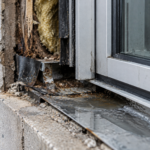
Three specific mechanisms drive failure in this condition. First, the flashing termination at the exterior face of the pocket gets compressed or displaced when the window frame is set and anchored; the frame bears directly on the membrane and installation torque on the anchor fasteners shears the termination.
Second, end dam height is sized for a flush condition and is simply too short for the pocket depth, allowing water to overtop the dam and enter the jamb intersection. Third, water traveling laterally along the sill before reaching the drainage point finds the gap at the jamb-to-sill intersection, which is almost never fully integrated in field-applied details.
Construction sequencing compounds all three mechanisms. Window units are frequently set before the sill flashing termination is fully integrated with the air and water barrier on the pocket face.
That concealed gap never gets corrected because it is buried under the frame by the time anyone looks. On one CMU backup project in the Northeast, a special inspector documented that 22 of 30 window units on the upper floors were set within 24 hours of flashing application, before the fluid-applied membrane had achieved manufacturer-specified cure.
The membrane deformed under the frame load and the termination bond failed at the pocket face. The building had active sill leaks within the first winter season.
The flashing material itself was never the problem.
ASTM E331 water penetration testing does not replicate pocket geometry. A test that sprays water at a window unit in a test chamber tells you nothing about what happens when that unit sits 4 inches behind the wall face on an unsloped concrete ledge.
Specifiers who rely on E331 unit test data to validate a recessed pocket installation are evaluating the wrong variable. The unit may be watertight.
The pocket is not.
Thermal Bridge Mechanics in the Recessed Pocket Condition
The pocket creates a geometry-driven thermal bridge that is distinct from and additive to, the standard frame-to-wall thermal bridge at a flush installation. Three exposed concrete or masonry surfaces at the sill, jambs and partial head project inward through the continuous insulation plane of the wall assembly.
That projection bypasses the thermal control layer entirely.
Research from the Building Science Corporation and Oak Ridge National Laboratory indicates that window perimeter thermal bridges can account for 15 to 25 percent of total window assembly heat loss in punched opening conditions. The pocket geometry extends the length of that perimeter bridge and increases the exposed surface area of the thermally weak substrate.
A standard punched opening in an 8-inch CMU wall with a flush window frame has a perimeter bridge length equal to the rough opening perimeter. A 4-inch recessed pocket in the same wall increases the thermally exposed surface area at each jamb and sill by the full pocket depth times the opening dimension, adding roughly 30 to 40 percent more bridging surface on a typical 4-foot-wide by 6-foot-tall opening.
CMU is the clearest example. An 8-inch CMU block carries a nominal R-value of approximately R-1.5 to R-2.
0. That is the material sitting at the jamb and sill of the pocket, exposed to interior conditions on one side and exterior conditions on the other.
ASHRAE 90.1-2022, Section 5. 5.
3, requires continuous insulation for mass wall assemblies, but the pocket geometry creates a condition where CI cannot be maintained at the perimeter without a detail that most standard drawings do not show. The compliance path through the prescriptive table assumes a wall assembly with uninterrupted CI.
The pocket perimeter is an interruption that the compliance calculation ignores unless the energy model explicitly accounts for it, which requires a linear thermal transmittance input that most energy modelers do not calculate.
The interior condensation risk at the pocket reveal is a separate failure mode from bulk water intrusion, but it is frequently misdiagnosed as such. When the interior surface temperature at the jamb or sill drops below the dew point of the interior air, condensation forms on the concrete or masonry face.
That moisture then runs to the sill and presents exactly like a flashing failure. I have seen building owners spend significant money resealing windows that were not leaking; the water was coming from their own interior air.
In one case, a property manager had a window contractor reseal the same three windows on a north-facing CMU wall three times over two years. Infrared thermography during the third investigation showed interior jamb surface temperatures of 38 degrees Fahrenheit at an interior dew point of 44 degrees.
The sealant was intact. The geometry was producing condensation faster than the interior finishes could absorb it.
ISO 10211:2017 provides the methodology for calculating linear thermal transmittance (psi value) at wall junctions. U.
S. practice rarely applies this standard at window perimeters.
It should. A psi value calculation at the pocket condition will quantify the bridge and allow the designer to evaluate mitigation options before construction, not after.
The calculation requires a two-dimensional heat flow model of the pocket cross-section, which adds time to the design process but is far less expensive than a post-occupancy remediation program.
Where Standard Sill Flashing Details Break Down
Four failure modes appear specifically in recessed pockets and they are distinct from the generic flashing failures that show up in post-construction investigation reports.
The first is the most common: the flashing membrane is applied to the horizontal sill surface only, without turning up onto the vertical pocket face to form a true sill pan. That upturned leg is what creates the dam against the wall.
Without it, water at the back of the sill has nowhere to go except into the rough opening. This failure appears repeatedly in shop drawing submittals because window manufacturers provide standard sill pan details that show the membrane on a flat surface terminating at the wall face.
The detail is correct for a flush condition. Applied to a pocket, it omits the most important leg of the pan entirely.
Reviewers approve the submittal because the flashing product is correct. The geometry of the application is never questioned.
The second is field-formed end dams fabricated from the flashing membrane without rigid backing. Under the weight and installation torque of the window frame, they collapse.
A flat piece of membrane folded into a corner is not an end dam. It is a temporary shape that fails at first load.
Pre-formed rigid end dams, either manufactured sheet metal units or pultruded fiberglass corner pieces bonded to the membrane, are the correct solution. They are available from multiple flashing system manufacturers and add minimal cost to the assembly.
They are specified infrequently because the standard detail does not require them and the field crew has no reason to install what the drawing does not show.
The third is a drainage gap at the exterior face of the pocket blocked by sealant applied continuously across the sill-to-cladding interface. The installer seals the joint because it looks like a joint that should be sealed.
The drainage path disappears. This is a drawing communication failure as much as a field execution failure.
If the detail does not explicitly label the drainage outlet as an open joint and note that sealant must not be applied at that location, the default behavior of any experienced sealant applicator is to seal it. That default behavior is correct in every other context on the building.
The pocket sill is the exception and the exception must be called out.
The fourth applies specifically to CMU backup assemblies: through-wall flashing that terminates at the wrong plane relative to the window rough opening. The flashing exits the CMU at the correct elevation but at the face of the backup wall, not at the face of the pocket.
Water that gets behind the cladding hits the flashing, follows it inward and enters the rough opening from below. This condition is particularly difficult to diagnose because the through-wall flashing appears correct at the CMU face.
The failure is at the relationship between the flashing termination plane and the window rough opening plane, which are separated by the full pocket depth and are never shown in the same detail view on most drawing sets.
IBC 2021, Section 1404.4, requires flashing at window and door openings. It does not specify geometry for recessed conditions.
That silence is not permission to detail the pocket any way you want; it is a gap that the designer must fill with engineering judgment. WDMA I.
S. 7 installation guidelines are similarly silent on pocket depth variables.
The industry has not caught up to this condition in its published guidance.
Precast vs. CMU vs. Metal Panel: System-Specific Risk Profiles
Each assembly type presents a distinct risk profile for the recessed pocket condition and the mitigation strategies that work in one system do not transfer directly to the others.
In precast concrete, the pocket geometry is cast into the panel and cannot be corrected in the field. If the sill lacks a cast-in drainage slope, shimming is possible but rarely executed with enough precision to achieve the 1:12 minimum that ASTM E2112-19 recommends.
The thermal bridge is monolithic and continuous across the panel face. There is no insulation layer to interrupt it at the perimeter.
Precast pocket conditions require the drainage slope, the sill pan geometry and the flashing termination locations to be resolved at the shop drawing stage, before casting. After the panel is made, your options are limited and expensive.
A precast producer will cast a sloped sill surface if the contract documents require it. The slope must be dimensioned on the architectural drawings and confirmed on the structural shop drawings.
It is not a default condition. On the Mid-Atlantic building described at the opening of this article, the precast shop drawings showed a flat sill with no slope notation.
The architect’s detail showed a sloped sill with a 1:12 dimension. The discrepancy was never reconciled during submittal review and the panels were cast flat.
That single coordination failure produced 34 leaking windows.
In CMU backup assemblies, the pocket geometry is built in the field, which means it can be modified. That flexibility is also the risk: field crews build what the drawings show and if the drawings show a flat sill with a standard flashing termination, that is what gets built.
The thermal bridge at the CMU jamb and sill is severe given the material’s low effective R-value and it is compounded by the difficulty of maintaining CI continuity at the pocket perimeter. One practical approach is to fur out the pocket faces with a minimum 1-inch polyisocyanurate board bonded to the CMU and faced with a compatible air and water barrier membrane.
That assembly raises the effective R-value at the pocket perimeter, reduces the linear thermal bridge and provides a bondable substrate for the sill pan flashing. It requires coordination between the masonry contractor and the waterproofing contractor and must be sequenced before window installation.
It is rarely shown on standard CMU wall details and must be explicitly specified.
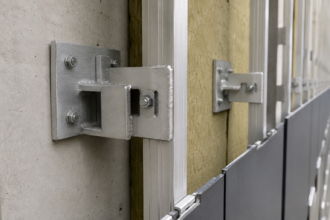
Metal panel systems with subframes offer the most flexibility because the window position relative to the panel face is adjustable. The risk is that the subframe itself creates a thermal bridge at every attachment point and the pocket geometry that results from setting the window back from the panel face still requires a resolved drainage and flashing condition that the panel manufacturer’s standard details rarely address.
Metal panel manufacturers typically provide details that show the window frame at the subframe face with a sealant joint at the perimeter. That detail addresses weathertightness at the frame-to-panel interface.
It does not address what happens at the sill of the pocket between the panel face and the window frame. That zone is the designer’s responsibility and it must be detailed as a drained and back-ventilated condition with a sill pan that integrates with the air and water barrier behind the panel system.
Detailing the Pocket Correctly: What the Drawings Must Show
The detail set for a recessed window pocket must resolve four conditions explicitly and none of them can be left to field judgment or standard flashing practice.
The sill pan must be a true pan: a continuous membrane turned up onto the vertical pocket face at the back and sides, with rigid end dams at the jambs. The upturned leg height must equal or exceed the pocket depth.
A 4-inch recess requires a 4-inch upturned leg minimum. That is not a standard detail in any window manufacturer’s installation guide.
The pan membrane must be selected for compatibility with both the substrate material at the sill and the air and water barrier on the pocket face. In precast and CMU conditions, that means a fluid-applied or self-adhered sheet membrane that can bond to concrete or masonry without a primer failure at the upturned leg.
Specify the membrane system, the primer requirement and the minimum upturned leg dimension as explicit drawing notes, not as a reference to the manufacturer’s standard installation instructions.
The drainage path from the pan to the exterior face of the pocket must be unobstructed and must not rely on a joint that a sealant applicator will instinctively close. Design the drainage as a weep through the sill material or a sloped surface that terminates at an open joint.
Show it explicitly on the drawing. If the drawing does not show it, it will not be built.
For precast sills, a cast-in weep tube at the low point of the pan is the most reliable solution. For CMU sills with a cladding system, an open vertical joint in the cladding at the sill elevation, aligned with the drainage outlet of the pan, provides the path.
That joint must be shown on the cladding layout drawing and protected from inadvertent sealing by a note on both the cladding detail and the window sill detail.
The thermal control layer must be addressed at the pocket perimeter. For CMU assemblies in IECC Climate Zones 4 through 7, leaving the pocket jamb and sill as exposed CMU is not defensible under ASHRAE 90.1-2022 continuous insulation requirements.
Insulating the pocket faces with a rigid insulation board, properly integrated with the CI plane of the wall, reduces the linear thermal bridge and raises the interior surface temperature above the condensation threshold. The insulation board thickness at the pocket face should be determined by a psi value calculation per ISO 10211:2017, not by matching the wall CI thickness.
The geometry of the pocket creates a different heat flow path than the field of the wall and the mitigation thickness is different as a result. A 2-inch polyisocyanurate board at the pocket face of an 8-inch CMU wall in Climate Zone 5 will typically raise the interior jamb surface temperature above the condensation threshold at design winter conditions.
A 1-inch board may not. The calculation takes the guesswork out.
The air barrier must be continuous across the rough opening perimeter before the window is set. In recessed pocket conditions, the air control layer on the pocket face is the most vulnerable location in the entire assembly.
Air leakage at that joint transports orders of magnitude more moisture than vapor diffusion through the wall. Seal the pocket face to the rough opening with a compatible fluid-applied or sheet membrane, verify continuity before the window is installed and treat that step as a hold point in the construction sequence.
Do not let the window cover an unverified air seal. The hold point must appear in the project specifications under the window installation section and in the quality control plan.
A special inspector or the architect’s field representative should verify the air seal condition and document it with photographs before the window frame is set. That documentation becomes the baseline record if a moisture problem develops later.
The forensic record on recessed pocket failures is consistent: the flashing was there, the sealant was applied and the window passed shop drawing review. What failed was the geometry and geometry is a drawing problem before it is a field problem.
Get the pocket detail right on paper, then inspect it in the field before it disappears behind the frame.