



The Role of AI in Building Envelope Design, Construction, and Operations
Artificial intelligence has moved quickly from a speculative technology to a practical tool across the design and construction industry. In building envelope practice, AI is beginning to influence how teams analyze performance, coordinate documentation, identify risk, and manage operational data.
The conversation around AI often becomes polarized. Some view it as a transformational force that will automate large portions of technical practice, while others dismiss it as a temporary productivity trend. The reality is more practical. AI is unlikely to replace experienced building envelope professionals, but it is already changing how information is processed, reviewed, and applied.
For architects, facade engineers, consultants, contractors, and owners, the important question is not whether AI will affect the building envelope industry. The question is where it can provide measurable value, where it introduces new risks, and how firms can apply it responsibly.
Why the Building Envelope Industry Is Well Suited for AI
Building envelope work generates large volumes of fragmented technical information:
- Drawings
- Specifications
- Submittals
- Product data
- Testing reports
- Field observations
- Thermal models
- Water infiltration data
- Maintenance records
- Warranty documentation
- Commissioning reports
Much of this information is repetitive, difficult to organize, and highly dependent on pattern recognition. These are conditions where AI tools can provide meaningful assistance.
The building envelope industry also operates within a high-risk environment. Moisture intrusion, air leakage, thermal discontinuities, condensation risk, and material incompatibility can create costly failures that may not become visible for years. AI systems are increasingly capable of identifying patterns associated with these risks, particularly when trained on historical project data.
At the same time, building envelope decisions still depend heavily on judgment, constructability awareness, and experience. AI can assist with data processing and prediction, but it cannot independently understand project intent, contractor behavior, sequencing constraints, or the nuances of real-world installation.
That distinction is critical.
AI in Early Design and Concept Development
One of the earliest areas where AI has gained traction is conceptual design.
Generative design tools can quickly evaluate multiple facade configurations based on inputs such as:
- Solar exposure
- Energy targets
- Orientation
- Glazing ratios
- Daylighting goals
- Embodied carbon objectives
- Cost constraints
This allows project teams to study performance tradeoffs much earlier in the design process.
For example, AI-assisted workflows can help identify facade geometries that balance daylight access with solar heat gain reduction. They can also rapidly compare shading strategies, insulation approaches, or glazing configurations across multiple climate zones.
In practice, these tools are most valuable during feasibility and optimization phases. They can accelerate analysis that previously required significant manual modeling effort.
However, the quality of the output still depends entirely on the quality of the inputs.
AI-generated facade concepts can appear convincing while overlooking critical issues such as:
- Drainage pathways
- Structural movement accommodation
- Thermal bridge continuity
- Access and maintainability
- Material compatibility
- Constructability
- Long-term durability
Without experienced review, AI can create technically attractive solutions that perform poorly in the field.
Improving Envelope Coordination and Documentation
Coordination failures remain one of the largest sources of envelope-related construction issues.
Many building enclosure problems originate not from product failure, but from incomplete detailing, scope gaps, or poorly coordinated transitions between systems.
AI tools are increasingly being used to support documentation review and clash detection.
Current applications include:
- Reviewing drawing sets for inconsistencies
- Identifying missing details
- Comparing specifications against drawings
- Detecting coordination conflicts between disciplines
- Flagging incomplete assemblies
- Organizing RFIs and submittal responses
These tools can significantly reduce the time required to review large document packages.
For envelope consultants, this creates an opportunity to focus more effort on higher-level technical review rather than repetitive administrative tasks.
AI may also improve specification quality control by identifying conflicting performance requirements or incomplete references. On large projects with multiple consultants and phased revisions, this type of automated cross-checking can reduce coordination gaps that are otherwise difficult to identify.
Still, there are important limitations.
AI systems do not inherently understand performance intent. A detail may appear internally consistent while still failing to address water management, movement, or continuity requirements.
Envelope detailing remains highly dependent on contextual judgment.
AI and Building Envelope Performance Modeling
Performance modeling is another area where AI is beginning to influence practice.
Traditionally, thermal analysis, condensation analysis, daylight simulation, and energy modeling require specialized software and significant modeling effort. AI-assisted workflows can streamline portions of this process by automating repetitive modeling tasks and rapidly evaluating large datasets.
Potential applications include:
- Predicting condensation risk
- Optimizing thermal performance
- Evaluating facade energy use
- Identifying likely air leakage locations
- Comparing enclosure assemblies
- Forecasting operational performance
Machine learning models can also analyze historical project performance data to identify correlations between enclosure design decisions and long-term operational outcomes.
For owners managing large building portfolios, AI may eventually support predictive maintenance strategies based on known deterioration patterns.
For example, systems could potentially identify facade assemblies with elevated risk for:
- Sealant failure
- Water infiltration
- Glazing degradation
- Coating breakdown
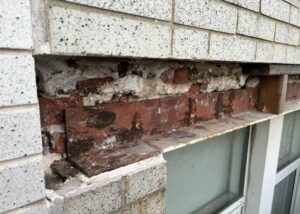
- Corrosion
- Moisture accumulation
This type of predictive analysis could help owners prioritize inspections and capital planning before failures become visible.
However, AI-based performance modeling is only as reliable as the underlying data.
Building envelope performance is influenced by variables that are often difficult to quantify accurately, including workmanship quality, installation tolerances, weather exposure, sequencing, maintenance practices, and occupancy conditions.
AI can identify trends, but it cannot eliminate uncertainty.
Construction Phase Applications
AI is also beginning to influence construction-phase quality management.
Some contractors and technology providers are using AI-assisted image recognition to analyze site photographs and identify potential installation deficiencies.
Applications under development include:
- Detecting incomplete flashing installation
- Identifying missing fasteners
- Reviewing sealant continuity
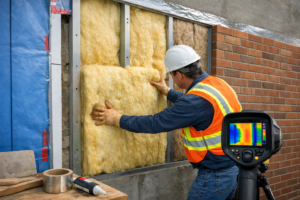
- Monitoring insulation placement
- Comparing installed conditions against models
- Tracking construction progress
Drone imagery and site scanning technologies are increasingly combined with AI analysis to improve documentation and field verification.
These tools may eventually help reduce the reliance on manual photo review and improve issue tracking on large projects.
AI-driven project management systems are also being used to organize field reports, RFIs, punch lists, and quality observations.
For building envelope consultants, this could improve traceability and documentation management across complex projects.
But field quality control still depends heavily on physical observation and professional interpretation.
AI cannot reliably assess many conditions that experienced enclosure professionals evaluate routinely, including:
- Substrate quality
- Moisture conditions
- Material damage
- Installer workmanship
- Proper adhesion
- Concealed deficiencies
- Sequence-related risk
The technology may assist inspections, but it does not replace them.
Existing Buildings and Facility Operations
AI may ultimately have its largest impact during the operational life of buildings.
Large facilities generate extensive performance data through:
- Building automation systems
- Leak detection systems
- Thermal imaging
- Energy monitoring
- Indoor environmental sensors
- Maintenance records
AI tools can analyze this information to identify abnormal patterns and operational inefficiencies.
Potential applications include:
- Detecting developing moisture intrusion
- Identifying energy loss trends
- Monitoring facade thermal performance
- Supporting preventive maintenance planning
- Prioritizing facade inspections
- Forecasting component replacement timing
For owners with large property portfolios, these systems may improve long-term asset management and reduce reactive maintenance.
AI could also support lifecycle analysis by helping teams compare long-term operational implications of different enclosure systems.
As sustainability requirements continue to expand, this type of data-driven performance management will likely become increasingly important.
Risks and Limitations of AI in Envelope Practice
Despite the growing interest in AI, there are significant risks associated with overreliance.
The most immediate concern is false confidence.
AI-generated outputs often appear highly polished and authoritative, even when technically incorrect or incomplete. This creates a risk that less experienced users may accept recommendations without sufficient review.
In building envelope practice, incomplete analysis can create substantial liability exposure.
Some current AI limitations include:
- Lack of true engineering judgment
- Limited understanding of constructability
- Inability to reliably interpret field conditions
- Difficulty assessing material compatibility
- Weak understanding of sequencing and installation behavior
- Dependence on incomplete or biased training data
- Potential for inaccurate technical references
There are also legal and contractual concerns.
Questions remain regarding:
- Responsibility for AI-generated recommendations
- Intellectual property ownership
- Data confidentiality
- Model transparency
- Standard of care implications
- Documentation reliability
Most firms are still developing internal policies governing how AI can be used in technical workflows.
For now, AI should be treated as an assistive tool rather than an autonomous decision-maker.
The Importance of Human Expertise
Building envelope performance depends on more than technical calculations.
Experienced professionals understand how systems behave under real-world conditions:
- How installers interpret details
- Where sequencing failures occur
- Which assemblies are difficult to execute consistently
- How environmental exposure accelerates deterioration
- Which products perform differently than laboratory data suggests
This type of experiential judgment is difficult to replicate through AI systems.
The enclosure industry also relies heavily on interdisciplinary coordination between architects, engineers, manufacturers, consultants, contractors, and owners. Successful outcomes often depend on communication, negotiation, and practical decision-making that extend beyond technical analysis.
AI can process information quickly, but it does not possess accountability, professional judgment, or field experience.
The firms that benefit most from AI will likely be those that integrate it strategically while maintaining strong technical oversight.
What the Industry Should Expect Next
AI adoption within the building envelope industry will likely continue gradually rather than through sudden disruption.
In the near term, the most practical applications will probably focus on:
- Documentation management
- Specification review
- Coordination assistance
- Data organization
- Performance analysis support
- Operational monitoring
More advanced predictive capabilities may emerge as firms accumulate larger datasets tied to actual building performance.
However, widespread adoption will depend on several factors:
- Data quality
- Software interoperability
- Liability considerations
- Industry standards
- Client expectations
- Regulatory acceptance
- Professional trust
The industry is still in the early stages of understanding how AI can be integrated responsibly into enclosure practice.
Conclusion
AI is beginning to reshape portions of building envelope design, construction, and operations, particularly in areas involving data analysis, coordination, and performance monitoring.
Its value lies primarily in improving efficiency, identifying patterns, and supporting decision-making across increasingly complex projects.
At the same time, building envelope performance remains deeply dependent on professional judgment, constructability awareness, field experience, and technical accountability.
AI can assist experienced practitioners, but it cannot replace the expertise required to design, detail, and evaluate durable enclosure systems.
For the foreseeable future, the most effective approach will be balanced adoption: using AI to improve workflow efficiency and data analysis while maintaining rigorous technical oversight and professional responsibility.
In building envelope practice, successful outcomes will still depend on the same fundamentals that have always mattered — sound detailing, realistic constructability, quality installation, and informed technical judgment.
I drafted a publish-ready article on the role of AI in building envelope design, construction, and operations, focused on practical applications, limitations, risk management, and where the technology is realistically adding value in the industry today.