Phenolic Core vs. Mineral Core Compact Panels: What the Fire Test Data Actually Tells Specifiers About Code Compliance in North American Rainscreen Applications
When “Compact Panel” Means Everything and Nothing: The Specification Language Gap
A submittal package for a six-story healthcare facility in a jurisdiction enforcing NFPA 285 cleared the architect’s desk with the product listed generically as “compact panel rainscreen system, 8mm, high-pressure laminate core. ” The same language had sailed through on three prior approved projects.
The AHJ flagged it at permit review: the specified product carried no NFPA 285 assembly listing and the phenolic core variant submitted could not be substituted for the mineral core product tested in the listed assembly. The project lost six weeks.
The facade subcontractor repriced with a compliant product at a $140,000 delta.
That scenario is not unusual. The term “compact panel” encompasses products with fundamentally different core chemistries: phenolic resin (HPL-based), mineral-filled composite and fiber-cement variants.
Specifications routinely treat them as interchangeable. Master specification libraries, including legacy MasterSpec Section 07 44 43 (Faced Composite Wall Panels), have historically used generic language that does not distinguish core type as a code-relevant variable.
The substitution pathway from phenolic to mineral core is not a minor product swap. It changes the fire performance classification of the assembly.
When a contractor submits an “equal,” specification language that omits core type provides no defensible basis for rejection.
IBC Section 1402.5 establishes baseline material requirements for exterior cladding, but it does not resolve the core-type question on its own. That resolution happens upstream, in the specification.
The problem compounds on projects where multiple facade consultants contribute to a specification package. A curtainwall consultant may write the panel section while a separate envelope consultant handles the air and weather barrier section and neither document explicitly ties the panel core type to the fire assembly requirements that govern both.
The result is a specification that is internally inconsistent without anyone having made an error in their own section. Coordination between Division 07 sections is where this gap most often opens and it is where the AHJ will find it first.
Inside the Panel: How Phenolic and Mineral Cores Differ at the Material Level
Phenolic core panels are built from kraft paper layers saturated with phenolic resin, pressed under high heat and pressure. The result is a dense, dimensionally stable sheet with excellent machinability and weather resistance.
It is also a combustible substrate by composition. Surface burning characteristics for phenolic core panels typically fall at Class B or Class C under ASTM E84, depending on thickness and facing treatment.
These panels do not meet the noncombustibility threshold established by ASTM E136 (Standard Test Method for Behavior of Materials in a Vertical Tube Furnace) and IBC Section 703.5 is unambiguous on that point.
Mineral core panels take a different route. Calcium silicate, fiber-cement and magnesium oxide-based matrices form the core and noncombustibility or limited-combustibility is achievable depending on exact composition and ASTM E136 test results.
Class A surface burning characteristics are more readily attained with mineral cores and their composition makes them categorically different from phenolic products under IBC Chapter 7 definitions.
The performance differences extend beyond fire. Mineral core panels carry higher density and greater thermal mass, which affects both facade detailing and long-term dimensional behavior.
A typical 8mm phenolic core panel weighs approximately 1.1 to 1. 3 pounds per square foot.
A calcium silicate mineral core panel at the same thickness can run 1.8 to 2. 2 pounds per square foot, a difference that accumulates quickly across a large facade and requires the structural engineer of record to verify subframing capacity before substitution occurs.
Moisture absorption characteristics also diverge: phenolic cores resist liquid water well but can be sensitive to edge exposure in poorly detailed assemblies, particularly at horizontal cut edges left unsealed at subframing attachment points. Mineral core products vary by binder type and require attention to edge sealing in wet climates, especially in fiber-cement variants where prolonged edge moisture exposure can initiate delamination of factory-applied coatings.
Neither core type is maintenance-free. Both require proper detailing at the four control layers: water, air, vapor and thermal.
The fire distinction, though, is the one that generates permit delays.
NFPA 285 Is an Assembly Test, Not a Product Test: and That Distinction Changes Everything
Specifiers who treat an NFPA 285 listing as a product certification are reading it wrong. NFPA 285:2019 (Standard Fire Test Method for Evaluation of Fire Propagation Characteristics of Exterior Wall Assemblies) tests the full wall assembly: cladding, air and weather barrier, insulation, framing and substrate together.
A passing result is valid only for the specific configuration tested. Substituting core type, insulation product or air barrier membrane can invalidate the listing entirely.
This matters enormously in practice. Phenolic core panels have achieved NFPA 285 compliance in specific tested assemblies.
Those assemblies exist. But they are narrowly defined, often requiring specific insulation types (typically mineral wool at defined thickness and density) and specific substrate combinations that limit design flexibility.
A specifier who selects a phenolic core panel based on one tested assembly and then modifies the insulation layer to suit a different thermal target has potentially stepped outside the listing without realizing it. A common example: a design team selects a phenolic core panel with a tested assembly that uses 2-inch mineral wool at 8 pcf density, then value-engineers the insulation to 1.5-inch polyisocyanurate to hit a lower installed cost.
The thermal math may work. The fire assembly does not.
The tested configuration no longer applies and the submittal that arrives at the building department references an NFPA 285 report for an assembly that was never actually built.
Mineral core panels appear in a broader range of listed NFPA 285 assemblies. Their noncombustible or limited-combustible composition gives them more headroom in assembly configurations and AHJs in most jurisdictions accept them with less scrutiny.
That does not mean mineral core panels are universally compliant in any configuration. The assembly test framework still applies.
But the starting position is more favorable and the path to a compliant submittal is typically shorter.
IBC Section 1403.5 governs exterior wall coverings on Type I and Type II construction. IBC 2021 Section 1402.5 references NFPA 285 compliance as the pathway for combustible cladding on noncombustible construction types.
If your building is Type I or II and your cladding is combustible, NFPA 285 is not optional. It is the compliance mechanism.
The code does not offer an alternative pathway based on product performance data, manufacturer letters of assurance or prior project approvals in other jurisdictions. The test report for the specific assembly configuration is the record that matters and it needs to be in the submittal package before the permit application is filed, not after the AHJ asks for it.
How to Read an NFPA 285 Test Report: The Four Variables That Determine Whether a Submittal Is Actually Compliant
Test reports are not marketing documents. They are legal records of a specific assembly configuration and reading them requires attention to four variables that determine whether a given submittal actually falls within the tested scope.
The first variable is panel core type and thickness. The report must explicitly identify core composition.
“Compact panel” or “HPL panel” without core identification is insufficient for submittal approval. If the report lists a mineral core product and the contractor submits a phenolic core panel at the same thickness, the listing does not transfer.
Thickness tolerances matter as well: a report written for a 10mm panel does not automatically cover an 8mm panel of the same core type, because panel mass and char behavior under fire conditions are thickness-dependent. Specifiers should confirm that the tested thickness matches the specified thickness, not just the core chemistry.
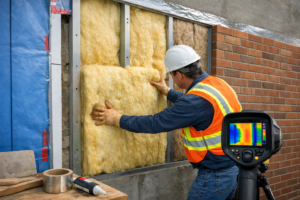
The second variable is insulation type, thickness and position. Most NFPA 285 failures in rainscreen assemblies originate at the insulation layer, not at the cladding face.
The tested insulation must match the specified insulation exactly. Mineral wool at 2 inches and 8 pcf density is not interchangeable with polyisocyanurate at the same thickness, even if the nominal R-values are similar.
Effective R-value and fire behavior are separate questions. Continuous insulation position relative to the air barrier also matters: some tested assemblies place insulation between the air barrier and the substrate, others place it outboard of the air barrier and that positional difference is part of the tested configuration.
Swapping insulation position to simplify installation sequencing invalidates the assembly.
The third variable is the air and weather barrier product. Some listed assemblies are tied to a specific WRB membrane.
Substituting a fluid-applied product for a self-adhered sheet or vice versa, may require a new engineering judgment letter or re-testing. The WRB is part of the fire assembly, not just the water control layer.
This surprises many specifiers who treat the WRB as a purely hygrothermal component. In a ventilated rainscreen cavity, the WRB surface is exposed to the cavity airspace and contributes to flame spread behavior under fire conditions.
A fluid-applied WRB with a different surface chemistry than the tested product introduces a variable the test report cannot account for.
The fourth variable is subframing geometry and cavity depth. Tested cavity dimensions affect flame propagation behavior through the ventilated rainscreen gap.
A cavity depth or framing configuration that differs materially from the tested assembly introduces uncertainty that an AHJ is entitled to reject. Standard rainscreen cavity depths range from 3/4 inch to 2 inches depending on subframing system and the tested cavity dimension is a fixed parameter in the NFPA 285 report.
A project that specifies a 1.5-inch cavity against a test report written for a 3/4-inch cavity needs to address that discrepancy explicitly in the submittal, either through an engineering judgment letter or a separate tested assembly that matches the actual cavity dimension.
Where Phenolic Core Panels Still Belong: Appropriate Applications and Honest Tradeoffs
Phenolic core panels are not the wrong product. They are the wrong product when specified without verifying assembly compliance on Type I or II construction in jurisdictions enforcing NFPA 285. In applications where fire test requirements are less restrictive or where a tested assembly exists that matches the design intent, phenolic core panels offer real advantages.
Their machinability is superior. Tight radius curves, routed reveals and complex geometries are easier to achieve with phenolic core than with most mineral core alternatives.
A 6mm phenolic core panel can be cold-formed to radii that would crack a calcium silicate panel of equivalent thickness and CNC-routed reveals at 3mm depth are achievable without compromising structural integrity of the panel face. Weight is lower, which reduces dead load on the facade framing and simplifies substructure design.
On a retrofit project where the existing structure has limited reserve capacity for facade dead load, the weight difference between phenolic and mineral core products can determine whether the subframing system requires structural reinforcement. For low-rise Type V construction or interior applications where NFPA 285 is not triggered, phenolic core panels can be the right call on both performance and cost grounds.
Covered walkways, single-story retail facades and interior feature wall applications all represent appropriate uses where the fire test compliance pathway is either not required or is satisfied by less demanding test methods such as ASTM E84 alone.
The tradeoff to name explicitly: phenolic core panels in a rainscreen assembly on a Type I building without a verified NFPA 285 listing are a code compliance liability, regardless of how well they perform in every other respect. Durability, aesthetics and cost are irrelevant if the submittal fails at the AHJ’s desk.
Specifiers who understand this distinction can use phenolic core panels appropriately. Those who do not will keep generating the scenario described at the top of this article.
Writing the Specification to Close the Substitution Gap
The fix is not complicated. It requires three additions to the specification that most legacy sections omit.
First, identify core type explicitly in Part 2 materials. “Compact panel: mineral core, calcium silicate or magnesium oxide-based matrix, minimum 8mm thickness, Class A surface burning characteristics per ASTM E84” is a defensible specification.
“Compact panel, HPL, 8mm” is not, on a project where mineral core performance is required. The Part 2 language should also reference the specific NFPA 285 assembly number or report identifier that governs the specified configuration, so that the compliance pathway is traceable from the specification to the test report without requiring the reviewer to reconstruct the connection independently.
Second, require that the submittal package include the complete NFPA 285 test report for the proposed assembly, not just a letter of compliance or a product data sheet reference. The report must identify the tested assembly configuration in sufficient detail to confirm that the proposed products, insulation and WRB fall within the tested scope.
A one-page letter from the panel manufacturer stating that the product “has been tested in accordance with NFPA 285” does not satisfy this requirement. The actual test report, typically 30 to 60 pages, identifies the specific products, dimensions and configurations tested and that level of detail is what the plan reviewer needs to confirm compliance.
If the contractor proposes a modification, require an engineering judgment letter from a qualified fire protection engineer before approval. Engineering judgment letters are not a blanket workaround; they are a formal technical document that a licensed fire protection engineer prepares and stamps, accepting professional responsibility for the conclusion that the modified assembly performs equivalently to the tested configuration.
Third, add a substitution restriction that explicitly states core type as a non-substitutable variable. CSI MasterSpec Section 07 44 43 in its legacy form does not do this.
Your project specification needs to. The substitution clause should read something like: “Substitution of panel core type (phenolic for mineral or mineral for phenolic) constitutes a change in fire performance classification and will not be considered as an equal substitution under Division 01 substitution procedures.
” This language gives the architect a contractual basis to reject a non-compliant substitution without having to re-argue the technical case at the submittal review stage, when schedule pressure typically favors accepting whatever the contractor has already ordered.
These three additions take less than a page. They prevent the six-week delay and the $140,000 delta.
What AHJs Are Actually Asking For and Where Jurisdictional Variation Creates Risk
AHJ interpretation of NFPA 285 requirements varies more than most specifiers expect. Several jurisdictions, including those enforcing the 2021 IBC with local amendments, have issued guidance that tightens submittal requirements for combustible cladding on noncombustible construction beyond what the base code language strictly requires.
California’s Office of Statewide Health Planning and Development (OSHPD, now HCAI) has historically applied particularly rigorous review to facade assemblies on healthcare occupancies, which is exactly the building type in the opening scenario. HCAI plan reviewers routinely request the full NFPA 285 test report, the complete product data sheets for every component in the tested assembly and written confirmation from the panel manufacturer that the submitted product matches the tested product in core composition, thickness and surface treatment.
A submittal that satisfies a municipal building department in a less scrutinized jurisdiction may fail HCAI review on the same documentation.
In practice, this means a submittal package that would clear permitting in one jurisdiction may fail in another, even with identical products and assemblies. The engineering judgment letter pathway exists for assemblies that fall outside tested configurations, but it requires a licensed fire protection engineer, adds cost and time and is not guaranteed to satisfy every AHJ.
Some jurisdictions will not accept engineering judgment letters as a substitute for a full NFPA 285 test report on high-occupancy or high-rise projects. New York City, which enforces its own Building Code rather than the IBC directly, has additional requirements under BC Chapter 14 that address exterior wall assemblies on high-rise occupancies and the Department of Buildings has issued technical policy documents that further define acceptable submittal content for facade fire compliance.
Specifiers working in New York City on Type I or II construction should treat the NYC BC requirements as a separate compliance layer, not an equivalent substitute for IBC-based NFPA 285 documentation.
The practical implication: verify AHJ expectations before finalizing the facade specification, not after the submittal is rejected. A pre-application meeting or written inquiry to the building department on a project of this complexity is best practice, not an optional step.
The Specification You Write Today Will Be Read by a Contractor Who Has Never Heard of NFPA 285
The final risk in this chain is not the AHJ. It is the facade subcontractor reading your specification in a competitive bid environment, looking for the least expensive compliant product and finding specification language that gives them room to substitute.
Contractors are not fire test experts. They are price optimizers working within the boundaries the specification sets.
If those boundaries do not explicitly define core type as a compliance variable, the substitution will happen and the submittal will arrive with a phenolic core product on a project that needed mineral core performance.
The price differential between phenolic and mineral core compact panels in the 8mm range runs approximately $4 to $8 per square foot at the material level, depending on manufacturer, finish and order volume. On a 20,000-square-foot facade, that differential represents $80,000 to $160,000 in material cost alone, before installation labor, subframing adjustments for the weight difference or any schedule impact from a rejected submittal. A facade subcontractor bidding a competitive project has a direct financial incentive