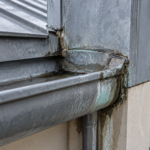
The Hidden Liability in “Equivalent” Substitutions: When Envelope Value Engineering Crosses the Line
Introduction: The Quiet Risk Behind “Approved Equal”
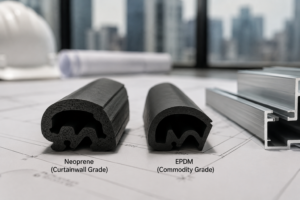
On most commercial projects, substitutions are presented as routine. A product is unavailable, long-lead, or priced higher than anticipated. The contractor submits an “equivalent” for review. The data sheets look similar. A test report is attached. The schedule is protected. The budget is stabilized.
And yet, years later—when air leakage increases, sealants fail prematurely, water appears at transitions, or a fire-resistance rating is challenged—the focus shifts to a familiar question:
Was the substituted product truly equivalent within the tested assembly?
In today’s cost-driven and supply-constrained environment, contractor-driven substitutions in facade and roofing systems are accelerating. Increasingly, litigation centers not on flawed design intent, but on undocumented “approved equals” that subtly altered the performance of air barriers, waterproofing systems, cladding assemblies, or fire-resistive configurations.
For architects and envelope consultants, the liability risk is rarely obvious at the time of review. It is embedded in the system interactions that make the building envelope function as a whole.
This is where value engineering crosses the line.
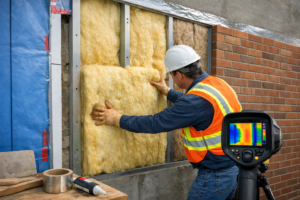
The Building Envelope Is a System, Not a Collection of Products
Every experienced envelope professional understands this principle. Assemblies are tested—not individual components. Performance depends on compatibility, sequencing, attachment, and detailing continuity.
Substitutions often focus on single attributes:
- Similar ASTM test results
- Comparable thickness or density
- Equivalent compressive strength
- Nominally similar fire classification
- Matching warranty duration
But envelope performance is driven by interaction effects:
- Adhesion between air barrier and substrate
- Chemical compatibility between membrane and sealant
- Fastener pull-out capacity in actual field substrates
- Drainage plane continuity at transitions
- Thermal expansion compatibility between dissimilar materials
- Fire propagation behavior across interfaces
A product that “meets spec” in isolation may not perform equivalently within the tested assembly.
This distinction is central to understanding substitution risk.
Where Substitutions Most Commonly Undermine Performance
1. Air Barrier Systems
Air barrier substitutions frequently hinge on material type—self-adhered sheet vs. fluid-applied vs. mechanically attached. Even within the same category, differences in:
- Vapor permeance
- Primer requirements
- Cure time
- Temperature limitations
- Reinforcement fabric use
- Transition membrane compatibility
can alter field performance.
The assembly may have been tested for air leakage under ASTM E283 or whole-wall testing under ASTM E2357. The substituted product may have its own report—but not in the same assembly configuration.
Once continuity is compromised at transitions or adhesion fails at substrates, leakage rates can increase significantly. The failure rarely traces back to one glaring defect. Instead, it emerges as systemic performance degradation.
2. Roofing Membranes and Cover Boards
Roof assemblies are especially vulnerable to substitution-driven risk:
- Changing cover board type or thickness
- Altering insulation facer types
- Substituting adhesive systems
- Modifying fastener patterns
- Changing membrane manufacturer within a tested fire-rated assembly
Fire classification is particularly sensitive. A UL or FM-approved assembly is manufacturer- and configuration-specific. Substituting a component—even one with similar thickness or density—may invalidate the listing.
Wind uplift performance is similarly sensitive to fastening patterns and substrate compatibility. Minor deviations can materially change uplift resistance.
In litigation, the question becomes straightforward:
Was the installed assembly identical to the tested assembly?
If not, the liability exposure expands rapidly.
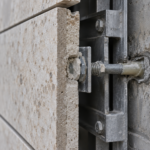
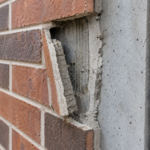
3. Rainscreen and Cladding Attachment Systems
Substitutions in cladding systems often involve:
- Alternate girt materials
- Modified anchor types
- Different corrosion protection
- Alternate thermal break materials
Structural calculations may confirm load capacity, but long-term durability issues emerge at interfaces:
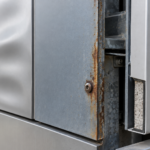
- Galvanic incompatibility
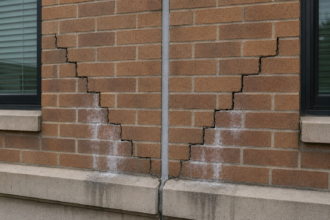
- Differential movement
- Creep under sustained load
- UV degradation of thermal isolators
Moreover, NFPA 285 compliance for combustible wall assemblies is highly configuration-specific. A change in insulation type, WRB, or attachment component can invalidate compliance—even if each product individually has test data.
Fire propagation risk is not theoretical. It is assembly-driven.
4. Sealants and Transition Materials
Sealant substitutions are among the most common—and least scrutinized—changes.
A sealant may meet ASTM C920 requirements, but that does not ensure:
- Adhesion to the specific substrates present
- Compatibility with adjacent membranes
- Resistance to plasticizer migration
- Long-term performance under movement cycling
Transition materials—often proprietary—are particularly vulnerable. Changing them disrupts the weakest links in the envelope.
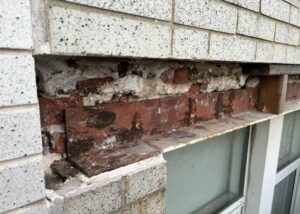
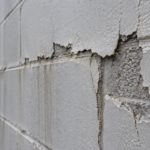
When water infiltration occurs at interfaces, it is rarely because the primary membrane failed. It is because continuity was altered.
The Legal and Professional Exposure
The liability exposure associated with substitutions falls into three categories:
1. Loss of Assembly-Based Defense
Design professionals rely on tested assemblies as part of their standard of care defense. If a system was designed and specified consistent with published testing and manufacturer guidance, that forms part of the professional record.
Substitutions can sever that link.
If the installed system no longer matches the tested configuration, the design professional’s reliance on that test data may no longer apply.
2. Documentation Gaps
Substitution approvals are often documented with brief notations:
“Approved as equivalent.”
“Meets spec requirements.”
“No cost or schedule impact.”
But what is rarely documented:
- Compatibility review notes
- Assembly-level testing equivalency analysis
- Confirmation of fire or wind rating continuity
- Confirmation of warranty impact
In litigation, incomplete documentation becomes a focal point.
3. Blurred Responsibility
Contractors often frame substitutions as cost-neutral and performance-equivalent. Owners expect architects and consultants to protect performance.
If a substitution is approved without clear limitation language, responsibility may shift to the design team—especially if the approval appears unconditional.
Courts and insurers often look at who had the technical expertise to evaluate system-level risk.
Why Substitution Pressure Is Increasing
Several macro forces are driving more aggressive substitution behavior:
- Supply chain volatility
- Material price escalation
- Contractor margin compression
- Global sourcing and private-label products
- Owner pressure to reduce capital costs
At the same time, insurance carriers are scrutinizing envelope-related claims more aggressively. Water intrusion, condensation damage, and fire compliance disputes remain high-frequency claim categories.
The result is a widening gap between design intent and installed condition.
Substitutions are the mechanism through which that gap opens.
What Architects and Consultants Should Actually Evaluate
When reviewing an “equivalent” substitution in a building envelope system, the evaluation should extend beyond datasheets.
Key questions include:
- Is the entire assembly still compliant with tested configurations?
Not just the product in isolation. - Has fire classification been revalidated?
Especially for wall assemblies subject to NFPA 285 or listed roof assemblies. - Are adjacent materials chemically compatible?
Particularly at air barrier and sealant interfaces. - Does the substitution alter movement capability at transitions?
- Does the change affect warranty coverage?
Many manufacturers void system warranties if third-party components are introduced. - Is third-party field testing required to confirm performance?
Air leakage testing, adhesion testing, or flood testing may be warranted. - Has the substitution been clearly documented with defined responsibility?
The review process must shift from product comparison to system risk assessment.
Common Mistakes That Increase Exposure
- Approving substitutions without conditional language
- Failing to require written confirmation of assembly compliance
- Relying solely on manufacturer cut sheets
- Not requiring updated shop drawings reflecting the change
- Allowing substitutions late in the submittal cycle under schedule pressure
- Not documenting limitations of review
These are process failures—not technical ignorance.
They are also avoidable.
Reframing “Value Engineering” in the Envelope Context
True value engineering improves lifecycle performance, constructability, or risk reduction without degrading performance.
Many envelope substitutions, however, are cost reductions disguised as equivalency.
The building envelope is not forgiving. It is exposed to water, temperature gradients, UV radiation, and movement every day of its service life. Small changes at installation can have amplified long-term consequences.
Savings achieved at bid day can be erased many times over in remediation costs, business interruption, or litigation.
The line between legitimate value engineering and concealed liability is crossed when:
- Assembly testing is invalidated
- Compatibility is assumed rather than verified
- Documentation is incomplete
- Responsibility is unclear
Conclusion: Protecting Performance Means Protecting the Assembly
The risk of product substitutions in building envelope systems is not hypothetical. It is structural.
Facade and roofing assemblies are interdependent systems that rely on continuity, compatibility, and tested configurations. When substitutions alter those systems—without rigorous evaluation and documentation—the liability shifts silently.
For architects and envelope consultants, the solution is not to reject all substitutions. It is to evaluate them at the assembly level, document the analysis, and clearly define responsibility.
The building envelope does not fail because of one line on a submittal log.
It fails because system integrity was compromised in small, undocumented ways.
And when that happens, “equivalent” becomes very difficult to defend.