How AI Could Change Building Envelope Consulting
Building envelope consulting has traditionally been a highly experience-driven profession.
Consultants rely on technical knowledge, field observation, forensic investigation, and practical judgment to evaluate enclosure performance and reduce project risk.
Artificial intelligence is beginning to influence many of these workflows.
While AI is unlikely to replace consultants, it may significantly change how building envelope professionals manage information, identify problems, and deliver services.
The most important changes will probably not involve fully automated design or inspection systems. Instead, AI is more likely to reshape the operational side of consulting by improving efficiency, analysis, and access to technical information.
For consulting firms, the challenge is understanding where AI can improve performance without compromising technical reliability or professional accountability.
Why Building Envelope Consulting Generates Large Amounts of Data
Envelope consulting involves extensive documentation throughout the life of a project.
Typical project records may include:
- Drawings
- Specifications
- Product data
- RFIs
- Submittals
- Field reports
- Laboratory testing
- Thermal analysis
- Water testing reports
- Mock-up observations
- Warranty records
- Litigation documentation
Many consulting firms manage decades of project information across multiple project types, climates, and enclosure systems.
Historically, much of this information has been difficult to organize and reuse efficiently.
AI tools are particularly effective at identifying patterns within large datasets.
This creates opportunities for consultants to improve:
- Technical research
- Quality control
- Documentation review
- Failure analysis
- Knowledge management
- Reporting workflows
The value is not necessarily in replacing technical expertise.
The value is in helping consultants process information more efficiently.
AI and Technical Documentation Review
One of the most time-consuming aspects of consulting work is document review.
Consultants often review thousands of pages of drawings and specifications to identify:
- Scope gaps
- Inconsistent detailing
- Missing transitions
- Performance conflicts
- Coordination deficiencies
- Ambiguous requirements
AI-assisted review systems are becoming increasingly capable of analyzing these large document sets.
Potential applications include:
- Identifying inconsistent terminology
- Comparing specifications against drawings
- Flagging missing assemblies
- Detecting repeated coordination issues
- Organizing submittal reviews
- Summarizing RFIs
For consultants, this may reduce administrative workload and improve review consistency.
Rather than manually searching for repetitive coordination issues, teams can spend more time evaluating performance-critical conditions.
However, AI still struggles with contextual interpretation.
A detail may appear technically complete while still failing to address:
- Drainage paths
- Differential movement
- Water management strategy
- Installation sequencing
- Constructability limitations
Envelope review remains heavily dependent on experience.
AI in Forensic Investigations
Forensic enclosure consulting may also be affected by AI-assisted analysis.
Building failures often involve complex interactions between:
- Design decisions
- Material behavior
- Environmental exposure
- Workmanship quality
- Maintenance practices
- Construction sequencing
AI systems trained on historical failure data may eventually help consultants identify recurring risk patterns more quickly.
Potential applications could include:
- Comparing observed conditions against known failure types
- Organizing forensic records
- Analyzing inspection photographs
- Reviewing maintenance histories
- Identifying recurring deterioration patterns
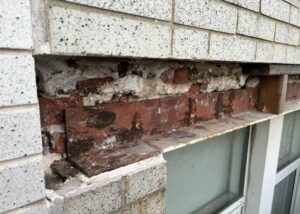
Image-recognition systems may eventually assist with identifying visible facade distress conditions such as:
- Cracking
- Staining
- Sealant deterioration
- Corrosion
- Displacement
- Surface damage
These tools could improve consistency in large-scale facade assessments.
Still, forensic consulting depends heavily on interpretation.
Two buildings with similar visible symptoms may have entirely different root causes.
AI may assist investigations, but it cannot independently determine causation or liability.
Improving Field Reporting and Quality Control
Field observation and reporting are central components of building envelope consulting.
AI tools are increasingly being integrated into project management and reporting systems.
Potential benefits include:
- Automated report organization
- Faster photo categorization
- Searchable field observations
- Trend identification across projects
- Improved issue tracking
- Streamlined punch list management
On large projects, these systems could improve communication between consultants, contractors, and owners.
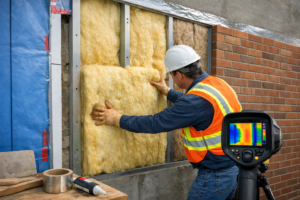
Some firms are also exploring AI-assisted site analysis using:
- Drone imagery
- Laser scanning
- Thermal imaging
- Mobile photo documentation
These technologies may help consultants document conditions more efficiently.
However, field observations involve far more than image capture.
Experienced consultants routinely assess conditions that AI systems cannot reliably interpret, including:
- Material softness
- Adhesion quality
- Moisture presence
- Surface preparation
- Installer workmanship
- Sequencing-related deficiencies
Physical inspection and technical judgment remain essential.
AI and Building Portfolio Management
Owners increasingly expect consultants to support long-term asset management rather than only project-specific services.
AI may significantly expand capabilities in this area.
Large building portfolios generate extensive operational data through:
- Inspection records
- Maintenance logs
- Leak reports
- Energy-use data
- Sensor systems
- Thermal imaging
- Repair histories
AI-driven analysis may help consultants identify:
- Buildings with elevated risk profiles
- Recurring failure patterns
- Deterioration trends
- Maintenance priorities
- Capital planning needs
This could improve predictive maintenance strategies and reduce reactive repairs.
For example, AI systems may eventually help forecast when facade sealants, coatings, or glazing systems are approaching elevated failure risk based on exposure and historical performance data.
Consultants may increasingly play a role in interpreting this information and helping owners prioritize intervention strategies.
Risks of Overreliance on AI
Despite the potential benefits, there are substantial risks associated with overreliance on AI systems.
The most significant concern is the possibility of inaccurate conclusions presented with high confidence.
AI-generated content can appear technically sophisticated while containing major flaws or omissions.
Potential risks include:
- Incorrect technical references
- Oversimplified analysis
- Incomplete code interpretation
- Misidentification of root causes
- Poor understanding of constructability
- False assumptions based on incomplete data
There are also important professional liability concerns.
Consultants remain responsible for the accuracy of their recommendations regardless of whether AI tools assisted the process.
Questions surrounding:
- Standard of care
- Documentation reliability
- Intellectual property
- Data privacy
- Model transparency
are still evolving.
Firms adopting AI technologies will likely need formal internal policies governing how these tools are used and reviewed.
The Future Role of Consultants
AI is unlikely to eliminate the need for building envelope consultants.
In many ways, the increasing complexity of facade systems may make experienced consultants even more valuable.
As projects generate larger amounts of technical data, consultants who can interpret information critically and apply sound judgment will remain essential.
The profession may gradually shift toward:
- Higher-level technical analysis
- Risk management
- Data interpretation
- Performance strategy
- Operational consulting
- Predictive maintenance planning
Routine administrative tasks may become more automated, allowing consultants to focus more attention on technical decision-making and client advisory services.
Conclusion
AI is beginning to influence building envelope consulting through improvements in data analysis, documentation management, field reporting, and operational monitoring.
Its greatest value will likely come from helping consultants process increasingly complex project information more efficiently.
At the same time, successful enclosure consulting still depends heavily on experience, field knowledge, constructability awareness, and professional judgment.
AI can assist consultants, but it cannot replace the technical accountability required to evaluate risk and protect long-term building performance.
For consulting firms, the most effective approach will likely involve careful integration of AI tools while maintaining rigorous technical oversight and strong quality-control processes.