

Wildfire Urban Interface Codes Are Reshaping Exterior Wall Assemblies
The Expanding Influence of Wildfire Risk on Building Envelope Design
Wildfire risk is no longer confined to remote forest communities. Over the past decade, large-scale fires in the Western United States have increasingly reached suburban development zones where residential and commercial construction meets vegetated landscapes. These areas—commonly referred to as the Wildland–Urban Interface (WUI)—have become a focal point for new building regulations intended to reduce structure ignition during wildfire events.
- The Expanding Influence of Wildfire Risk on Building Envelope Design
- How Wildfires Ignite Buildings
- WUI Codes and Their Growing Reach
- Cladding Materials: Moving Toward Noncombustible Systems
- Ventilation Openings: A Major Ember Entry Point
- Roof-to-Wall Transitions and Soffit Detailing
- The Role of Exterior Wall Cavities
- Windows, Glazing, and Radiant Heat Exposure
- A Shift in Risk Awareness for Design Teams
- Practical Challenges in WUI-Compliant Design
- The Future of Wildfire-Resistant Enclosures
For building envelope professionals, this shift is beginning to influence how exterior wall assemblies are designed, detailed, and specified. Codes that once focused primarily on structural fire resistance are now addressing wildfire exposure mechanisms such as wind-driven embers, radiant heat, and flame contact.
As more states and municipalities adopt WUI regulations, architects and facade engineers are encountering requirements that directly affect cladding materials, ventilation strategies, soffit construction, and roof-to-wall transitions. The result is a gradual but significant evolution in how exterior walls are assembled in fire-prone regions.
Understanding how wildfire ignition actually occurs—and where typical envelope systems are vulnerable—is becoming essential knowledge for design teams working in these jurisdictions.
How Wildfires Ignite Buildings
Contrary to common perception, most buildings exposed to wildfires are not destroyed by direct flame fronts. Research following major fires has repeatedly shown that windborne embers are the primary ignition mechanism for structures.
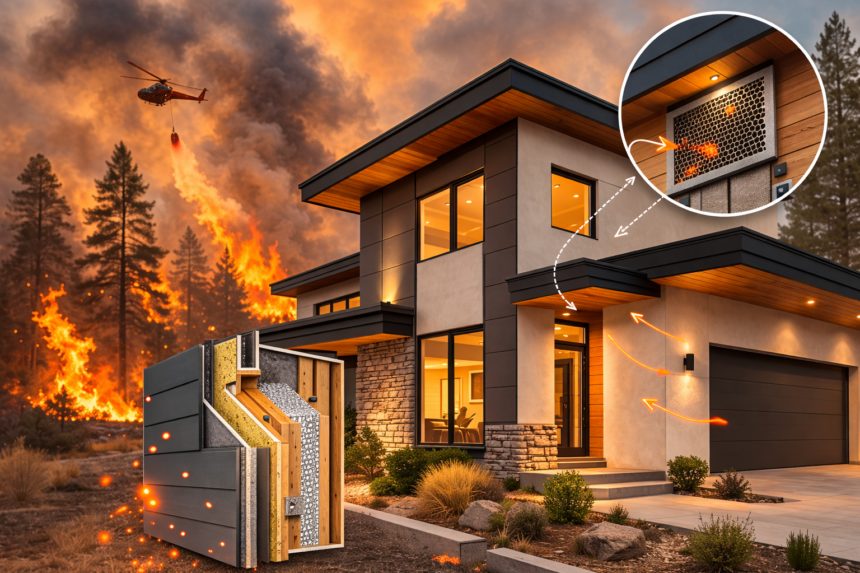
During large wildfires, burning debris can be carried miles ahead of the fire line by strong winds. These embers accumulate in vulnerable areas of a building envelope, including:
- Vented attic openings
- Roof valleys and gutters
- Exterior wall cavities behind cladding
- Soffit and eave assemblies
- Window and door perimeters
Once embers penetrate these locations, they can ignite combustible materials such as wood sheathing, insulation facers, debris buildup, or exposed framing.
Radiant heat from nearby burning structures or vegetation also contributes to ignition risk. Even without direct flame contact, prolonged radiant heat can cause combustible cladding materials to pyrolyze and ignite.
These mechanisms explain why wildfire-resistant design focuses heavily on preventing ember intrusion and limiting combustible materials within exterior assemblies.
WUI Codes and Their Growing Reach
Wildland–Urban Interface codes were originally adopted in fire-prone Western states, but their geographic footprint is expanding.
Jurisdictions across California, Colorado, Oregon, Washington, and parts of the Southwest now enforce WUI regulations for buildings located within designated wildfire hazard zones. These codes are typically based on provisions from the International Wildland–Urban Interface Code (IWUIC) or state-specific standards.
While the exact requirements vary, most WUI codes address several envelope-related factors:
- Combustibility of exterior wall materials
- Fire resistance of cladding systems
- Ember-resistant ventilation
- Roof assembly performance
- Protection of soffits and overhangs
- Defensible space around buildings
For design teams, the implications extend well beyond roofing materials. Exterior wall assemblies must now be evaluated through the lens of wildfire exposure pathways.
Cladding Materials: Moving Toward Noncombustible Systems
One of the most visible changes driven by WUI regulations is a shift away from combustible exterior cladding materials.
Traditional wood siding, untreated wood shingles, and many polymer-based facade systems can contribute to ignition risk during wildfire events. As a result, codes often require exterior wall coverings that meet noncombustible or ignition-resistant classifications.
Common materials used to meet these requirements include:
- Fiber cement siding
- Metal panels
- Stucco assemblies
- Masonry veneers
- Noncombustible composite panels
However, specifying a noncombustible exterior surface alone does not necessarily eliminate wildfire risk.
Many facade systems incorporate combustible components within the wall assembly, including:
- Rigid foam insulation
- Wood-based sheathing
- Weather-resistive barriers
- Drainage cavity materials
If embers reach these concealed layers through ventilation openings or cladding gaps, ignition can still occur. For this reason, some jurisdictions require tested wall assemblies rather than individual product classifications.
Facade engineers increasingly need to evaluate the entire wall system—not just the outer cladding—when assessing wildfire performance.
Ventilation Openings: A Major Ember Entry Point
Attic and cavity ventilation is essential for moisture management and thermal performance, but it also creates one of the most common pathways for ember intrusion.
Standard vents can allow embers to enter attic spaces where combustible materials are present. Once inside, smoldering ignition may go undetected until the fire spreads through the structure.
To address this risk, WUI codes typically require ember-resistant vents designed to block burning debris while maintaining airflow.
These systems often incorporate:
- Corrosion-resistant metal mesh screens with smaller openings
- Baffle configurations that prevent direct ember entry
- Intumescent materials that expand under high heat
For facade designers, the challenge is balancing wildfire resistance with traditional building science principles. Reduced ventilation capacity can create moisture accumulation risks if not carefully designed.
Projects in WUI zones increasingly require coordination between fire protection requirements and enclosure performance modeling.
Roof-to-Wall Transitions and Soffit Detailing
The intersection of roofs, soffits, and exterior walls represents one of the most vulnerable locations for wildfire ignition.
Open eave construction—common in many architectural styles—can expose rafters, blocking, and roof sheathing to direct ember attack. Once embers accumulate in these cavities, they can ignite wood framing or debris.
Modern WUI-compliant detailing often incorporates several protective strategies:
- Enclosed soffits with noncombustible materials
- Fire-resistant soffit vents designed to block embers
- Tight roof-to-wall flashing interfaces that eliminate ember traps
- Reduced overhang geometries in high-risk zones
From an enclosure perspective, these transitions already represent complex air barrier and water management details. Adding wildfire resistance requirements further increases the importance of careful coordination between disciplines.
Small detailing decisions—such as gaps in soffit panels or exposed blocking—can significantly affect ignition risk.
The Role of Exterior Wall Cavities
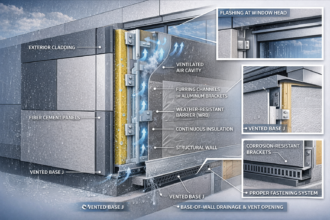
Ventilated rain screen assemblies are widely used in commercial construction to improve moisture management and durability. However, these systems introduce continuous vertical cavities behind the cladding.
In wildfire scenarios, such cavities can act as chimneys, allowing flame spread if ignition occurs at the base of the wall.
Design strategies to mitigate this risk include:
- Installing horizontal fire blocking within cavities
- Limiting ventilation opening sizes
- Using noncombustible insulation and cavity materials
- Incorporating tested fire-resistant rain screen assemblies
Balancing rain screen performance with wildfire resistance remains an evolving area of envelope design.
Windows, Glazing, and Radiant Heat Exposure
Windows represent another vulnerability during wildfire exposure.
Radiant heat from nearby flames or burning structures can cause glass breakage, allowing embers to enter the building interior. Once interior furnishings ignite, structural loss becomes far more likely.
WUI codes often require tempered glazing or multi-pane glass for windows exposed to wildfire zones. Tempered glass provides higher resistance to thermal stress and reduces the likelihood of early breakage during fire exposure.
Window frame materials also matter. Combustible frames may deform under heat, creating openings that allow ember entry.
For facade engineers, this reinforces the importance of evaluating window systems as part of the broader fire-resilience strategy.
A Shift in Risk Awareness for Design Teams
Wildfire-resistant design is still evolving, but one trend is clear: building envelope assemblies are increasingly part of the wildfire mitigation conversation.
Historically, fire codes for exterior walls focused primarily on flame spread between floors or adjacent structures. Wildfire exposure introduces a different set of risks involving embers, radiant heat, and concealed ignition pathways.
This requires a more holistic view of exterior wall performance.
Architects and facade consultants must now consider how small openings, material choices, and ventilation strategies influence ignition risk during extreme fire events.
In many jurisdictions, insurers are also beginning to examine wildfire resilience when evaluating building risk—further reinforcing the importance of robust envelope design.
Practical Challenges in WUI-Compliant Design
Implementing wildfire-resistant assemblies often introduces several practical challenges:
Balancing ventilation and ember resistance
Attic and cavity ventilation must support moisture control while preventing ember intrusion.
Maintaining architectural intent
Design features such as exposed wood elements or open eaves may conflict with WUI requirements.
Coordinating multi-trade detailing
Roofing, cladding, structural framing, and mechanical systems all intersect at locations vulnerable to wildfire ignition.
Avoiding unintended performance tradeoffs
Changes made for fire resistance should not compromise water management, thermal performance, or air barrier continuity.
For these reasons, wildfire resilience is best addressed early in the design process rather than treated as a late-stage compliance exercise.
The Future of Wildfire-Resistant Enclosures
Climate trends, expanding development in fire-prone landscapes, and rising insurance losses are likely to accelerate adoption of WUI codes across additional regions.
As this occurs, wildfire exposure may become a standard design consideration alongside wind loads, moisture management, and energy performance.
For facade engineers and building envelope consultants, the key challenge will be integrating wildfire resistance into enclosure systems without compromising durability or constructability.
Exterior wall assemblies have always served as the primary barrier between buildings and environmental forces. Increasingly, those forces include not only rain, air, and temperature—but wildfire as well.
Design teams that understand how envelope systems influence ignition risk will be better positioned to deliver buildings capable of withstanding these evolving hazards.