

Why Building Envelope Commissioning Is Moving from Optional to Expected
For decades, commissioning was primarily associated with mechanical systems. Owners expected commissioning agents to verify HVAC performance, controls integration, and energy performance. The building envelope — despite being the primary barrier protecting buildings from water intrusion, uncontrolled air leakage, and heat loss — rarely received the same level of systematic verification.
- Key Questions About Building Envelope Commissioning
- What Is Building Envelope Commissioning?
- Why Building Envelope Failures Remain So Common
- Why High-Performance Buildings Are Less Forgiving
- What Does Building Envelope Commissioning Include?
- Design Review of the Enclosure System
- Mockups and Preconstruction Testing
- Field Observation During Installation
- Field Testing to Verify Performance
- When Should Building Envelope Commissioning Start?
- How Much Does Building Envelope Commissioning Cost?
- Why Owners Are Increasingly Requiring Envelope Commissioning
- Why Envelope Commissioning Is Becoming Standard Practice
- A Shift Toward Verification Rather Than Assumption
That assumption is changing.
Across commercial construction, building envelope commissioning (BECx) is rapidly moving from a specialized consulting service to an expected component of project risk management. Owners, insurers, and sophisticated design teams increasingly recognize that even well-designed facades can fail if installation errors, sequencing conflicts, or poorly coordinated transitions undermine performance in the field.
The shift is particularly visible in high-performance buildings, where tighter envelopes and more complex assemblies leave little margin for construction errors.
Before examining why commissioning is gaining traction, it is useful to clarify several common questions owners and design teams ask.
Key Questions About Building Envelope Commissioning
Professionals evaluating commissioning often ask several fundamental questions:
- What is building envelope commissioning?
- What does building envelope commissioning include?
- When should building envelope commissioning start?
- How much does envelope commissioning cost?
- Why are owners increasingly requiring it?
Understanding these questions provides useful context for why commissioning is becoming a standard part of commercial project delivery.
What Is Building Envelope Commissioning?
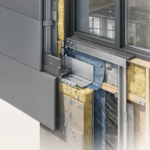
Building envelope commissioning (BECx) is a systematic process used to verify that a building’s enclosure — including walls, roofs, windows, waterproofing, and air barrier systems — is designed, installed, and tested to perform as intended.
The commissioning process typically begins during design and continues through construction. It often includes design reviews, facade mockup testing, field observations during installation, and targeted performance testing of critical enclosure components.
The goal is to confirm that the building envelope achieves continuous air, water, and thermal control layers, reducing the risk of moisture intrusion, energy loss, and premature deterioration.
Rather than assuming the enclosure performs as designed, commissioning provides a structured method for verifying that performance in the field matches the design intent.
Why Building Envelope Failures Remain So Common
Water intrusion and uncontrolled air leakage remain among the most frequent causes of building envelope failures. When these problems occur, the consequences are rarely minor.
Investigating facade failures often requires removing exterior cladding or interior finishes, interrupting building operations and exposing owners to significant repair costs.
In many cases, forensic investigations reveal that the failure was not caused by a defective product or fundamentally flawed design concept. Instead, problems typically arise from installation errors or poorly coordinated transitions between systems.
Common issues uncovered in investigations include:
- Discontinuous air barrier transitions
- Improperly flashed window and curtain wall interfaces
- Incorrect sequencing between waterproofing and cladding installation
- Fastener penetrations that compromise membranes
- Blocked drainage paths within rainscreen assemblies
These problems frequently occur at interfaces between trades. Curtain wall installers, waterproofing contractors, roofers, and cladding installers may each control a portion of the enclosure system.
Without a structured verification process, small coordination failures can become major building problems.
Why High-Performance Buildings Are Less Forgiving
Modern building envelopes are designed to achieve much higher levels of airtightness and thermal performance than earlier construction.
Continuous air barriers, thicker insulation layers, and advanced facade systems significantly improve energy efficiency. However, these improvements also make buildings more sensitive to installation errors.
Small discontinuities in the air barrier can produce substantial air leakage under pressure differences. Thermal bridges introduced by poorly coordinated structural attachments can compromise insulation performance and create condensation risks.
In addition, high-performance buildings often rely on controlled indoor humidity and airtight construction to maintain stable conditions. When the envelope does not perform as intended, moisture can accumulate within wall assemblies or migrate to cold surfaces where condensation occurs.
As envelopes become more complex and performance expectations increase, traditional quality control methods — relying primarily on contractor experience and visual inspection — are often insufficient.
Building envelope commissioning provides a structured approach to verifying performance.
What Does Building Envelope Commissioning Include?
While the exact scope varies by project, most commissioning programs include several core components.
Design Review of the Enclosure System
Commissioning often begins with a technical review of envelope drawings and specifications.
The commissioning provider evaluates the design for potential performance risks, including:
- Discontinuities in air or water control layers
- Difficult-to-construct transitions
- Conflicting vapor control strategies
- Structural attachments that interrupt insulation continuity
- Drainage paths vulnerable to blockage during construction
Identifying these issues early allows the design team to resolve them before construction begins, when changes are easier and less costly.
Mockups and Preconstruction Testing
Many projects include facade mockups that are tested before large-scale installation begins.
Mockup testing may evaluate:
- Air leakage performance
- Water penetration resistance
- Dynamic pressure response
- Thermal continuity
Beyond testing, mockups allow installers to refine construction methods and sequencing. Lessons learned during mockup construction often lead to adjustments that improve overall facade performance.
Field Observation During Installation
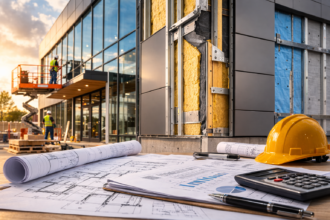
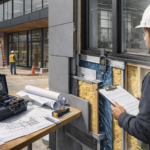
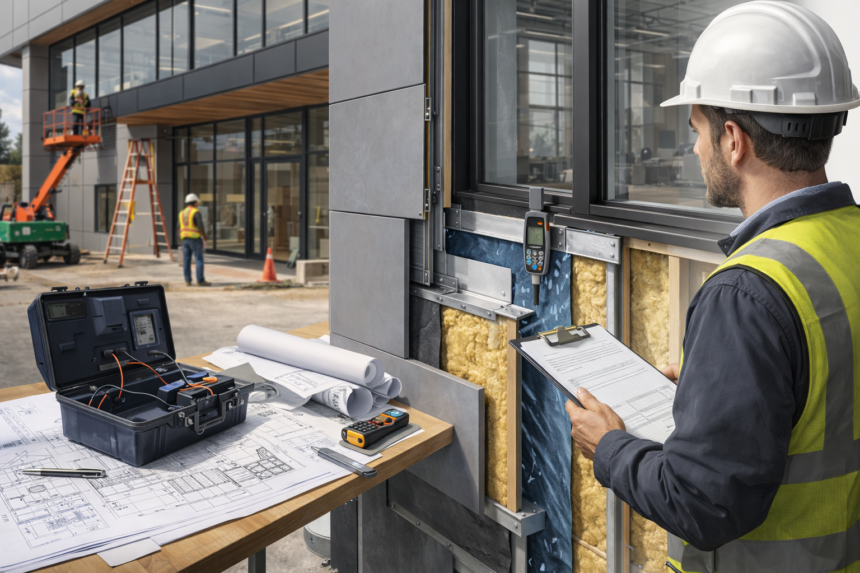
Envelope commissioning also includes periodic site observations during construction.
Commissioning professionals typically review critical installation stages such as:
- Air barrier installation and continuity
- Window and curtain wall transitions
- Waterproofing at foundations and roof edges
- Cladding attachment systems and drainage layers
- Penetrations through air and water control layers
These observations help identify issues before assemblies are concealed by finishes.
Correcting a missing air barrier transition while a wall assembly is still exposed is straightforward. Correcting the same issue after cladding installation can require extensive demolition.
Field Testing to Verify Performance
Performance testing is another key component of commissioning.
Testing may include:
- Whole-building air leakage testing
- Chamber testing of curtain wall sections
- Water spray testing at facade interfaces
- Infrared thermography to identify thermal anomalies
These tests provide objective confirmation that the envelope performs within expected parameters.
They can also identify localized defects that might otherwise remain undetected until failures occur.
When Should Building Envelope Commissioning Start?
A common misconception is that commissioning occurs near the end of construction.
In practice, the most effective commissioning programs begin during schematic design or design development.
Early involvement allows commissioning providers to identify constructability issues and continuity risks before facade details are finalized. Waiting until construction begins significantly reduces the ability to address design-related problems.
For this reason, many institutional owners now require commissioning participation during early design phases.
How Much Does Building Envelope Commissioning Cost?
The cost of building envelope commissioning typically represents a relatively small fraction of total construction cost.
For many commercial projects, commissioning services fall in the range of approximately 0.1% to 0.5% of total construction cost, depending on building size, facade complexity, and the scope of testing required.
Projects with large curtain wall systems, extensive facade mockups, or whole-building air leakage testing generally fall toward the higher end of that range.
Owners increasingly view this cost as a form of risk management. Identifying installation problems during construction is almost always less expensive than investigating and repairing envelope failures after occupancy.
Why Owners Are Increasingly Requiring Envelope Commissioning
Owners are driving the growing adoption of commissioning for several practical reasons.
Reduced Risk of Expensive Repairs
Facade failures can lead to significant repair costs and operational disruptions. Commissioning helps identify problems early, when corrections are still manageable.
Documentation of Due Diligence
Commissioning records document design reviews, testing procedures, and field observations. In disputes involving envelope failures, this documentation can demonstrate that reasonable verification steps were taken.
Portfolio-Level Quality Control
Large institutional owners often manage multiple buildings with similar assemblies and contractors. Commissioning provides a structured quality assurance process that can be applied consistently across projects.
Why Envelope Commissioning Is Becoming Standard Practice
Several broader industry trends are reinforcing the shift toward commissioning:
- Increased emphasis on airtight construction for energy efficiency
- Greater facade complexity in modern buildings
- Performance-based energy codes and sustainability targets
- Rising awareness of moisture-related durability risks
- Increased insurance scrutiny of building envelope failures
Some institutional design standards and sustainability programs already require envelope commissioning for certain project types.
As these expectations expand, commissioning is increasingly viewed as a routine part of delivering durable, high-performing buildings.
A Shift Toward Verification Rather Than Assumption
Historically, building envelopes were constructed with the assumption that sound design and experienced contractors would deliver reliable performance.
Modern building assemblies are too complex for that assumption alone.
High-performance envelopes depend on precise coordination between materials, trades, and construction sequencing. Even small discontinuities in control layers can undermine the performance of the entire system.
Building envelope commissioning introduces a disciplined process for verifying that critical elements are installed correctly and perform as intended.
For owners focused on durability, energy performance, and long-term risk management, that level of verification is increasingly becoming an expected part of project delivery.