


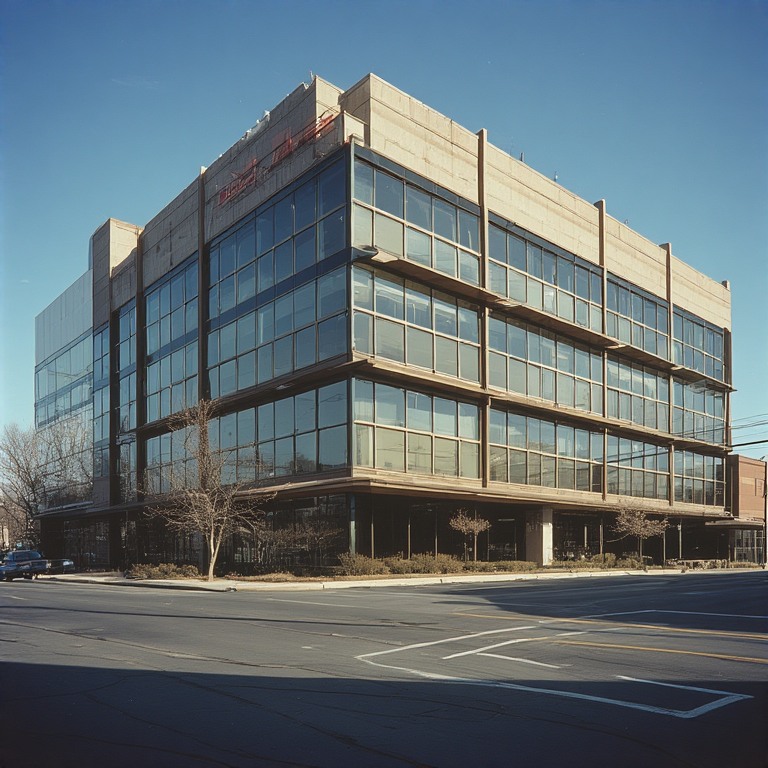
The Retrofit Surge: Why 1980s–1990s Facades Are Entering the Failure Window
Across North America, a large share of commercial buildings constructed between the early 1980s and late 1990s are now 25 to 45 years old. For many of these assets, the original facade systems were sealant-dependent barrier assemblies—EIFS, site-glazed curtain walls, face-sealed precast, and masonry cavity walls with minimal drainage redundancy.
Those systems are now entering a predictable failure window.
This is not a sudden crisis. It is a lifecycle reality. Sealants harden. Gaskets shrink. Flashings were value-engineered. Drainage was often assumed rather than designed. Maintenance was deferred. And the cumulative effects of thermal cycling, UV exposure, and moisture drive are now visible.
Owners are increasingly asking a direct question:
When should an aging commercial facade be replaced?
For envelope consultants and property owners, the answer requires understanding not just what is failing—but why these particular decades of construction are uniquely vulnerable.
The Sealant-Dependent Era
From roughly 1980 to the late 1990s, many facade systems relied on a primary line of defense: exposed sealant joints.
Common characteristics included:
- Face-sealed EIFS without drainage planes
- Two-stage precast joints executed as single-stage in the field
- Site-glazed curtain walls with minimal internal compartmentalization
- CMU backup walls with inconsistent air barriers
- Limited use of self-adhered membranes compared to today
At the time, these systems met code requirements and often passed laboratory testing. However, the field execution and long-term maintenance assumptions were less robust than contemporary standards.
The industry had not yet fully absorbed the lessons from large-scale envelope failures of the 1990s and early 2000s. Drainage redundancy, pressure-equalized rain screen design, and continuous air barrier verification were not consistently enforced in practice.
The result was widespread installation of assemblies that depended heavily on sealant continuity for water tightness.
Sealant is not a durable primary defense strategy over decades.
Understanding the Service Life Curve
Most high-performance sealants have a realistic service life of 15 to 25 years under typical exposure. In harsher climates or high-movement joints, degradation can begin sooner.
By 2026, a facade installed in 1990 is 36 years old. Even one installed in 1998 is nearing 30 years of service.
At this stage, common conditions include:
- Loss of elasticity and adhesion
- Cohesive splitting at high-movement joints
- UV degradation and surface cracking
- Adhesion failure due to substrate movement or contamination
- Improper original joint design (insufficient width-to-depth ratios)
The failure mechanism is rarely dramatic at first. Instead, water intrusion begins as intermittent leakage events tied to wind-driven rain. Over time, concealed moisture accumulates in sheathing, framing, and insulation.
Because barrier systems lack secondary drainage, small joint failures often lead directly to interior leakage or concealed deterioration.
This is the failure window: the period when joint deterioration intersects with aging substrates and deferred maintenance.
Why 1980s–1990s Buildings Are Particularly Vulnerable
Not all aging facades are equal. Buildings from this era face a convergence of risk factors:
1. Transitional Design Standards
The industry was between generations of building science knowledge. Continuous air barriers were inconsistently detailed. Thermal bridging was rarely modeled. Vapor control was simplified.
Details that would be considered high-risk today were common practice.
2. Value Engineering Culture
The development cycles of the 1980s and 1990s emphasized first cost. Many assemblies were reduced in complexity during procurement. Joint designs were tightened. Backup membranes were omitted. Drainage paths were interrupted.
Those decisions rarely manifested as immediate failures—but they shorten lifecycle resilience.
3. Increased Climate Exposure
Over the last three decades, many regions have experienced higher rainfall intensity and more extreme temperature swings. Systems designed to minimal performance thresholds are now exposed to greater stress cycles.
4. Deferred Maintenance
Sealant replacement cycles were often ignored. Many assets have not undergone comprehensive facade renewal programs. Spot repairs replaced systematic resealing.
Barrier systems do not tolerate deferred maintenance well.
The Insurance and Capital Pressure
Insurance carriers are increasingly scrutinizing aging facade systems. Repeated water intrusion claims, mold exposure risk, and litigation history tied to enclosure failures have reshaped underwriting criteria.
For owners of 30- to 40-year-old assets, insurers are asking:
- Has the facade undergone recent condition assessment?
- Is there documented sealant maintenance history?
- Are there known water intrusion events?
- Is there concealed damage?
Buildings without clear documentation are perceived as higher risk.
At the same time, capital planning cycles are converging with facade deterioration curves. Many owners are evaluating 5–10 year hold strategies and weighing whether to invest in targeted repairs or pursue full recladding.
This is not purely a technical decision. It is a risk management and asset positioning decision.
When Should an Aging Commercial Facade Be Replaced?
There is no universal age threshold. Replacement decisions should be based on performance data, not calendar age alone. However, several indicators suggest that targeted repairs may no longer be sufficient.
1. Systemic Joint Failure
If sealant degradation is widespread rather than isolated, a full reseal program may be required. Even then, the substrate condition must be verified. If joint substrates are deteriorated or movement exceeds original assumptions, resealing alone may not restore reliability.
2. Concealed Sheathing or Framing Damage
Exploratory openings revealing widespread moisture damage indicate that failures are not superficial. At this stage, recladding may be more cost-effective than repeated localized demolition.
3. Lack of Drainage Redundancy
Barrier EIFS or face-sealed systems without drainage planes present ongoing risk. Even with new sealants, the assembly has no tolerance for future failure.
4. Energy and Thermal Upgrades
Older curtain walls and opaque walls often underperform current energy standards. If owners are pursuing decarbonization goals or major mechanical upgrades, facade replacement may align with broader capital strategy.
5. Insurance or Financing Requirements
In some cases, lenders or insurers effectively drive the decision by requiring envelope remediation as a condition of coverage or refinancing.
Targeted Remediation vs. Recladding
The technical question is rarely “Can we repair it?” The question is “Will the repaired assembly meet acceptable risk tolerance for the next 20 years?”
Targeted Remediation Makes Sense When:
- The underlying substrate is sound.
- Drainage paths exist and function.
- Joint failures are localized.
- The building has undergone consistent maintenance.
- The ownership horizon is short.
Typical scope may include:
- Comprehensive sealant replacement
- Flashing upgrades at high-risk interfaces
- Addition of localized drainage improvements
- Curtain wall gasket replacement
Recladding Becomes Justified When:
- Failures are systemic.
- Substrates are deteriorated.
- There is no secondary water management.
- Energy performance is materially deficient.
- The owner has a long-term hold strategy.
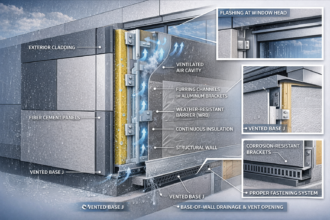
Recladding also allows incorporation of modern air barrier systems, continuous insulation, improved thermal performance, and tested rain screen assemblies.
However, recladding carries structural, logistical, and tenant-disruption implications that must be weighed carefully.
Common Misjudgments in the Failure Window
Several recurring mistakes appear in projects involving late-20th-century facades:
Assuming Resealing Resets the Clock
Replacing sealant does not restore substrate integrity. It does not add drainage. It does not correct original detailing deficiencies.
Ignoring Movement Compatibility
New sealants installed into joints with incorrect width-to-depth ratios will fail prematurely again.
Underestimating Concealed Damage
Surface observations often underrepresent internal deterioration. Strategic destructive testing is essential.
Deferring Decision-Making
Short-term patching can extend risk without reducing it. At some point, incremental spending exceeds the cost of strategic intervention.
What Consultants Should Be Advising Now
Envelope consultants should encourage owners of 1980s–1990s buildings to conduct proactive facade condition assessments before active leakage drives emergency spending.
A comprehensive assessment should include:
- Sealant adhesion and cohesion testing
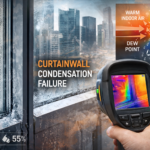
- Infrared or moisture scanning
- Targeted destructive probes
- Review of original details and shop drawings
- Movement analysis
- Thermal performance evaluation
The goal is to move from reactive maintenance to informed capital planning.
Buildings in this age cohort should not be viewed as isolated cases. This is a market-wide wave. Consultants who understand the lifecycle curve can guide owners toward rational, risk-aligned decisions.
The Coming Decade of Retrofit Activity
The industry is entering a period where large volumes of late-20th-century commercial facades will require either major remediation or full replacement.
This is not driven by aesthetics. It is driven by predictable material aging intersecting with heightened performance expectations.
For property owners, the key question is no longer whether intervention will be required. It is whether that intervention will be planned—or forced by failure.
For envelope professionals, the opportunity lies in reframing the discussion from short-term repair cost to long-term risk exposure.
Sealant-dependent barrier systems were never designed to perform indefinitely. Their service life assumptions are now being tested.
The failure window is open. The only variable is how deliberately owners choose to respond.