


The Hidden Moisture Risks of Electrification Retrofits
- Why Electrification Retrofits Change Moisture Behavior
- Airtightness Improvements and Reduced Drying Potential
- Lower Heating Temperatures and Interior Surface Conditions
- Interior Insulation Retrofits: A Critical Moisture Variable
- Roof Assemblies and Changing Thermal Profiles
- Construction Moisture in Deep Energy Retrofits
- Assemblies Most Vulnerable to Retrofit Moisture Problems
- Common Mistakes in Electrification Retrofits
- The Role of Hygrothermal Analysis in Retrofit Design
- Integrating Envelope Expertise Into Electrification Planning
- A Performance Shift the Industry Is Still Learning
Across North America, building electrification is accelerating. Cities and states are adopting building performance standards and decarbonization policies that push buildings away from fossil-fuel heating toward electric heat pumps, improved insulation, and tighter envelopes. For existing commercial and multifamily buildings—many constructed before modern air barrier requirements—these initiatives are triggering large numbers of deep energy retrofits.
From an energy perspective, the benefits are clear. Electrification paired with improved airtightness can significantly reduce operational carbon, improve comfort, and stabilize building energy use.
From a building envelope perspective, however, these retrofits are changing how heat, air, and moisture move through assemblies that were never designed for high-performance airtight construction. As buildings are tightened and heating systems evolve, unintended moisture and condensation risks can emerge inside walls and roof assemblies.
In other words, electrification retrofits can improve energy performance while simultaneously increasing moisture stress within the building envelope.
For envelope consultants and retrofit architects, understanding these interactions is becoming essential as electrification-driven retrofits accelerate.
Why Electrification Retrofits Change Moisture Behavior
Electrification rarely occurs in isolation. Most building electrification retrofits are part of broader energy upgrades that may include:
- Adding interior or exterior insulation
- Improving air sealing and airtightness
- Replacing windows
- Installing heat pump systems
- Upgrading ventilation systems
- Reducing uncontrolled infiltration
Each of these measures can improve energy performance. Together, however, they fundamentally alter the thermal and moisture dynamics of the building envelope.
Many older buildings were constructed under very different assumptions. Assemblies relied on:
- Significant air leakage
- Higher interior heat loads from combustion systems
- Continuous heat flow through walls
- Uncontrolled drying through airflow
These inefficiencies often helped assemblies dry. When energy retrofits eliminate those conditions, moisture that enters the wall or roof assembly may remain trapped longer.
This shift in moisture balance is one of the most overlooked risks in deep energy retrofits.
Airtightness Improvements and Reduced Drying Potential
Improving airtightness is one of the most effective ways to reduce energy loss. Air sealing limits uncontrolled infiltration, improves thermal comfort, and allows mechanical systems to operate more efficiently.
However, air leakage in older buildings also acted as an unintended drying mechanism.
When retrofit projects significantly tighten the envelope, assemblies lose that incidental drying pathway. At the same time, moisture can still enter the assembly through vapor diffusion, minor leakage at penetrations, or construction moisture.
If the wall or roof assembly has limited drying potential, that moisture can accumulate over time.
This issue becomes particularly important in retrofits involving:
- Interior insulation upgrades
- Interior air barrier installations
- Re-cladding projects that alter drying pathways
A tighter envelope can improve energy performance while increasing the likelihood of condensation risk in walls.
Lower Heating Temperatures and Interior Surface Conditions
Electrification retrofits typically replace combustion-based heating systems with air-source or water-source heat pumps. These systems operate differently from traditional gas or oil heating.
Combustion systems often produced higher interior air temperatures and localized heating near exterior walls. Heat pumps, particularly those optimized for efficiency, generally operate at lower supply temperatures and provide more uniform heating.
While this improves efficiency, it can subtly change interior surface temperatures at exterior walls.
In marginal assemblies—such as poorly insulated masonry walls or thermally bridged curtain walls—lower interior surface temperatures may increase the likelihood of condensation during cold weather. Even small temperature shifts can move the dew point into vulnerable materials inside the wall.
For buildings already close to the threshold of condensation risk, electrification can expose previously hidden moisture problems.
Interior Insulation Retrofits: A Critical Moisture Variable
Many electrification retrofits include insulation upgrades to meet energy targets. When exterior insulation is not feasible—particularly in urban buildings or historic facades—interior insulation is often proposed.
From a building science perspective, interior insulation is one of the most moisture-sensitive retrofit strategies.
Adding insulation to the interior side of a wall reduces heat flow from the building into the existing structure. As a result:
- Exterior structural materials become colder
- The dew point shifts deeper into the wall
- Drying toward the interior is reduced
This condition is especially problematic in mass masonry buildings.
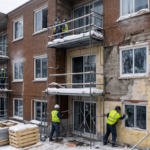
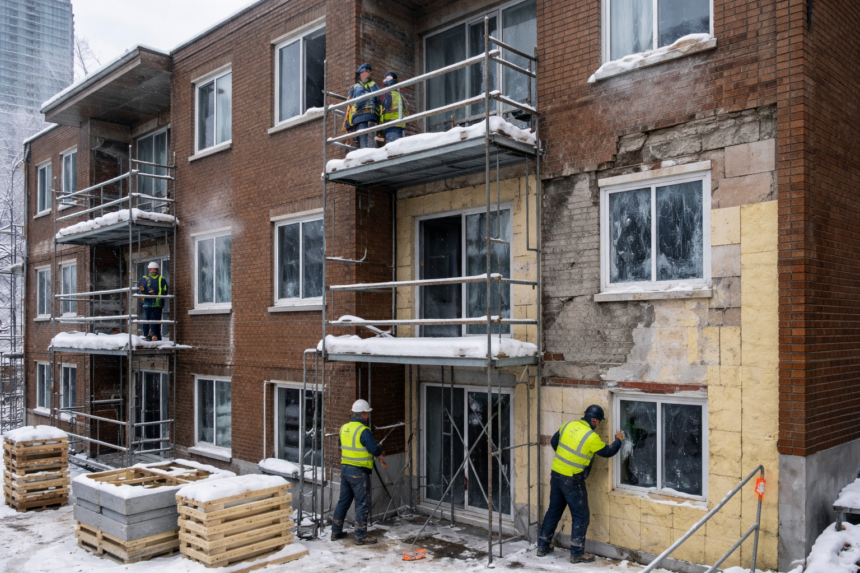
Historic brick walls that once remained relatively warm due to interior heat can become significantly colder after interior insulation is added. If moisture enters the wall—through rain leakage, vapor diffusion, or construction moisture—it may accumulate within the masonry.
Potential consequences include:
- Freeze-thaw deterioration of brick or mortar
- Mold growth in insulation cavities
- Corrosion of embedded steel components
These risks are well known in building science research, but they are increasingly relevant as electrification retrofits drive more interior insulation projects.
Roof Assemblies and Changing Thermal Profiles
Moisture risks during electrification retrofits are not limited to walls. Roof assemblies can also experience shifting thermal conditions.
In many older buildings, combustion appliances historically introduced heat into mechanical rooms, attics, or roof cavities. When these systems are removed during electrification retrofits, those spaces may become cooler.
At the same time, retrofit projects may add insulation above the roof deck or modify ventilation strategies.
These changes can alter the temperature gradient through the roof assembly. If vapor control layers are poorly located or air leakage is not controlled, condensation can occur within the roof structure—particularly in compact or low-slope roof systems with limited drying potential.
Roof retrofits that add insulation above an existing deck must also consider the possibility of trapped moisture within the original assembly.
Construction Moisture in Deep Energy Retrofits
One often overlooked issue in electrification retrofits is construction-phase moisture.
Deep energy retrofits frequently involve adding insulation and airtight layers to existing assemblies that may already contain moisture. Once those assemblies are encapsulated, drying potential can be significantly reduced.
Examples include:
- Wet masonry walls insulated from the interior
- Roof decks covered with new insulation while still damp
- Wall cavities sealed before construction moisture has dissipated
If moisture is trapped during the retrofit process, it may remain in the assembly long after the project is complete.
Envelope consultants should carefully evaluate existing moisture conditions before insulation or air barrier upgrades are installed.
Assemblies Most Vulnerable to Retrofit Moisture Problems
Not all buildings face the same risk. Moisture problems during electrification retrofits tend to appear in certain types of assemblies.
Mass masonry walls
Historic brick and stone walls are highly sensitive to interior insulation and reduced heat flow.
CMU cavity walls with limited drainage
Older cavity walls often lack modern flashing and drainage detailing, making them vulnerable when drying potential is reduced.
Pre-2000 steel stud walls
Many older steel-framed wall systems have minimal insulation and significant thermal bridging.
Barrier wall systems
Walls that rely on perfect exterior sealing rather than drainage can trap moisture when retrofit modifications change drying pathways.
Low-slope compact roofs
These assemblies often have limited drying capacity and can accumulate moisture when thermal conditions change.
Identifying these conditions early in a retrofit project is critical to managing condensation risk.
Common Mistakes in Electrification Retrofits
As electrification-driven retrofits increase, several recurring mistakes are appearing in project reviews.
One common issue is evaluating energy performance without analyzing moisture behavior. Energy modeling tools are widely used, but hygrothermal analysis remains underutilized in retrofit design.
Another frequent mistake is assuming that assemblies which historically performed well will continue to perform after modifications. Many legacy walls relied on heat loss and air leakage to remain dry.
Coordination challenges can also create problems. Mechanical engineers may focus on electrification and ventilation, while architects address insulation upgrades. Without integrated envelope analysis, critical moisture interactions may be missed.
In some projects, ventilation systems are redesigned without fully considering interior humidity control. Higher interior humidity can increase vapor drive into the envelope during cold weather, further elevating condensation risk.
The Role of Hygrothermal Analysis in Retrofit Design
Managing moisture risk in electrification retrofits increasingly requires hygrothermal analysis.
Unlike traditional energy modeling, hygrothermal modeling evaluates how heat, air, and moisture interact within assemblies over time. These tools can simulate:
- Dew point location within the wall
- Moisture accumulation over seasonal cycles
- Drying potential toward the interior or exterior
- Sensitivity to interior humidity assumptions
For assemblies that combine interior insulation, improved airtightness, and modified HVAC systems, this analysis can reveal risks that are not visible in standard energy models.
In many cases, relatively small design adjustments—such as selecting vapor-permeable insulation or improving exterior drainage—can significantly improve durability.
Integrating Envelope Expertise Into Electrification Planning
Electrification is a necessary step toward decarbonizing the built environment. But as buildings become tighter and mechanical systems evolve, the building envelope must operate under new environmental conditions.
Successful retrofit projects increasingly require close coordination between mechanical engineers, architects, and building envelope consultants.
Key considerations should include:
- Evaluating existing assemblies before insulation upgrades
- Assessing drying potential in modified wall systems
- Carefully locating vapor control layers
- Coordinating ventilation strategies with interior humidity control
- Modeling moisture behavior in high-risk assemblies
Treating electrification and envelope performance as separate design problems can introduce significant durability risk.
A Performance Shift the Industry Is Still Learning
Electrification and deep energy retrofits are transforming how buildings operate. The push to reduce carbon emissions and improve efficiency will only accelerate in the coming decade.
But as buildings become tighter and better insulated, the building envelope is operating under conditions very different from those assumed when many older buildings were constructed.
Moisture behavior that was once masked by heat loss and air leakage is becoming more visible.
For envelope consultants and retrofit architects, the challenge is not resisting electrification but understanding how these upgrades affect the entire environmental system of the building.
When electrification retrofits consider both energy performance and moisture risk, they can improve durability as well as efficiency. When those interactions are overlooked, condensation risk in walls and roofs can become the unintended consequence of otherwise well-intentioned energy upgrades.