



Test Reports vs. Traceability: Why Third-Party Audited Manufacturing Matters More Than Ever
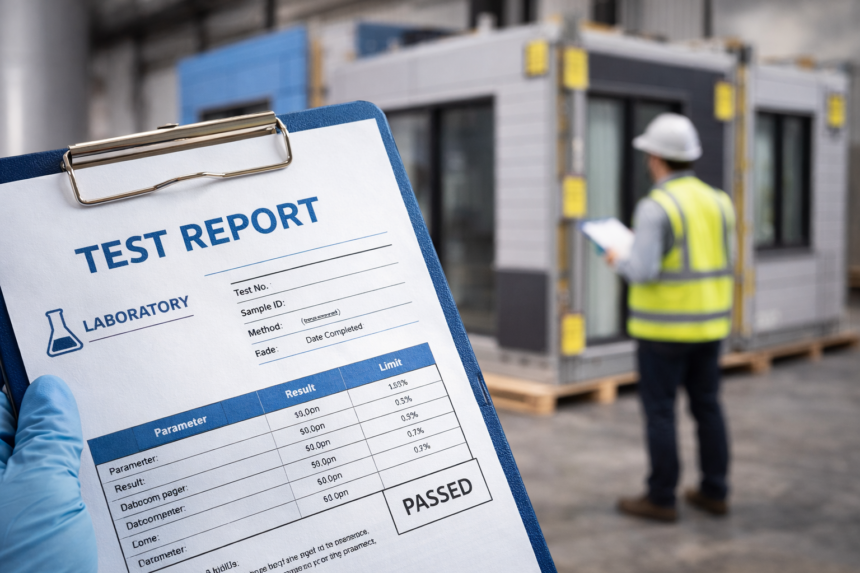
A lab test report can be persuasive. It carries a date, a standard, a measured result, and often a respected laboratory’s logo. In submittal reviews, it is frequently treated as proof of performance.
But a single test report does not guarantee that what arrives on site is what was tested.
In today’s globalized manufacturing environment—where components are private-labeled, production shifts between facilities, and value engineering substitutions occur late in procurement—the gap between a tested specimen and the delivered product has widened. That gap represents risk: performance risk, warranty risk, and ultimately litigation risk.
Third-party audited manufacturing and supply chain traceability are no longer optional safeguards. They are fundamental controls for managing facade reliability.
The Limits of a Standalone Test Report
Most building envelope products are qualified through laboratory testing to ASTM standards or proprietary protocols. Curtain wall assemblies undergo air, water, and structural testing. Cladding systems are evaluated for fire performance, impact resistance, and durability. Sealants and membranes are tested for adhesion, movement capability, and weathering resistance.
These tests answer an important question:
Did this specific specimen perform under controlled laboratory conditions?
They do not answer a more critical question:
Will every unit produced and delivered to the project perform the same way?
A test specimen is a snapshot in time. It reflects:
- A specific batch of material
- A specific manufacturing configuration
- A specific production facility
- A specific date
Without oversight of the manufacturing process, there is no mechanism ensuring ongoing equivalency between tested samples and shipped product.
For architects and owners, that distinction matters. In litigation, the defense that “it passed testing” often collapses under scrutiny of manufacturing controls.
Where Performance Drift Actually Occurs
In practice, performance drift occurs in subtle ways.
Raw Material Substitution
Resins, coatings, adhesives, reinforcing fibers, and fillers may be sourced from different suppliers over time. Even minor formulation changes can affect:
- UV resistance
- Adhesion
- Fire performance
- Thermal movement characteristics
If the original test report reflects a different formulation, the project team may unknowingly be relying on outdated data.
Manufacturing Location Changes
Production is frequently shifted offshore or between domestic facilities. Differences in:
- Equipment calibration
- Curing times
- Quality control protocols
- Environmental conditions
can influence performance characteristics.
Private Labeling and Rebranding
Some facade components are manufactured by one entity and sold under multiple brand names. A test report issued under one product name may not reflect the supply chain realities of another.
Value Engineering Substitutions
Late-stage substitutions often rely on “equivalent” test data. But unless equivalency includes audited manufacturing, the substitution may introduce unknown variability.
These are not hypothetical risks. They are recurring themes in building envelope failure cases.
What Third-Party Audited Manufacturing Actually Means
Third-party certification is not simply a logo on a product data sheet. It involves:
- Verification that the product tested matches the product being sold
- Periodic factory audits
- Quality control documentation review
- Ongoing surveillance testing
- Traceable labeling and listing
Organizations such as Intertek, UL Solutions, and DrJ Engineering provide evaluation reports and listings that include these oversight mechanisms.
The distinction is critical:
- A lab test report is static.
- An audited listing is dynamic and ongoing.
For facade materials—where fire performance, water penetration resistance, and structural behavior are interdependent—ongoing verification reduces the likelihood of drift between design intent and installed reality.
Why This Matters for Facade Materials Specifically
The building envelope operates as a system. Minor deviations can produce disproportionate consequences.
Fire Performance
Exterior wall assemblies are increasingly scrutinized for fire propagation risk. If insulation density, facer composition, or cladding subcomponents differ from the tested assembly, code compliance can be compromised.
Fire exposure events do not tolerate manufacturing variability.
Water Management
Water intrusion failures rarely result from a single dramatic defect. They typically arise from incremental weaknesses—sealant adhesion inconsistencies, flashing thickness variability, coating porosity changes.
If the tested membrane thickness was 60 mils but production tolerance allows significant reduction without oversight, long-term durability changes.
Structural and Movement Performance
Curtain wall anchors, fasteners, and framing components depend on predictable mechanical properties. Variability in alloy composition or fabrication tolerances can affect load transfer and movement capacity.
A single anchor failure under wind load can cascade into broader facade distress.
For architects and specification writers, the question becomes:
Are we specifying performance—or are we specifying performance plus controlled manufacturing?
The Litigation Lens
In envelope-related disputes, forensic investigations frequently examine:
- Whether the installed product matches the tested specimen
- Whether manufacturing quality control was documented
- Whether substitutions were traceable and approved
- Whether the product was listed by an accredited third-party agency
A standalone test report offers limited protection when the opposing expert demonstrates that the supplied material originated from a different plant, production run, or formulation.
Conversely, documented third-party audits and traceable listings provide a defensible record that due diligence was exercised.
Owners increasingly understand this distinction. Insurers certainly do.
Specifying for Traceability, Not Just Testing
Architects and consultants can materially reduce risk by adjusting how specifications are written.
1. Require Current Third-Party Listings
Specify that products must maintain active listings from recognized certification bodies, not simply “have been tested.”
Require documentation showing:
- Evaluation report number
- Expiration date
- Applicable standards
- Manufacturing facility identification
2. Prohibit Unverified Substitutions
Include language requiring that any proposed substitution:
- Be supported by equivalent third-party audited listings
- Demonstrate identical manufacturing controls
- Provide updated evaluation reports
3. Request Factory Audit Confirmation
For high-risk components—fire-rated assemblies, waterproofing systems, critical anchors—require confirmation that manufacturing facilities are subject to ongoing surveillance audits.
4. Align Submittals With Traceability
Submittals should include:
- Batch identification
- Manufacturing location
- Listing marks or certification labels
- Quality control documentation
This shifts review from a paper exercise to a verification exercise.
Common Misconceptions
“If It Passed ASTM Testing, It’s Fine.”
Testing verifies capability under controlled conditions. It does not ensure production consistency.
“We’ve Used This Manufacturer for Years.”
Manufacturing processes evolve. Ownership changes. Supply chains shift. Historical performance does not guarantee current equivalency.
“Certification Is Just a Marketing Add-On.”
Proper third-party certification involves recurring oversight. It is a risk management mechanism, not branding.
Cost vs. Risk: A False Economy
Eliminating certified products to reduce first cost often produces marginal savings relative to total project value. The downstream cost of remediation—especially for water intrusion or facade fire concerns—can be orders of magnitude greater.
The premium associated with third-party audited products is typically a fraction of:
- Envelope remediation
- Legal fees
- Business interruption
- Insurance premium escalation
Owners concerned with lifecycle durability and risk exposure increasingly recognize this.
Why Third-Party Certification Is Important for Facade Materials
For those asking the practical question—why is third-party certification important for facade materials?—the answer is straightforward:
Facade systems must perform predictably over decades under variable environmental stress. Predictability requires manufacturing consistency. Manufacturing consistency requires oversight beyond the manufacturer’s internal quality control.
Independent auditing closes the gap between laboratory testing and field performance.
It provides:
- Ongoing validation
- Documented traceability
- Reduced substitution risk
- Defensible compliance records
In complex building envelope assemblies, these controls materially improve reliability.
Moving From Testing to Accountability
The industry’s reliance on single test reports emerged in a simpler supply chain environment. That environment no longer exists.
Globalized sourcing, private labeling, and aggressive cost pressure have made manufacturing transparency more difficult—and more necessary.
Architects, specification writers, and owners who shift their focus from “Was it tested?” to “Is it continuously verified?” materially reduce project risk.
A test report demonstrates past performance.
Third-party audited manufacturing demonstrates ongoing accountability.
For facade materials exposed to weather, fire risk, structural loads, and long service life expectations, that distinction is not administrative—it is foundational to performance.