


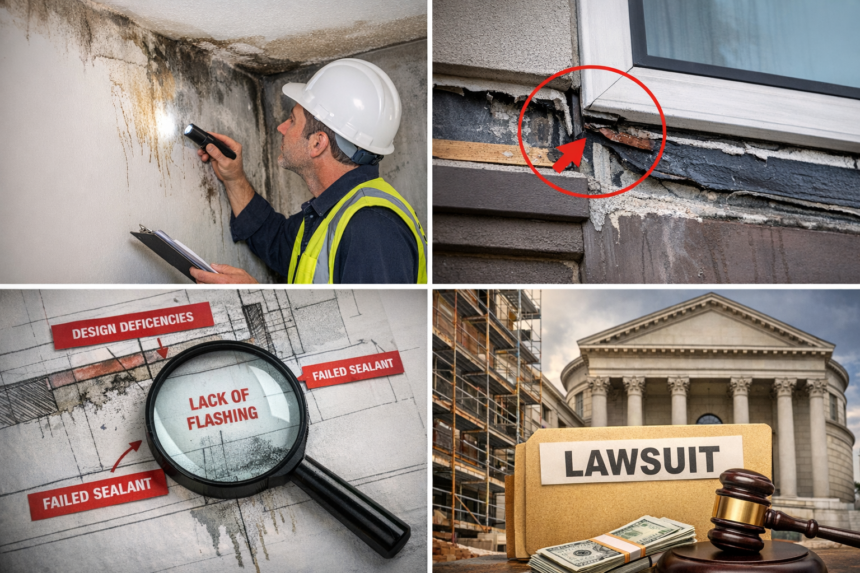
Moisture Intrusion Litigation Trends: What Forensic Reports Are Revealing About Design Gaps
Thesis: Forensic investigations increasingly show that systemic detailing oversights—not catastrophic events—are the root cause of chronic moisture intrusion and the majority of high-value construction defect lawsuits tied to enclosure failures.
Why This Matters: Construction defect claims related to water intrusion remain among the most expensive and prolonged disputes in commercial construction. Understanding the prevailing failure modes exposed in forensic reports is essential for design professionals seeking to mitigate risk, strengthen specifications, and improve project outcomes.
Introduction: Chronic Moisture, Chronic Risk
In the past decade, moisture intrusion has become a dominant theme in large-scale enclosure litigation. Unlike sudden failures tied to extraordinary events—such as hurricanes or seismic shifts—most cases brought before courts and arbitration panels originate in assemblies that never performed as intended from day one. Forensic investigations frequently point to systemic detailing deficiencies, rather than isolated workmanship errors or unforeseeable material failures, as the genesis of distress.
For architects and building envelope consultants, this trend underscores a troubling reality: water intrusion is not just a moisture management challenge, it is a design risk with significant legal and financial consequences.
This article synthesizes emerging litigation trends, common failure patterns revealed in forensic reports, and practical implications for design practice.
The Litigation Landscape: Defect Claims in Commercial Enclosures
Moisture intrusion remains among the most common triggers for construction defect claims in commercial buildings. Claims often involve multimillion-dollar demands addressing:
- Cost of remediation
- Business interruption impacts
- Diminished asset value
- Legal fees and extended dispute resolution
Several factors amplify the stakes of these cases:
1. Long Latent Periods
Many enclosure failures do not fully manifest until years after occupancy. Water stains, corrosion of concealed components, and mold growth may appear long after practical completion, complicating liability and insurance coverage.
2. Complexity of Assemblies
Contemporary facades integrate multiple materials and performance layers. Hybrid systems such as curtain wall-clad mass wall, thermally broken rain screens, and photovoltaic integrations increase interfaces—and increase opportunities for misinterpretation.
3. Evolving Standards and Expectations
Building codes, energy requirements, and durability expectations have all tightened. What was considered acceptable detailing a decade ago may now be judged below contemporary standards by juries and expert witnesses.
Common Findings in Forensic Reports: Design, Not Disaster
A review of forensic reports entered into evidence in recent litigation reveals clear patterns. While workmanship and installation quality are often implicated, root causes consistently point back to design decisions and detailing strategies that failed to address fundamental moisture control principles.
Below are the most common causes of water intrusion failures reflected in forensic testimony and expert analysis.
1. Incomplete Definition of Control Layers
Moisture control begins with clear definition of the three fundamental control layers:
- Rain Control Layer — Surface designed to shed bulk water
- Air Control Layer — Barrier to air leakage that carries moisture
- Vapor Control Layer — Restricts vapor diffusion under critical conditions
In too many cases, forensic experts find that design documents did not explicitly delineate these layers, leaving contractors to interpret assembly performance. Confusion over where the weather barrier ends and the vapor retarder begins results in assemblies that cannot deliver predictable hygrothermal performance.
Why It Matters: When control layers are undefined or discontinuous, building enclosures rely on good intentions rather than engineered performance.
2. Lack of Continuity at Interfaces
Failure to properly detail transitions between materials and assemblies is a pervasive design omission. Examples include:
- Curtain wall perimeter intersections without continuous rain barrier or air barrier continuity
- Transitions between through-wall flashings and adjacent cladding interfaces
- Roof-to-wall junctions lacking positive drainage and sealant back-up
Forensic evaluations repeatedly show moisture migration at these interfaces, often decades before visible staining.
Key Insight: Moisture will exploit the path of least resistance. Where control layers are interrupted, water will penetrate even small gaps.
3. Reliance on Sealants Without Redundant Defenses
Sealants remain a staple of enclosure transitions—but they perform poorly as sole means of moisture resistance. Design drawings that show sealants bridging expansive tolerances or spanning dynamic joints without backup configuration are a red flag in litigation.
Sealants age, lose adhesion, and crack; without redundant mechanisms (flashing, mechanical interlocks, back-ups), water can breach the joint.
Forensic Finding: Many envelope failures begin at heavily relied-upon sealant joints that lacked:
- Proper mating surfaces
- Defined bond-breaker placement
- Mechanical anchorage where anticipated movement exceeds sealant capability
4. Misplaced Confidence in Manufacturer “System” Claims
Manufacturers often market components as part of a “system,” implying compatibility and performance. Litigation outcomes increasingly reflect that a manufacturer’s system does not automatically equate to a complete moisture control strategy.
For example:
- Proprietary rainscreen panels paired with field-designed flashings
- Copings specified without engineered closure conditions
- Air barriers with unclear substrate attachment strategies
Forensic experts frequently point out that such assemblies were never tested as installed—despite marketing language suggesting otherwise.
Takeaway: Specifications must treat manufacturer literature as informative, not prescriptive. Design professionals must still engineer transitions and enforce integration.
5. Inadequate Provision for Drainage and Ventilation
Moisture that passes the first line of defense must have a drainage plane and space to evacuate. Unfortunately, many designs omit:
- Clear drainage paths behind cladding
- Weep holes and collection cavities that tie to open air
- Ventilation paths to remove trapped moisture
Forensic moisture mapping in litigation has shown capillary action wicking water past barriers that were otherwise weathertight. Without intentional drainage and ventilation, assemblies retain moisture, leading to decay and accelerated deterioration.
6. Thermal Bridging and Condensation Risk
Poor understanding of thermal behavior at junctions can create unintended condensation planes. For example:
- Steel shelf angles without thermal break
- Insulation termination at connectors
- Inadequate exterior insulation continuity
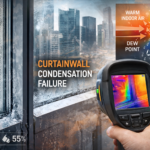
Condensation within cavities creates repeat wetting and drying cycles that over time degrade adhesives, corrosion-protected elements, and organic back-up materials.
Forensic hygrothermal modeling is now routinely introduced into evidence to demonstrate that designs failed to anticipate such conditions.
Why These Patterns Persist
If these issues are well understood, why do they keep happening? Forensic reports suggest several underlying factors:
Risk Transfer Through Documentation
Design teams often rely on broad references to standards without engineering the specific integration for the project context. Generic specifications that defer detailing to contractors shift risk but do not eliminate it.
Fragmented Coordination
Enclosure performance depends on coordination across disciplines (structural, mechanical, architectural). When control layers are not assigned to a particular design submittal or party, continuity breaks down.
Budget Constraints and Value Engineering
Changes during construction, especially value engineering that reduces redundancy in moisture control, often proceed without adequate evaluation of moisture performance consequences.
Lessons for Design Professionals
The patterns revealed in litigation and forensic reports point to clear areas where design practice can evolve.
1. Define Control Layers Explicitly in Drawings
A design that does not clearly show where each control layer begins, ends, and overlaps is a design that invites interpretation—and error.
Use:
- Distinct graphic layers for air, rain, vapor controls
- Annotation of strategies at all interfaces
- Explicit continuity requirements in specifications
This clarity reduces ambiguity during execution and strengthens defensibility in disputes.
2. Detail Interfaces With Redundancy
Assume that no single sealant or tape will perform indefinitely. Redundancy means:
- Mechanical interlocks with sealants as secondary
- Flashings sized and sloped for positive drainage
- Back-ups behind primary seals
Forensic cases show that redundant systems rarely fail catastrophically.
3. Evaluate Manufacturer Systems Within Project Context
Treat manufacturer literature as part of a performance equation, not the whole answer. Conduct:
- Compatibility assessments at transitions
- Mock-ups evaluated by project performance criteria
- Third-party testing where integration is novel
This approach aligns with how expert witnesses assess moisture performance in litigation—based on project-specific evidence, not marketing claims.
4. Incorporate Hygrothermal Analysis Earlier
For assemblies at risk of condensation or moisture retention, early modeling can identify:
- Temperature and moisture gradients
- Potential dew point locations
- Effectiveness of cavity ventilation strategies
Early analysis reduces late-stage redesign and defensibility challenges.
5. Document Decision Rationale
In litigation, forensic experts not only evaluate what was specified, but why it was specified. Designs supported by documented performance criteria, risk assessments, and coordination minutes stand stronger than those developed through ad-hoc process.
Conclusion: Design Gaps Are Predictable—and Avoidable
Moisture intrusion litigation trends reveal a common theme: chronic water infiltration is seldom due to unforeseeable events. Instead, failures emerge from design detailing that did not fully address fundamental control layer principles, interface continuity, and redundancy.
For architects and building envelope consultants, the solution is not greater reliance on products or standards alone—but a disciplined approach to defining moisture control strategies, integrating control layers through complex interfaces, and documenting design intent.
The consequences are significant: fewer defect claims, improved asset performance, and greater confidence that buildings will perform as designed—not as litigated.