



Ice Dams Are Not a Roofing Problem: The Building Science Failures Behind Recurring Winter Damage
Introduction: Stop Blaming the Membrane
Each winter, the same sequence repeats itself across cold climates. Icicles form along eaves. Snow melts unevenly. Water backs up beneath the roof edge. Interior leaks appear. By spring, owners are demanding warranty reviews, infrared scans, and often complete roof replacements.
In many of these cases, the roofing system is blamed.
But recurring ice dam damage is rarely a membrane selection issue. It is typically the visible symptom of deeper enclosure failures—specifically uncontrolled air leakage, thermal discontinuities, and misaligned insulation strategies at the roof-to-wall interface.
For envelope consultants and roofing designers, this distinction matters. Ice dams are not primarily a waterproofing problem. They are a building science problem.
Understanding that difference is the key to delivering durable solutions rather than seasonal repairs.
What Actually Causes Ice Dams in Commercial Buildings?
Ice dams form when three conditions occur simultaneously:
- Snow accumulation on the roof
- Heat loss through the roof assembly
- Exterior temperatures below freezing at the eave
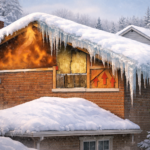
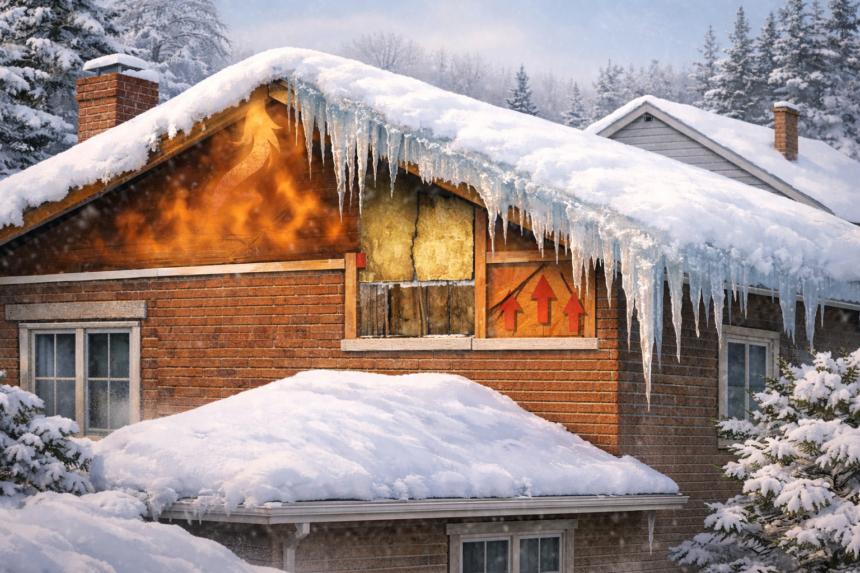
Heat escaping from the building warms the roof deck. Snow melts above the warmed area. Meltwater flows downslope until it reaches a colder section of roof—typically the overhang or eave—where it refreezes.
As the ice thickens, it forms a dam. Water backs up behind it. If the roofing system or edge condition is vulnerable, water is forced beneath flashings, seams, or terminations.
The key insight is this: the melting is not caused by solar gain alone. In most commercial failures, it is driven by interior heat escaping through the enclosure.
That heat movement is almost always linked to:
- Air leakage from the conditioned space
- Insulation discontinuities or compression
- Thermal bridging at structural elements
- Poor alignment between wall and roof thermal control layers
Replacing the membrane does not address those root causes.
Air Leakage: The Primary Driver
In cold climates, uncontrolled air leakage is often the dominant mechanism behind ice dam formation.
Warm interior air rises and seeks exit points. In commercial buildings, common leakage paths include:
- Top-of-wall transitions
- Mechanical penetrations
- Open parapet cavities
- Discontinuous air barriers at roof interfaces
- Steel deck flutes that are not sealed at perimeter conditions
Even small leakage pathways can transport significant heat. Unlike conductive heat loss through insulation, air leakage carries both sensible heat and moisture.
When warm air escapes into the roof assembly, it elevates deck temperatures locally. Snow above that area melts. Refreezing occurs at colder roof edges.
The result is often highly localized ice dam formation—directly above wall lines, above mechanical rooms, or adjacent to parapets.
Infrared thermography frequently confirms this pattern: the warmest roof areas align with interior air leakage pathways, not membrane seams.
Insulation Discontinuity: The Hidden Weak Point
Even when specified R-values appear sufficient on paper, insulation performance in the field often tells a different story.
Common discontinuity issues include:
- Gaps at roof-to-wall transitions
- Compressed batt insulation at perimeter conditions
- Poorly fitted rigid boards at steel angles
- Tapered insulation that thins excessively near edges
- Structural members penetrating the thermal layer
At parapets, the problem is often more pronounced. The roof insulation may be continuous across the deck, but the parapet itself is minimally insulated or not insulated at all. The interior side of the parapet becomes a heat bridge.
This warms the adjacent roof surface, accelerating melt patterns directly behind the parapet.
The same effect occurs at canopy transitions, clerestories, and partial-height walls.
From a building science standpoint, thermal continuity is more important than nominal R-value. A perfectly installed R-30 assembly with a 2-inch gap at the perimeter will underperform a continuous R-25 system.
Ice dams form where the thermal layer fails—not where the membrane is weakest.
The Roof-to-Wall Interface: Where Failures Concentrate
Most recurring commercial ice dam damage occurs at one of three locations:
- Eaves and overhangs
- Parapet-to-roof transitions
- Gutter and scupper conditions
These are not membrane field failures. They are interface failures.
At the eave, the roof deck extends beyond the heated envelope. If insulation and air control layers do not extend fully to the outermost edge of conditioned space, a sharp temperature gradient forms at that line.
Snow melts above the warm interior footprint. It refreezes over the unheated overhang.
In retrofit conditions, this is especially common when:
- Interior renovations altered ceiling configurations
- New HVAC systems increased interior temperatures
- Spray foam was installed discontinuously
- Air barrier continuity was not maintained during re-roofing
Roof replacements that ignore these enclosure transitions will not solve the problem.
Ventilation: Frequently Misunderstood in Commercial Contexts
In residential construction, attic ventilation is often presented as an ice dam solution. In low-slope commercial buildings, that strategy rarely applies.
Most commercial roofs are compact assemblies with no ventilated cavity. The thermal and air control layers must function as a single, integrated system.
Adding vents to a low-slope commercial roof rarely addresses the root cause and may introduce additional moisture risks.
The focus should instead be on:
- Continuous air barrier design
- Proper insulation alignment
- Edge detailing that preserves thermal continuity
Ventilation is not a substitute for enclosure integrity.
Why Insurance Claims Are Increasing
Owners are increasingly frustrated by recurring winter damage. Insurance carriers are equally concerned.
Several trends are amplifying ice dam exposure:
More Extreme Freeze–Thaw Cycles
Climate variability is producing more mid-winter thaws followed by rapid freezes. These swings accelerate melt–refreeze cycles and increase dam formation frequency.
Higher Interior Setpoints
Modern office, multifamily, and institutional buildings often maintain higher winter temperatures than legacy structures. That increases upward heat flow.
Air Tightness Improvements—Without Detailing Rigor
As buildings become more airtight at the wall plane, uncontrolled leakage often concentrates at roof transitions if detailing is inconsistent.
Ironically, partial improvements can make localized failures more pronounced.
Aging Building Stock
Many commercial buildings were never designed with modern thermal continuity standards. Re-roofing alone does not correct systemic enclosure gaps.
From a litigation standpoint, the question is shifting from:
“Did the roof fail?”
to:
“Was the enclosure properly designed and detailed to control heat and air movement?”
That distinction has significant professional liability implications.
Common Misdiagnoses
Envelope consultants frequently encounter the same incorrect assumptions:
“The Membrane Must Be Defective.”
In many cases, the membrane performs as intended. It was simply not designed to resist prolonged submersion caused by ice backup.
“We Need More Insulation.”
Adding R-value in the field of the roof may have minimal impact if the perimeter remains thermally weak.
“Install Heat Cables.”
Heat tracing can mitigate symptoms but increases energy use and maintenance complexity. It does not address underlying air leakage.
“Replace the Roof.”
Unless the replacement includes air barrier continuity, parapet insulation upgrades, and edge redesign, the same pattern often reappears within a few winters.
Seasonal repair strategies are attractive because they are visible and immediate. Durable solutions require investigation and design intervention.
Practical Investigation Strategies
When evaluating recurring ice dam damage, consultants should prioritize:
1. Air Leakage Testing
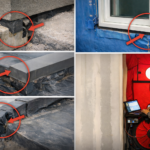
Blower door testing in low-rise commercial buildings can reveal significant leakage at roof interfaces.
2. Infrared Thermography
Cold-weather scanning helps identify localized warming patterns associated with air leakage or insulation gaps.
3. Destructive Verification at Transitions
Opening parapet cavities and eave conditions often reveals missing insulation or unsealed deck flutes.
4. Review of Original Air Barrier Design
Many legacy buildings lack a defined air control layer. In such cases, re-roofing provides an opportunity to introduce one.
Diagnosis should focus on heat flow pathways—not just water entry points.
Design Strategies for Durable Solutions
Addressing ice dams effectively requires integrated enclosure thinking.
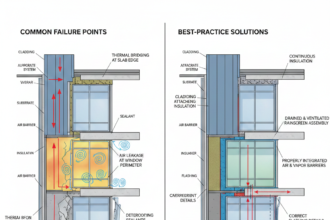
Establish a Continuous Air Barrier
The roof air barrier must align with the wall air barrier at the top-of-wall transition. This is often the weakest link.
Steel deck flutes should be sealed at perimeter conditions to prevent air migration into the roof assembly.
Maintain Thermal Continuity at Parapets
Exterior insulation wrapping parapets is often necessary to prevent thermal bridging. Interior-only insulation rarely solves the problem.
Extend Insulation to the Outer Edge of Conditioned Space
Avoid abrupt thermal breaks at overhangs. If overhangs are outside the thermal envelope, ensure the interior insulation plane terminates clearly and continuously.
Avoid Compression and Gaps
Installation quality matters as much as specification. Field inspection should confirm board fit, continuity, and alignment.
Coordinate Mechanical Penetrations
Large mechanical curbs and duct penetrations often bypass air control layers. Proper sealing and detailing are critical.
These measures shift the focus from roofing to enclosure performance.
Why This Matters for Consultants and Designers
For envelope professionals, ice dam failures present both risk and opportunity.
The risk lies in misattributing the cause. If a consultant recommends membrane replacement without addressing air leakage, recurring damage can undermine credibility.
The opportunity lies in reframing the discussion.
When owners ask, “Why does this keep happening?” the answer should focus on:
- Heat flow
- Air movement
- Thermal continuity
Providing a building science explanation demonstrates technical authority and positions the consultant as a problem solver rather than a repair specifier.
In litigation contexts, documentation of air barrier and insulation continuity is increasingly scrutinized. Consultants who understand and articulate these relationships reduce exposure for themselves and their clients.
Conclusion: Ice Dams Reveal the Weakness of the Enclosure
Ice dams are visible, dramatic, and destructive. But they are rarely the result of poor membrane chemistry or seam adhesion.
They are signals.
They indicate that warm interior air is escaping. They reveal where insulation is discontinuous. They expose thermal bridges at parapets and roof edges.
Replacing the roof without addressing those conditions treats the symptom, not the cause.
For experienced envelope consultants and roofing designers, the path forward is clear:
- Investigate heat movement first.
- Verify air barrier continuity.
- Ensure thermal alignment at transitions.
- Treat the roof as part of the enclosure—not an isolated system.
Ice dams are not a roofing problem.
They are a building science problem—and solving them requires enclosure thinking.