
High-Pressure Laminate Rainscreen Panels: Fire Code Classification, Substrate Compatibility and What Specifiers Get Wrong at the Permit Stage
The Permit Rejection That Was Entirely Predictable
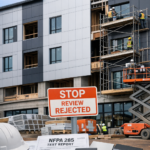
A mid-rise mixed-use project in a major metro market reaches the permit desk with HPL rainscreen panels fully specified, shop drawings submitted and lead times already running. Plan review comes back with a rejection.
- High-Pressure Laminate Rainscreen Panels: Fire Code Classification, Substrate Compatibility and What Specifiers Get Wrong at the Permit Stage
- The Permit Rejection That Was Entirely Predictable
- Why HPL Moved to the Front of the Facade Conversation
- How the IBC Actually Classifies Exterior Wall Finish Materials
- What NFPA 285 Actually Tests and What It Does Not
- Substrate Compatibility: The Variable That Invalidates Most Compliance Claims
- A Taxonomy of Errors at the Permit Stage
- What a Defensible Compliance Path Actually Looks Like
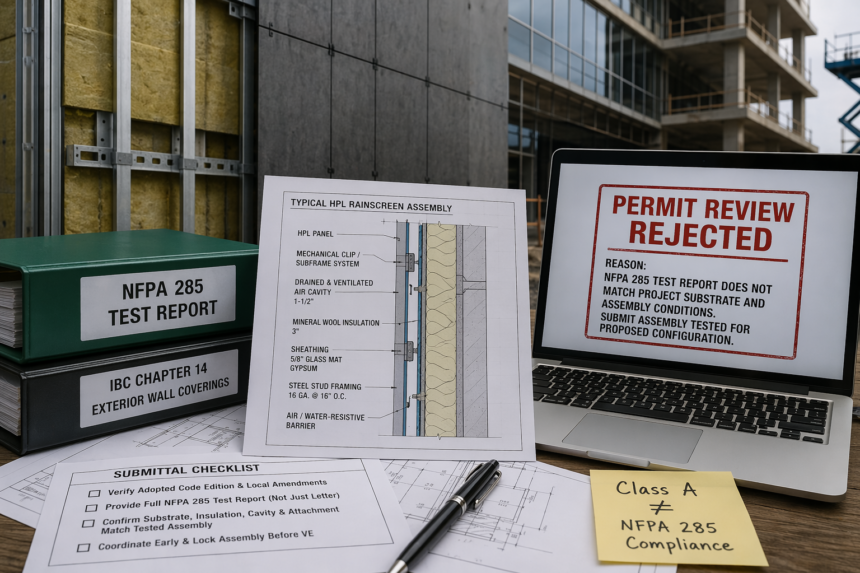
The specified assembly does not match the substrate conditions under which the manufacturer’s NFPA 285 test was conducted. The substitution that follows costs six weeks and a 12% cladding budget increase.
This is not an edge case. It is the predictable result of a classification gap that most specifiers do not discover until it is too late.
The gap exists because HPL has entered the facade market faster than specifier literacy about its regulatory framework has developed. The panels perform well aesthetically and durably.
The fire code compliance story is more complicated.
The six-week delay in that scenario is the optimistic outcome. When the substitution requires a different subframe system, different insulation and a recoordination of the air barrier detailing, the schedule impact compounds.
Contractors who have already mobilized for cladding installation absorb idle time. Glazing subcontractors who sequenced their work around the original cladding schedule get disrupted.
The 12% budget increase does not capture the full cost of the error because it does not account for the downstream coordination labor or the general contractor’s extended general conditions. The real cost of a permit rejection at this stage is substantially higher than the line item on the change order log.
Why HPL Moved to the Front of the Facade Conversation
Post-Grenfell scrutiny of aluminum composite material panels with polyethylene cores accelerated specifier interest in HPL as a perceived safer alternative. That perception is not wrong, but it is incomplete.
HPL is not a monolithic product category. Core composition, resin type and panel thickness vary significantly across manufacturers and product lines and those variables affect fire performance in ways that product data sheets rarely make explicit.
The distinction between compact HPL (solid through-body panels with no core differentiation) and HPL composite panels matters for both fire classification and structural behavior. Compact HPL carries different test data than a composite panel with a modified core, even when the face surfaces look identical and carry the same finish warranty.
Market adoption has outpaced code literacy. Specifiers are selecting HPL based on aesthetic and durability performance data before understanding the regulatory framework that governs how the assembly must be configured to remain code-compliant.
IBC Section 1402 establishes the material classification framework for exterior wall coverings and it applies regardless of how confident a manufacturer’s compliance letter sounds. The letter does not substitute for assembly-level verification.
What the post-Grenfell conversation also accelerated was manufacturer investment in NFPA 285 testing, which created a secondary problem. Multiple manufacturers entered the market with tested assemblies in a short window and those assemblies were tested under different substrate conditions because each manufacturer was optimizing for its own distribution relationships and target market segments.
The result is a product category where NFPA 285 compliance exists broadly across the manufacturer landscape but applies narrowly to specific assembly configurations that vary from one test report to the next. A specifier who treats all NFPA 285-tested HPL products as interchangeable is working from a false premise.
The test reports are not equivalent documents. They describe different assemblies and the differences are material to code compliance.
Compact HPL panels in the 6mm to 13mm thickness range behave differently under fire exposure than composite panels with aluminum or mineral-filled cores. The through-body density of compact HPL affects both flame spread and the structural integrity of the panel under prolonged heat exposure.
Specifiers who switch between compact and composite products during value engineering without re-examining the fire test data are making a substitution that looks cosmetically identical but carries a different compliance profile.
How the IBC Actually Classifies Exterior Wall Finish Materials
IBC Chapter 14 governs exterior wall coverings. Section 1402.1 establishes that materials must comply with applicable flame spread and smoke development requirements based on construction type and occupancy.
The critical fork in the road is this: HPL panels may be evaluated as an exterior wall covering under Section 1402, as a veneer under Chapter 14 or as an exterior wall finish triggering NFPA 285 testing. The path depends on how the assembly is configured and what the authority having jurisdiction expects to see at permit submission.
This ambiguity is not a loophole. It is a classification decision that carries real consequences.
Flame spread index per ASTM E84 is a panel-level test, not an assembly-level test. That distinction is the single most common source of permit rejection I see in practice.
A specifier submits an ASTM E84 Class A rating for the HPL panel and believes the fire compliance box is checked. The AHJ looks at the construction type, sees a multi-story Type I building with a combustible cladding assembly and asks for the NFPA 285 assembly test report.
The specifier does not have one that matches the project conditions.
Construction type drives the analysis. IBC Section 603.1 limits the use of combustible materials in Type I and Type II noncombustible construction.
Specifiers who develop their compliance assumptions on Type III projects and then apply those assumptions to a Type I building create a classification error that plan review will catch. The code is not ambiguous on this point.
The specifier’s familiarity with one project type does not transfer automatically to another.
The occupancy classification compounds the construction type analysis. A Type I-A office building and a Type I-B residential building over four stories carry different exposure assumptions and different AHJ expectations at permit submission, even when the exterior wall assembly is identical.
Residential occupancies above 40 feet trigger additional scrutiny under IBC Section 1403.5 because the egress and rescue access conditions differ from commercial occupancies. Specifiers who treat the IBC compliance path as a single checklist regardless of occupancy are missing a variable that AHJs in high-density markets apply consistently.
The 2021 IBC introduced additional clarifications to Chapter 14 that affect how combustible exterior wall finish materials are evaluated in jurisdictions that have adopted that cycle. Not all jurisdictions are on the 2021 cycle.
Some major markets are still enforcing the 2018 IBC and a handful of jurisdictions have local amendments that modify the Chapter 14 requirements in ways that are not visible in the base code. Confirming the adopted code cycle and any local amendments with the AHJ before establishing the compliance path is a basic due diligence step that gets skipped more often than it should.
What NFPA 285 Actually Tests and What It Does Not
NFPA 285 is a full-scale, multi-story fire propagation test of an exterior wall assembly. It evaluates the system, not the panel in isolation.
The test protocol requires a specific assembly configuration: a defined substrate (typically steel stud framing with specific sheathing or concrete/CMU backup), a defined insulation type and thickness, a defined air gap dimension and a defined panel attachment method. Any deviation from the tested configuration invalidates the compliance claim.
That last sentence is the one specifiers need to internalize.
HPL manufacturers who have conducted NFPA 285 testing have done so under specific substrate and cavity conditions. Those conditions appear in the test report, not the product data sheet.
The product data sheet will state that the panel has been tested to NFPA 285. It will not tell you that the test was conducted with 3-inch mineral wool in a 1. 5-inch drained cavity over 5/8-inch glass mat gypsum sheathing on 16-gauge steel stud framing at 16 inches on center.
That level of specificity lives in the test report and the test report is what the AHJ needs to evaluate.
Common specifier error: citing a manufacturer’s NFPA 285 compliance letter without verifying that the project’s substrate, insulation type and cavity depth match the tested assembly. The compliance letter confirms that a test was conducted.
It does not confirm that the test applies to your project. Those are different things.
IBC Section 1403.5 establishes when NFPA 285 testing is required for exterior wall assemblies containing combustible components. Once that trigger is met, the burden of proof is assembly-specific.
A letter is not proof.
The NFPA 285 test protocol itself is worth understanding in more detail than most specifiers carry into a project. The test burns a propane burner through a window opening on the first story of the test assembly for a defined exposure period, then evaluates whether the fire propagates vertically into the second story wall cavity and across the exterior face of the assembly.
The pass/fail criteria measure temperature rise at defined locations within the cavity and on the exterior panel surface. What the test does not measure is long-term performance, smoke toxicity in occupied spaces or the behavior of the assembly after the fire has been suppressed and the structure is being evaluated for reoccupancy.
NFPA 285 is a propagation test, not a complete fire safety evaluation. Specifiers who treat a passing result as a broad fire safety endorsement are reading more into the test than the protocol supports.
The test report format follows a standardized structure. Section 4 describes the test specimen construction in detail.
Section 5 describes the test procedure. Section 6 records the observations and measurements.
The pass/fail determination appears in Section 7. Specifiers who request test reports and read only the conclusion in Section 7 are missing the assembly description in Section 4, which is the section that determines whether the test applies to the project. Reading Section 4 carefully, comparing it line by line against the project’s wall assembly specification, is the verification step that prevents permit rejections.
Substrate Compatibility: The Variable That Invalidates Most Compliance Claims
NFPA 285 test reports specify exact substrate conditions. Concrete or CMU backup and steel stud framing with specific sheathing products are not interchangeable in compliance terms.
An assembly tested over concrete does not automatically comply when installed over 20-gauge steel stud framing with 5/8-inch sheathing, even if the panel and cavity dimensions are identical. The thermal mass, fire resistance and structural behavior of the backup wall affect how the assembly performs under the test protocol.
Insulation type is equally constrained. Mineral wool and rigid foam insulation within the cavity produce different fire propagation results.
Substituting one for the other without re-testing or a documented engineering judgment from the manufacturer voids the tested assembly. This matters because specifiers frequently optimize insulation selection for effective R-value or cost late in design development, after the NFPA 285 compliance path was established with a different insulation product.
Air cavity depth is a tested variable. A 1-inch drained cavity and a 2-inch ventilated cavity are not equivalent under the test protocol.
Specifiers who upsize the cavity to improve drainage performance or accommodate a thicker subframe system may unknowingly exit the tested configuration. The distinction between drained cavities, vented cavities and ventilated cavities matters here for both moisture management and fire performance.
Attachment system is part of the tested assembly. Mechanical clip systems, adhesive attachment and riveted subframe configurations each produce different results in fire exposure.
A proprietary subframe system from one manufacturer is not interchangeable with another’s, even when the panel dimensions and materials are similar. IBC Section 1703.4 establishes documentation requirements for research reports and test data submittals; the attachment system description must match what was tested.
The sheathing product specification within the tested assembly is a variable that receives less attention than it deserves. Glass mat gypsum sheathing, fiber cement sheathing and standard gypsum sheathing with water-resistive barrier facings produce different results under fire exposure because their core compositions and surface treatments respond differently to heat.
A test conducted with one sheathing product does not cover a substitution to a different sheathing product, even when both carry the same fire resistance rating under ASTM C1177 or equivalent standards. The fire resistance rating of the sheathing product in isolation and its performance as a component of the tested NFPA 285 assembly are separate evaluations.
The AHJ is asking about the assembly, not the component.
The stud gauge and spacing specified in the test report also constrain the compliance path in ways that create coordination conflicts late in design. A test conducted on 16-gauge studs at 16 inches on center does not automatically cover 20-gauge studs at 24 inches on center, even when the structural engineer has confirmed that the lighter framing meets the lateral load requirements for the cladding system.
The structural adequacy of the framing and its role in the tested fire assembly are separate questions. Specifiers who allow the structural engineer to optimize stud gauge and spacing without checking back against the NFPA 285 test report conditions create a compliance gap that surfaces at permit submission.
A Taxonomy of Errors at the Permit Stage
The permit rejections I see follow recognizable patterns. Naming them directly is more useful than describing them abstractly.
Error Type 1 is panel substitution after design development. The specifier establishes NFPA 285 compliance with one manufacturer’s tested assembly during schematic or design development, then value-engineers to a different manufacturer whose test was conducted on a different substrate configuration.
The AHJ rejects the submittal because the substituted panel has no compliant test report for the project’s actual wall assembly. The original manufacturer’s compliance does not transfer.
This error is entirely preventable if the compliance path is locked before value engineering begins.
Error Type 2 is conflating ASTM E84 Class A rating with NFPA 285 compliance. A Class A flame spread index (FSI at or below 25, smoke developed index at or below 450 per ASTM E84) satisfies some IBC provisions but does not substitute for NFPA 285 where that test is required by Section 1403.5. These are different tests measuring different things.
ASTM E84 measures surface burning characteristics of a material sample in a controlled tunnel. NFPA 285 measures fire propagation through a full-scale multi-story assembly under realistic exposure conditions.
Presenting one as evidence of the other fails at plan review.
Error Type 3 is late-stage substrate changes driven by structural or MEP coordination. The wall assembly shifts from CMU backup to light-gauge steel framing to resolve a floor-to-floor height conflict and nobody flags that the NFPA 285 compliance path was established for the CMU condition.
The cladding specification does not get updated. The AHJ catches it.
Error Type 4 is insulation substitution during construction document coordination. The mechanical engineer or energy consultant updates the wall assembly insulation to meet energy code compliance after the NFPA 285 compliance path has been established.
The new insulation product, whether a different mineral wool density, a switch from mineral wool to polyisocyanurate or a change in insulation position within the assembly, was not part of the tested configuration. The specification of record reflects the energy code update.
The fire compliance documentation reflects the original assembly. The two documents describe different assemblies and the AHJ will identify the conflict.
Error Type 5 is jurisdiction-specific code cycle mismatch. The specifier’s compliance documentation references the 2021 IBC, but the project is in a jurisdiction that has adopted the 2018 IBC with local amendments.
The NFPA 285 test report references a test standard edition that the local jurisdiction does not recognize as equivalent. This error is less common than the substrate mismatch errors but appears consistently in markets where code adoption lags the national publication cycle by several years.
Confirming the applicable code edition with the AHJ at project initiation, not at permit submission, is the only reliable way to avoid it.
What a Defensible Compliance Path Actually Looks Like
The specifier’s obligation is to verify that the project’s actual assembly conditions match the conditions under which the manufacturer’s NFPA 285 test was conducted. This means requesting the full test report, not the compliance letter.
It means reading Section 5 of the NFPA 285 test report, which describes the test assembly construction requirements including substrate and component specifications. It means confirming that the insulation product, thickness and position within the assembly match the tested configuration.
It means locking the cavity depth and attachment system before those variables get adjusted by value engineering or coordination.
When the project assembly does not match an existing tested configuration, the options are limited. The specifier can select a different panel product with a test report that matches the project conditions.
The specifier can work with the manufacturer to determine whether an engineering judgment or code compliance letter from a qualified fire protection engineer can bridge the gap, which some AHJs will accept and others will not. Or the specifier can commission new NFPA 285 testing, which is expensive and time-consuming and rarely practical on a project schedule.
The practical answer is to do the compliance verification work during schematic design, before the assembly is coordinated, before lead times are running and before the budget is committed. HPL performs well as a rainscreen cladding material on the right project with the right assembly.
The fire code compliance path is navigable. It just requires more specificity than most specifiers bring to the early design phase.
A defensible compliance path also includes documentation discipline that extends beyond the permit submission. The test report, the manufacturer’s confirmation that the project assembly matches the tested configuration and the AHJ’s acceptance of that documentation should all be retained in the project record.
During construction, any proposed substitution to the wall assembly, whether it originates from a contractor RFI, a value engineering proposal or a coordination conflict resolution, should trigger a formal review against the NFPA 285 test report conditions before the substitution is approved. The specifier who approves a sheathing substitution in response to a contractor RFI without checking the test report has created a field condition that no longer matches the permitted assembly.