


Air Barrier Discontinuities at Transitions: The Details That Compromise Whole-Building Performance
The Weakest Links in an Otherwise Continuous System
Most building envelope professionals understand the importance of a continuous air barrier. Field-applied membranes have improved dramatically over the past two decades. Materials are more robust. Testing protocols are clearer. Installers are better trained.
Yet when whole-building air leakage testing is performed, failures rarely trace back to large expanses of wall membrane.
They occur at transitions.
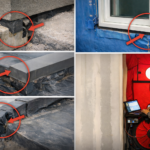
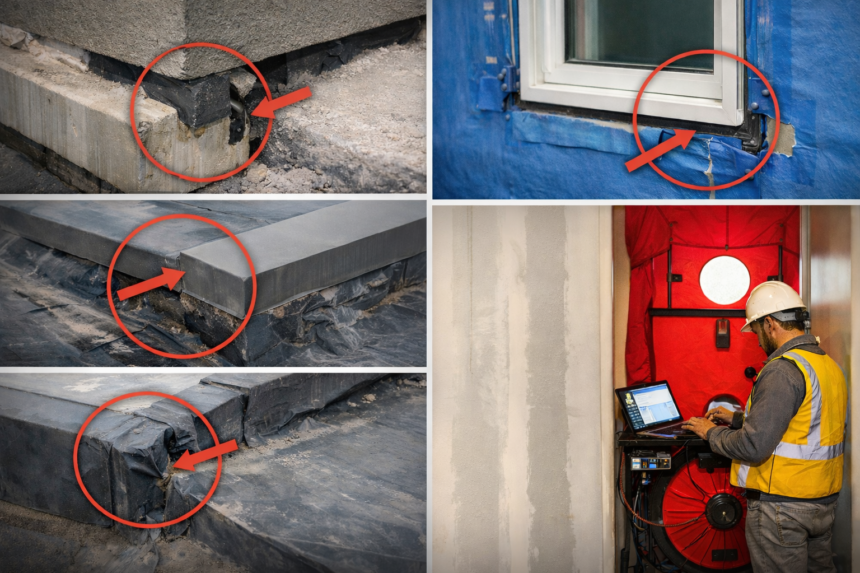
Slab edges. Window perimeters. Roof-to-wall interfaces. Changes in substrate. Mechanical penetrations. Control joints. Curtain wall tie-ins.
The industry’s focus on field membrane performance has masked a persistent reality: the air barrier is only as good as its continuity at the details.
As blower door testing requirements expand under the International Code Council and ASHRAE frameworks, and as performance-based codes become more common, these weaknesses are no longer theoretical. They are measurable.
And increasingly, they are enforceable.
Why Transitions Fail While Field Membranes Pass
Field membranes are typically installed on uniform substrates under relatively controlled conditions. They are continuous, inspectable, and straightforward to detail.
Transitions are different.
They involve:
- Multiple trades
- Changes in materials and geometry
- Sequencing dependencies
- Differential movement
- Tolerances that compound rather than cancel
At slab edges, the air barrier must often bridge concrete to sheathing, or concrete to curtain wall framing. At window perimeters, it must transition from wall membrane to frame, often through shims, anchors, and irregular openings. At roof-to-wall intersections, it may shift from fluid-applied membrane to self-adhered sheet to roofing membrane within inches.
Each change increases the risk of discontinuity.
And because these areas are concealed quickly, inspection opportunities are limited.
Slab Edges: The Chronic Leakage Zone
Slab edges are one of the most common leakage paths identified during whole-building testing.
Why?
- Concrete tolerances vary.
- Fire safing interrupts continuity.
- Curtain wall systems are often installed before air barrier tie-ins are complete.
- Trade scopes are fragmented.
In many projects, the air barrier is intended to transition from the wall membrane to a slab edge fire containment system and then to the floor line of the glazing system. On paper, the continuity is clear.
In the field, responsibility is not.
If the detail depends on fire safing installers to complete the air seal, but the specification does not explicitly require air barrier compatibility or testing, leakage is predictable.
Common failure mechanisms include:
- Gaps behind safing insulation
- Untreated irregular concrete surfaces
- Sealants applied to dusty substrates
- Inaccessible voids behind spandrel panels
Slab edges are rarely the “cause” of failure in a legal sense. But they are frequently the path of least resistance for air movement.
Window Perimeters: Geometry and Movement
Window-to-wall interfaces are another primary leakage location.
Architects often assume that because a window system has passed laboratory testing, the perimeter will perform as tested. But lab testing occurs under controlled conditions with ideal tolerances.
Field openings are not ideal.
Typical issues include:
- Rough openings oversized beyond sealant movement capacity
- Discontinuous backer rod
- Fluid-applied membranes not fully bonded to window frames
- Sealants applied before substrate curing
- Incompatible primers
Movement compounds these issues. Windows move differently than surrounding wall assemblies. Differential expansion, frame deflection under wind load, and slab edge drift can fatigue perimeter seals over time.
Blower door testing frequently identifies leakage at window heads and jambs—not because the window failed, but because the transition did.
Roof-to-Wall Interfaces: The Forgotten Detail
Roof-to-wall transitions often occur late in the construction schedule, when sequencing pressure is highest.
The air barrier may shift from:
- Fluid-applied wall membrane
- To self-adhered transition membrane
- To roofing underlayment
- To fully adhered roof membrane
Each manufacturer may provide a compatible detail. But compatibility between manufacturers is not always confirmed.
Common problems include:
- Termination bars without sealant continuity
- Discontinuous priming
- Membranes installed out of recommended temperature range
- Tie-ins deferred until after parapet cladding installation
These interfaces are especially vulnerable because they are concealed by coping caps, parapet panels, or roofing assemblies. When leakage occurs, access for remediation is disruptive and costly.
Blower Door Testing Is Changing the Risk Profile
Whole-building air leakage testing is now required in many jurisdictions under the International Energy Conservation Code and performance pathways influenced by ASHRAE 90.1.
Historically, air barrier discontinuities could remain undetected unless significant comfort or condensation issues developed. Now, they are exposed before occupancy.
This shift changes the project dynamic:
- Leakage is quantifiable.
- Responsibility is traceable.
- Remediation occurs before substantial completion.
Projects that fail testing often discover that remediation costs are not distributed evenly. Transition repairs can require removal of interior finishes, curtain wall panels, or roofing components.
The cost of correcting a 1/8-inch gap at a slab edge is minimal before enclosure. It is significant after interior build-out.
Why Specifications Alone Do Not Solve the Problem
Many projects include well-written air barrier specifications. Submittals are reviewed. Mockups are performed.
Yet leakage persists.
The gap lies between specification intent and field execution at interfaces.
Common breakdowns include:
- No assigned trade responsible for final air seal continuity
- Lack of pre-installation coordination meetings focused on transitions
- Mockups that test assemblies but not all transitions
- No inspection protocol before concealment
- Incomplete compatibility verification between adjacent materials
Air barrier continuity is not achieved by product selection alone. It requires deliberate coordination across trades.
Where Do Air Barrier Systems Typically Fail?
For architects and commissioning agents asking this question, field testing and forensic investigations consistently point to the same locations:
- Slab edge-to-wall transitions
- Window and curtain wall perimeters
- Roof-to-wall interfaces
- Mechanical and electrical penetrations
- Expansion joints
- Below-grade to above-grade transitions
Field membranes on uninterrupted sheathing are rarely the primary leakage source unless installation was grossly deficient.
Failure concentrates where geometry, sequencing, and responsibility overlap.
Practical Strategies to Reduce Transition Risk
Improving transition performance requires shifting attention early in design and aggressively during construction.
1. Draw the Air Barrier Line Continuously
Do not rely on product notes alone. Graphically trace the air barrier in section and detail drawings. Identify every change in material.
If the line disappears behind a component without a clearly defined tie-in, the detail is incomplete.
2. Assign Responsibility Explicitly
Each transition must have a designated trade responsible for final continuity. “By others” is not a strategy.
Specifications should clearly identify which trade completes and verifies the tie-in at:
- Slab edges
- Window perimeters
- Roof transitions
3. Conduct Transition-Focused Pre-Installation Meetings
General air barrier meetings are insufficient. Hold focused coordination sessions specifically addressing:
- Sequencing
- Access
- Substrate readiness
- Compatibility
Walk through the actual field conditions before work begins.
4. Inspect Before Concealment
Commissioning agents and envelope consultants should prioritize inspection of transition areas before they are covered by cladding, insulation, or roofing.
Photographic documentation is helpful. Physical verification is better.
5. Mock Up Transitions, Not Just Assemblies
Full-scale mockups often focus on aesthetic or water testing performance. Include air barrier continuity verification at transitions, particularly slab edges and window interfaces.
Testing a representative transition in a mockup can prevent widespread field remediation later.
Why This Matters Beyond Code Compliance
Air leakage is not merely an energy issue.
Uncontrolled air movement drives:
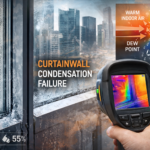
- Interstitial condensation
- Mold risk
- Corrosion of embedded steel
- Reduced thermal performance
- Occupant comfort complaints
In high-performance buildings, small discontinuities can undermine modeled energy savings and create long-term durability risks.
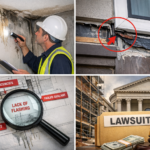
For owners and developers, failed air testing introduces schedule delay and direct remediation costs. For architects and commissioning agents, it introduces professional liability exposure.
Transitions are where risk concentrates.
Conclusion: Continuity Is a Coordination Problem
The industry has largely solved the material science of air barrier membranes.
It has not fully solved the coordination challenge at transitions.
Whole-building testing is revealing what forensic investigations have long shown: most air barrier failures occur at the interfaces between systems, not within the systems themselves.
For architects and commissioning agents, the practical question is no longer whether the specified air barrier product performs. It is whether the design team has deliberately detailed and coordinated the transitions where performance is most vulnerable.
If the air barrier line cannot be traced clearly across slab edges, window perimeters, and roof interfaces, performance should not be assumed.
Continuity is not achieved in specifications.
It is achieved at the details.