
ACM vs. Solid Aluminum vs. Steel Rainscreen Panels: A Specifier’s Guide to Material Selection for Commercial Facades
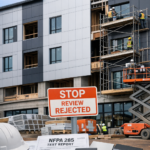
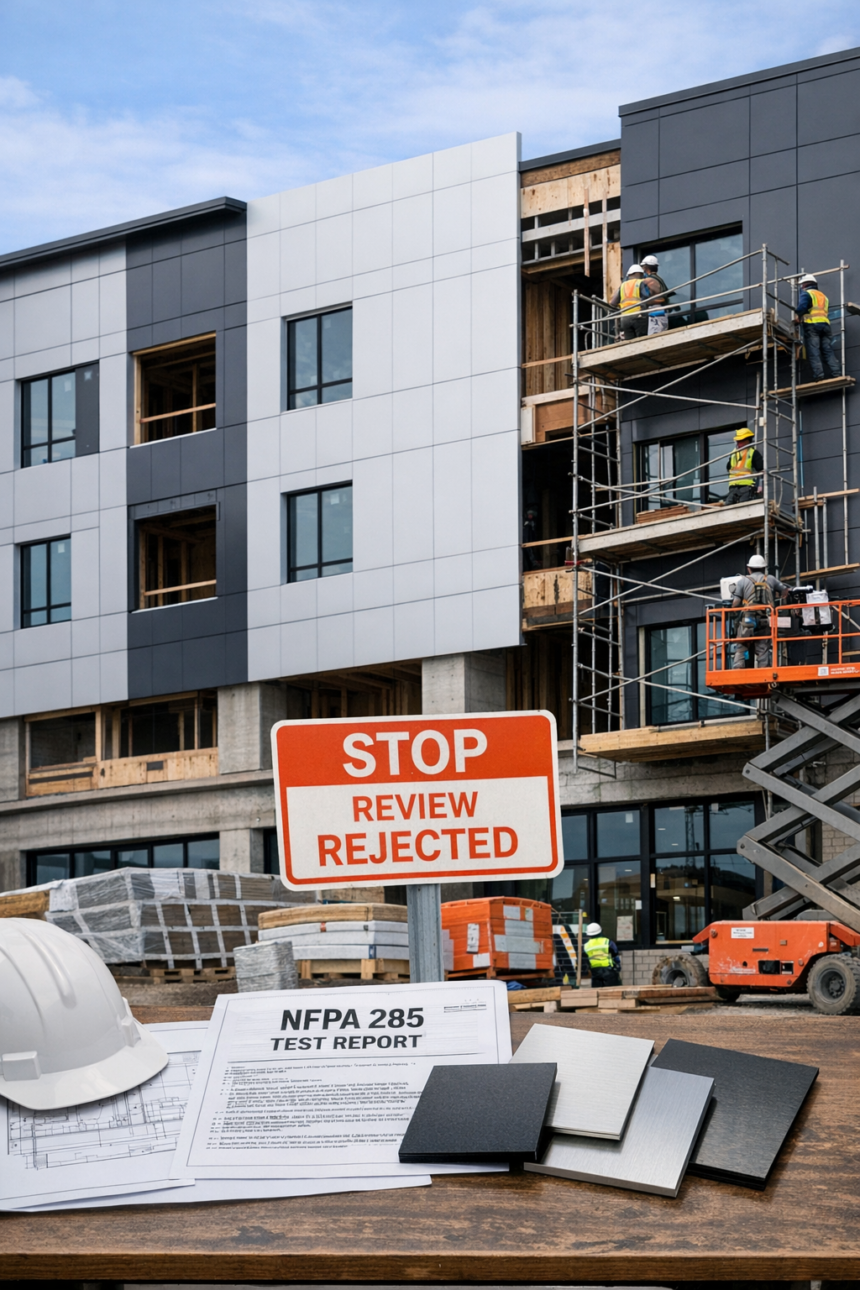
A mid-rise mixed-use project in the Southeast reaches the submittal review stage only to have its ACM panel specification rejected by the Authority Having Jurisdiction. The polyethylene-core composite the team had used on three prior projects no longer satisfies the local amendment to IBC Chapter 14 adopted after Grenfell.
- ACM vs. Solid Aluminum vs. Steel Rainscreen Panels: A Specifier’s Guide to Material Selection for Commercial Facades
- Why the Post-Grenfell Regulatory Shift Changed the Specifier’s Starting Point
- Understanding the Three Materials: Composition, Manufacturing and Baseline Properties
- Fire Performance Classification: Reading NFPA 285 Compliance Across All Three Materials
- Panel Flatness, Fabrication Tolerances and Aesthetic Performance Over Time
- Coating Durability: AAMA 2604 vs. 2605 and What the Difference Actually Means in Service
- Total Installed Cost: Why Unit Price Comparisons Mislead
- Making the Selection Decision: A Framework Built on Documentation First
The substitution scramble that follows costs the owner six weeks of schedule and forces a value-engineering conversation that should have happened at schematic design. This scenario is no longer an edge case.
It is a recurring pattern that makes material-level due diligence a front-end obligation, not a shop drawing problem.
Why the Post-Grenfell Regulatory Shift Changed the Specifier’s Starting Point
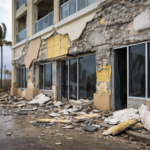
The 2017 Grenfell Tower fire killed 72 people and directly implicated ACM cladding with polyethylene cores as a primary flame-spread contributor. North American code bodies responded.
IBC 2021 Section 1402.5 tightened combustibility and test documentation requirements for exterior wall covering materials on Type I and Type II construction and enforcement authorities in several jurisdictions adopted supplemental amendments that go beyond the base code. The practical effect is that a PE-core ACM system that passed plan review in 2018 may not pass in the same jurisdiction today.
Miami-Dade, New York City and the State of California have each issued interpretive bulletins or local amendments that impose requirements stricter than the base IBC and the list of jurisdictions taking that step has grown every code cycle since 2018.
NFPA 285 is the governing full-scale fire propagation test for exterior wall assemblies. It measures flame spread and heat release across a multi-story wall assembly under realistic fire exposure conditions.
The compliance unit is the assembly, not the panel. That distinction is the most consequential thing a specifier can internalize from this entire regulatory shift.
A manufacturer’s product data sheet showing NFPA 285 compliance is not a project-level clearance. It is a reference to a specific tested configuration that may or may not match the wall assembly your project is actually building.
Material selection must begin with fire classification documentation. Not product familiarity.
Not unit price. If you cannot produce a current NFPA 285 test report with an assembly drawing that matches your project conditions before the design development phase ends, you are carrying schedule and liability risk that belongs in the owner’s risk register.
The specifier who treats fire compliance as a submittal-phase confirmation rather than a schematic-phase selection filter is the specifier whose projects generate the cautionary case studies that fill continuing education sessions.
Understanding the Three Materials: Composition, Manufacturing and Baseline Properties
ACM consists of two aluminum skins, typically 0.020 inches each, bonded to a thermoplastic or mineral-filled core. Standard panel thicknesses are 3 mm, 4 mm and 6 mm.
The core composition is the variable that drives every downstream decision: polyethylene cores are combustible, fire-retardant cores reduce but do not eliminate combustibility and mineral-filled or non-combustible cores approach the performance of solid metal. Treating ACM as a single material category is a specification error.
A specification that reads “aluminum composite material panels” without designating core type is an open invitation for a contractor to bid the least expensive core available, which is invariably the PE-core product. The Division 07 specification section must name the core type explicitly, reference the required NFPA 285 assembly and prohibit substitution of core type without re-verification of fire compliance documentation.
Solid aluminum plate is monolithic aluminum alloy, typically 5005 or 6061, in gauges from 0.125 inches to 0. 250 inches or greater.
There is no core variable. Solid aluminum is inherently non-combustible per ASTM E136, the standard test method for assessing combustibility of materials and that classification holds across alloys and gauges relevant to facade applications.
The 5005 alloy is the standard choice for painted facade panels because of its superior anodizing and coating adhesion characteristics. The 6061 alloy appears in structural applications where higher tensile strength is needed for attachment hardware or long-span panel profiles, but its surface characteristics make it less suitable for high-quality painted finishes without additional surface preparation.
Steel rainscreen panels use cold-rolled or hot-dip galvanized steel, Galvalume or stainless steel substrates at thicknesses typically in the 14-gauge to 18-gauge range. The substrate is non-combustible.
The coating system becomes the primary performance variable for durability, not fire classification. Stainless steel substrates, typically Type 304 or Type 316, carry a significant cost premium but eliminate the cut-edge corrosion risk that requires careful detailing on galvanized and Galvalume products.
Type 316 is the appropriate choice within one mile of saltwater; the molybdenum content in 316 provides meaningfully better chloride resistance than 304 in marine exposure conditions.
One clarification that prevents persistent reader confusion: “rainscreen” describes the drainage-plane assembly strategy, not a material. All three panel types can be deployed in a rainscreen configuration with a vented and drained cavity behind the cladding.
The material comparison in this article applies across that shared assembly context.
Fire Performance Classification: Reading NFPA 285 Compliance Across All Three Materials
NFPA 285 compliance is assembly-specific. A panel that passes in one wall assembly configuration, with a specific insulation type, air barrier product and framing system, does not automatically pass in a different configuration.
Specifiers who treat a manufacturer’s NFPA 285 compliance letter as a blanket clearance are misreading the document. The tested assembly drawing is the compliance artifact.
If your project assembly deviates from that drawing in insulation type, thickness or air barrier product, you need either a new test or a defensible engineering judgment letter from a qualified fire engineer. Engineering judgment letters are not a loophole; they are a legitimate code pathway, but they require a licensed fire protection engineer to sign and seal them and they must address every deviation from the tested assembly in writing.
A one-paragraph letter from a panel manufacturer’s technical representative is not an engineering judgment letter.
ACM core type determines the compliance pathway. PE-core ACM carries the most restricted path and typically requires a specific tested assembly with mineral wool insulation to achieve NFPA 285 compliance on Type I and Type II buildings.
Substituting EPS or polyisocyanurate insulation in that assembly invalidates the test result. This is the substitution error that generates the most field rejections.
A contractor who swaps the specified mineral wool continuous insulation for polyiso because polyiso is more readily available or easier to install has just invalidated the NFPA 285 compliance basis for the entire wall assembly and that error may not surface until the special inspection report flags it or the AHJ requests the tested assembly drawing at final inspection. FR-core ACM broadens the tested assembly options somewhat, but the specifier still bears responsibility for confirming the match.
Mineral-filled or non-combustible core ACM approaches solid aluminum in compliance flexibility.
Solid aluminum is non-combustible per ASTM E136 and generally achieves NFPA 285 compliance across a wider range of assembly configurations. That does not mean compliance is automatic.
Specifiers must still confirm the specific assembly is tested or that a code-compliant engineering judgment letter is in place. Steel panels carry the same non-combustible substrate advantage; galvanized or Galvalume coatings do not introduce combustibility concerns and standard painted coatings are thin enough that they do not affect NFPA 285 classification in typical assemblies.
FM Global Property Loss Prevention Data Sheet 1-31 adds a supplementary compliance framework relevant to insured commercial projects, imposing restrictions on ACM core types that go beyond IBC minimums. If the project carries FM Global insurance requirements, confirm those restrictions before finalizing the panel specification.
FM Global’s restrictions on PE-core ACM are more sweeping than IBC 2021 Section 1402.5 and a project that satisfies the base code may still fail FM Global acceptance review, triggering a re-specification cycle late in design development.
The documentation checklist for any submittal should include the specific NFPA 285 test report number, the tested wall assembly drawing and a letter of compliance confirming the project assembly matches the tested configuration. Require all three.
Accepting only the compliance letter is insufficient.
Panel Flatness, Fabrication Tolerances and Aesthetic Performance Over Time
ACM’s flatness advantage is real and it is the primary aesthetic reason the material dominated commercial facade specifications for two decades. The composite construction, with skins bonded to a rigid core, produces inherently flat panels with minimal oil-canning risk.
Industry standard flatness tolerance runs approximately plus or minus 0.030 inches over a 4-foot span. That performance is largely independent of panel size within standard dimensions, which simplifies detailing and reduces field rejection rates.
The composite construction also provides dimensional stability across temperature cycles, which means the flatness you see at the fabrication shop is the flatness you get after two years of thermal cycling on the building. That predictability has real value on high-visibility facades where any visible waviness in the installed panels will generate owner complaints regardless of whether it falls within published tolerances.
Solid aluminum plate is susceptible to oil-canning. Visible waviness in large, thin or improperly detailed panels is not a manufacturing defect; it is a predictable consequence of monolithic metal’s response to residual stress and thermal movement.
Mitigation strategies include increasing gauge (which adds cost and weight), specifying tension-leveled sheet, incorporating stiffening returns or ribs into the panel profile and limiting panel width-to-thickness ratios. These are design decisions that must happen before fabrication.
Specifying solid aluminum at 0.125 inches for panels exceeding 36 inches in either dimension without stiffening ribs is asking for oil-canning complaints during the first year of occupancy. A practical rule of thumb used by experienced facade consultants is to limit unsupported flat panel dimensions to no more than 24 times the panel thickness before stiffening ribs or returns are required.
At 0.125-inch gauge, that puts the practical unsupported dimension limit at approximately 36 inches. At 0.187-inch gauge, the limit extends to roughly 54 inches.
Fabricators who specialize in solid aluminum facade panels will apply similar rules internally, but the specification must not leave that decision to the fabricator’s discretion.
Steel panels occupy a middle position. The higher stiffness-to-weight ratio of steel relative to aluminum reduces oil-canning susceptibility at equivalent gauges.
A 16-gauge steel panel will outperform a 0.125-inch aluminum plate of similar dimensions for flatness. The tradeoff is weight: steel panels run roughly three times the weight per square foot of ACM at comparable panel sizes, which affects substructure design and seismic anchorage calculations.
On projects in ASCE 7 Seismic Design Category C or higher, the weight difference between steel and ACM panels can affect the design of the entire exterior wall framing system, not just the panel attachment clips. That calculation belongs in the structural engineer’s scope at schematic design, not as a late-stage discovery during structural drawing coordination.
Thermal movement tolerances differ across all three materials. Aluminum expands at approximately 0.0000131 inches per inch per degree Fahrenheit.
Steel expands at roughly 0.0000065 inches per inch per degree Fahrenheit. Joint sizing and attachment clip design must account for these differences explicitly, particularly in IECC Climate Zones 6 and 7 where seasonal temperature swings exceed 100 degrees Fahrenheit.
A panel system designed with aluminum thermal movement coefficients and then re-specified in steel without recalculating joint widths will produce panels that are either over-gapped in winter or contact-stressed in summer, neither of which is acceptable on a facade expected to perform for 30 years.
Coating Durability: AAMA 2604 vs. 2605 and What the Difference Actually Means in Service
Coating specification is where specifiers most often underspecify and the consequences show up at year 10 not year 1. AAMA 2605 is the performance standard for high-performance organic coatings on aluminum extrusions and panels, requiring 70% PVDF resin content and specifying minimum chalk and fade resistance thresholds over a 10-year exterior exposure period. AAMA 2604 requires 50% PVDF or equivalent and carries a lower performance threshold.
The cost difference between a 2604 and 2605 coating system is typically 5% to 8% of the panel unit price. The difference in service life in a coastal or high-UV environment is measured in decades.
A project in Phoenix or Miami that specifies AAMA 2604 to reduce first cost is trading a modest upfront savings for a re-coating cycle that will arrive 8 to 12 years earlier than it would with a 2605 system, at a cost that will far exceed the original savings when scaffolding, surface preparation and owner disruption are included.
All three panel materials can accept AAMA 2605-compliant coatings. The substrate does not limit the coating specification.
Steel panels require additional primer systems for corrosion protection beneath the topcoat and the coating specification must address cut-edge protection at fabricated openings where the galvanized or Galvalume substrate is exposed. This is a detail that frequently gets missed in specifications written for aluminum and then applied to steel without revision.
Exposed cut edges on galvanized steel panels in coastal environments will show red rust within two to three years if the specification does not require field-applied zinc-rich primer at all cut edges and fabricated openings. That failure mode is entirely preventable and entirely the result of a specification that was not written for the actual substrate being installed.
For projects in IECC Climate Zone 1 or coastal environments within one mile of saltwater, specify AAMA 2605 as a minimum. Do not treat it as an upgrade.
Specify salt spray resistance per ASTM B117 at a minimum of 3,000 hours for any steel panel application in those environments. Manufacturers who cannot provide test documentation to that threshold should not be on the approved products list for coastal applications regardless of their unit price position.
Total Installed Cost: Why Unit Price Comparisons Mislead
ACM typically carries the lowest material unit price of the three. That number is also the least useful figure in a total installed cost comparison.
ACM requires factory fabrication of routed and folded returns, which concentrates cost in the shop rather than the field. Solid aluminum plate requires more extensive fabrication for equivalent panel profiles and the oil-canning mitigation measures described above add fabrication cost that does not appear in the raw material price.
Steel panels are generally competitive with FR-core or mineral-filled ACM on a fabricated unit cost basis, though the weight premium increases structural subgrid costs. On a 50,000-square-foot facade, the difference in subgrid steel tonnage between an ACM system and a steel panel system can represent $80,000 to $150,000 in additional structural framing cost that never appears in the panel line item but absolutely appears in the final project cost.
The substitution scenario from the opening is itself a cost data point. Six weeks of schedule on a mid-rise mixed-use project in a major metro market represents carrying costs that dwarf the price difference between PE-core and mineral-filled ACM.
At a construction loan rate of 7% on a $30 million project, six weeks of schedule delay costs the owner approximately $240,000 in financing alone, before accounting for contractor extended general conditions, re-submittal fees or any redesign costs triggered by the substitution. Front-loading the fire compliance documentation review at schematic design is not a conservative approach; it is the economically rational one.
Making the Selection Decision: A Framework Built on Documentation First
The material selection sequence should run in this order: confirm fire classification documentation for the specific project assembly, then evaluate flatness and aesthetic performance requirements, then specify the coating system to the appropriate AAMA standard, then compare total installed cost including subgrid and anchorage implications.
Specifiers who have watched a PE-core ACM submittal get rejected at the AHJ level know that the six-week schedule hit and the owner conversation that follows it are both avoidable. The materials that survive that scrutiny without drama are mineral-filled ACM, solid aluminum with appropriate gauge and stiffening and steel panels with a properly specified coating system.
All three are defensible choices on Type I and Type II construction when the documentation is in order before the design development phase closes. The specifier who builds that documentation requirement into the project delivery schedule at the outset is the one whose projects do not become cautionary examples at the next AIA continuing education session.