



Prefabricated Facade Panels: Risk Reduction Strategy or Risk Relocation?
Introduction: The Promise of Factory Precision
Labor shortages, schedule compression, and tighter energy performance requirements are reshaping how facade systems are delivered. Panelization—whether unitized curtain wall, insulated metal panels, or fully integrated cladding assemblies—has moved from niche to mainstream on many commercial projects.
The logic is straightforward. If you move work from the jobsite into a controlled manufacturing environment, you reduce variability, improve quality control, and compress installation schedules. Factory assembly allows repeatable processes, standardized inspection, and reduced weather exposure during fabrication.
But the central question remains: Are prefabricated facade systems actually more reliable—or does off-site fabrication simply relocate risk from the jobsite to the factory and the logistics chain?
For facade engineers and general contractors, the answer lies not in the concept of prefabrication itself, but in how the entire delivery chain is managed—from design coordination through transportation, sequencing, and integration with adjacent systems.
What Panelization Actually Changes
Prefabrication alters three fundamental aspects of facade delivery:
- Where quality control occurs
- When system integration decisions are locked in
- Who carries coordination risk
In a stick-built system, installation quality depends heavily on site conditions, crew expertise, supervision, and weather windows. In a unitized or prefabricated panel system, much of that work is completed in a plant environment with jigs, calibrated equipment, and documented QA/QC procedures.
That shift does reduce certain risks:
- Inconsistent fastener installation
- Field-applied sealant variability
- Weather-related installation defects
- On-site measurement errors
However, it also introduces new dependencies:
- Dimensional accuracy of structure
- Transportation protection
- Lifting and staging logistics
- Early design freeze decisions
Prefabrication does not eliminate risk. It changes its location and timing.
The Reliability Question: More Reliable in Theory?
When professionals ask, “Are prefabricated facade systems more reliable?” the answer depends on which failure modes are under consideration.
Water Penetration
Factory-installed glazing gaskets and pressure-equalized joints can provide more consistent assembly conditions than field installation. For example, unitized curtain wall systems commonly tested to standards such as AAMA 501 can demonstrate predictable performance in laboratory conditions.
But laboratory performance assumes:
- Correct panel alignment
- Proper interlock engagement
- Uncompromised gaskets
- Undamaged perimeter seals
If panels are twisted during lifting, racked during transport, or forced into out-of-tolerance openings, those same systems can experience joint distress and premature leakage.
Water management performance is only as good as site integration.
Thermal Performance
Integrated panels with continuous insulation and factory-installed air barriers can significantly reduce thermal bridging compared to fragmented field assemblies.
However:
- Panel-to-panel joints become critical thermal weak points.
- Anchoring systems often reintroduce structural thermal bridges.
- Field transitions at slab edges and tie-ins to roofing or podium conditions frequently undermine modeled R-values.
Factory precision does not compensate for poorly detailed transitions.
Air Barrier Continuity
One of the strongest arguments for panelization is improved air barrier continuity. Factory-installed membranes and gaskets can be inspected and tested prior to shipment.
Yet air leakage problems frequently occur at:
- Perimeter sealant joints
- Slab edge transitions
- Interface conditions with adjacent trades
Panelization improves intra-panel performance. It does not automatically solve inter-system coordination.
Transportation: The Underestimated Risk Multiplier
Off-site fabrication introduces a variable rarely discussed in early design meetings: transportation.
Large panels are subject to:
- Dynamic vibration
- Frame torsion
- Moisture exposure during transit
- Edge damage during loading/unloading
Even minor distortion can compromise gasket compression and joint tolerances. Repeated micro-movement during shipment may stress glazing seals or fastener connections.
Protection strategies—custom crating, weather wrapping, transport orientation, and inspection upon arrival—must be treated as engineered processes, not afterthoughts.
Too often, the QA/QC rigor of the factory ends at the loading dock.
Sequencing and Tolerance Stacking
One of the most significant risk transfers in prefabrication involves dimensional control.
Because panels are fabricated early, structural tolerances must be known and realistically achievable. The traditional field adjustment margin shrinks considerably.
Common field challenges include:
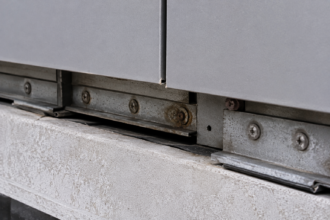
- Slab edge misalignment beyond allowable tolerance
- Out-of-plumb concrete or steel framing
- Embed location deviations
- Differential floor deflection not accounted for in design
When structural conditions exceed assumptions, installers may:
- Shim beyond design intent
- Force-fit panels
- Modify anchorage
- Field-alter perimeter seals
Each of these actions undermines the factory-controlled performance premise.
Successful panelized projects typically involve:
- Early tolerance coordination meetings
- 3D modeling of structural and facade interfaces
- Pre-installation surveys
- Clearly defined adjustment ranges
Without this rigor, prefabrication becomes a rigid system forced onto flexible site realities.
Design Freeze: Accelerated Decisions, Reduced Flexibility
Panelization compresses the design timeline.
Long lead times require early release of facade packages—often before all interior and MEP coordination is complete. Once panels are fabricated, late changes become expensive or impossible.
This creates several pressures:
- Early selection of glazing performance
- Finalization of anchorage strategies
- Commitment to aesthetic details
- Locking in interface assumptions
In traditional delivery, many of these decisions evolve alongside construction. With prefabrication, they must be resolved earlier.
The risk is not that early decisions are wrong. The risk is that they are incomplete.
For general contractors managing schedule compression, this tradeoff is often intentional. But it must be understood: schedule gains can increase coordination exposure.
Field Integration: Where Most Failures Still Occur
Most documented facade failures are not caused by panel fabrication defects. They occur at:
- System transitions
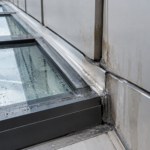
- Roof-to-wall interfaces
- Expansion joints
- Parapets
- Podium interfaces
Panelized systems frequently stop at a defined scope boundary. Everything beyond that line—sealants, membranes, flashing tie-ins—is typically field installed.
If those interface details are not rigorously designed and inspected, the benefits of factory fabrication are diminished.
In litigation scenarios, the question often becomes:
Was the failure inherent to the panel system—or did it occur at the field transition?
The distinction matters for responsibility, warranty allocation, and insurance coverage.
Long-Term Durability: What We Don’t Yet Fully Know
While unitized curtain wall has decades of track record in high-rise construction, other panelized systems—particularly hybrid assemblies integrating multiple control layers—have shorter field histories.
Questions that remain under ongoing observation include:
- Long-term sealant aging at vertical panel joints
- Differential movement stress at repetitive interlocks
- Replacement logistics for damaged panels
- Access and repair strategies after occupancy
Replacing a failed stick-built component is often localized. Replacing a large integrated panel can be complex and disruptive.
Durability is not only about initial performance. It is about inspectability, serviceability, and lifecycle maintenance.
Risk Allocation: Who Actually Owns the Exposure?
Panelization often consolidates responsibility under a single facade subcontractor or manufacturer. In theory, this simplifies accountability.
In practice, responsibility becomes fragmented across:
- Fabricator
- Installer
- Transportation contractor
- Structural contractor
- Sealant subcontractor
Clear delineation of scope is essential.
Key contract considerations include:
- Who inspects panels upon arrival?
- Who bears risk of transport damage?
- What constitutes acceptable structural tolerance?
- Who owns perimeter sealant performance?
Without clarity, risk relocation can become risk ambiguity.
When Prefabrication Truly Reduces Risk
Panelized facade systems consistently perform well when:
- Structural tolerances are tightly controlled
- Early coordination is comprehensive
- Transportation is engineered and documented
- Field interfaces are detailed with equal rigor as panels
- Installation crews are manufacturer-trained
- Inspection protocols are defined and enforced
In these conditions, prefabrication can:
- Reduce installation time
- Improve repeatability
- Enhance air and water performance consistency
- Limit weather exposure during construction
But these outcomes are the result of disciplined execution—not inherent advantages.
Common Misconceptions
Misconception 1: Factory-built means defect-free.
Factory QA reduces variability but does not eliminate design or coordination errors.
Misconception 2: Panelization eliminates site supervision needs.
Field integration still requires experienced envelope oversight.
Misconception 3: Testing equals performance.
Laboratory mockups validate system concepts. They do not account for transport stress or structural deviations.
Conclusion: Strategy or Shift?
Prefabricated facade panels are neither inherently safer nor inherently riskier than field-built systems. They are a different risk profile.
Off-site fabrication reduces certain types of variability and weather exposure. It increases dependence on logistics, early coordination, and structural precision.
For facade engineers and general contractors, the key question is not whether panelization is more reliable in abstract terms. The better question is:
Does the project team have the coordination discipline and tolerance control to support it?
When the answer is yes, panelization can be a powerful tool for improving predictability and compressing schedules.
When the answer is no, prefabrication does not eliminate risk—it simply relocates it to places that may be less visible until failure occurs.
In the current environment of labor scarcity and schedule pressure, panelization will continue to expand. The projects that succeed will not be those that assume factory fabrication guarantees performance. They will be the ones that manage the entire risk chain—from plant floor to final sealant bead—with equal rigor.